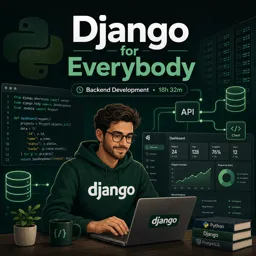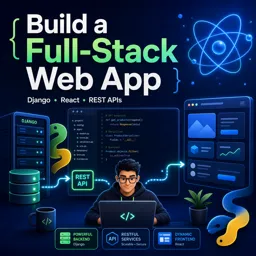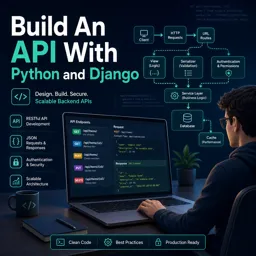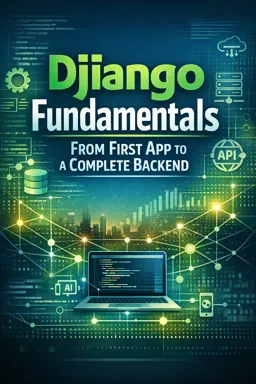

Free ebook on Django backend development: projects, ORM, migrations, authentication, settings, performance, and REST APIs.
Free ebook content
-

Django Fundamentals: Building and Running Your First Backend Project
+ Exercise: In a Django project, what is the main purpose of register an app like core in INSTALLED_APPS?
-
Django Project Structure, Apps, and URL Routing for Backend Features
+ Exercise: In a growing Django backend, which approach best keeps global URL routing maintainable while allowing each feature to own its own routes?


-
Django Models and Database Design with the ORM
+ Exercise: You notice a performance issue where iterating through a list of posts and accessing each post’s author causes many extra database queries. Which ORM approach best addresses this for loading the author data efficiently?
-
Migrations and Schema Evolution in Django
+ Exercise: When you need to backfill existing rows during a Django data migration, why should you retrieve models using apps.get_model() instead of importing them directly from your app’s models module?
-
Django Admin: Fast Back-Office Interfaces with Proper Configuration
+ Exercise: In Django admin, what is the best way to keep the changelist fast when list_display includes foreign key fields that would otherwise trigger many extra queries?
-
Views, Templates (Briefly), and the Request Lifecycle for Backend Pages
+ Exercise: In a Django backend page that handles both GET and POST in one view, what is the recommended behavior after a successful POST to prevent duplicate submissions on refresh?
-
Django Forms and Validation for Reliable Data Entry
+ Exercise: When updating an existing product, how can you make the SKU visible but effectively read-only while still protecting against forged POST data?
-
Authentication and Authorization in Django Backend Applications
+ Exercise: In a Django backend, how should access be handled when a user is logged in but does not have the required permission for a view?
-
Settings and Environment Configuration for Development and Production
+ Exercise: In a Django project that uses separate settings modules (base/dev/prod), what is the safest way to ensure production never starts with insecure defaults like a development SECRET_KEY?
-
Static and Media Files in Django: Handling Assets and User Uploads
+ Exercise: In a production Django setup, what is the correct approach for handling static files compared to user-uploaded media files?
-
Performance Basics with the Django ORM and Common Bottlenecks
+ Exercise: You have a list of objects and need to display a field from a single-valued related model (ForeignKey/OneToOne) for each item. What is the best ORM approach to avoid N+1 queries?
About the free ebook
Django Fundamentals: From First App to a Complete Backend
This free ebook provides a practical path to building dependable backend applications with Django. Start by creating and running a project, then learn how Django organizes projects and apps so features remain maintainable as an application grows.
Build data-driven backend features
Explore Django models, relational database design, and the ORM for working with data through Python. Learn how migrations safely evolve schemas, and configure the Django admin to create efficient back-office tools for managing application records.
Handle requests, input, and access safely
Understand the request lifecycle, views, and the role of templates in backend pages. The ebook also covers forms and validation for trustworthy data entry, plus Django authentication and authorization for controlling access to users, groups, and protected functionality.
Prepare an application for real-world use
Learn to separate development and production settings, manage environment-based configuration, and handle static assets and user-uploaded media. Practical ORM performance guidance highlights common bottlenecks and approaches for reducing unnecessary database queries.
Extend Django into an API backend
Finish with a pragmatic introduction to exposing Django data through Django REST Framework. By connecting project structure, models, security, configuration, and API concepts, you can move from a first Django app toward a complete backend foundation.
What you will be able to do
- Model and migrate application data with Django ORM.
- Create validated forms and protected backend workflows.
- Configure admin, settings, static files, and media uploads.
- Identify common ORM performance issues.
- Expose backend data through REST-oriented endpoints.
How do Django migrations update a database schema?
Migrations record model changes as versioned files and apply the required schema updates to the database.
What is the difference between Django static files and media files?
Static files are application assets such as CSS and JavaScript; media files are uploads provided by users.
How can Django ORM queries be made more efficient?
Use query profiling, avoid repeated queries, and use select_related or prefetch_related when loading related data.
This ebook includes:

12 content chapters

Digital certificate of course completion (Free)

Exercises to train your knowledge

100% free, from content to certificate
Ready to get started?

 recommended
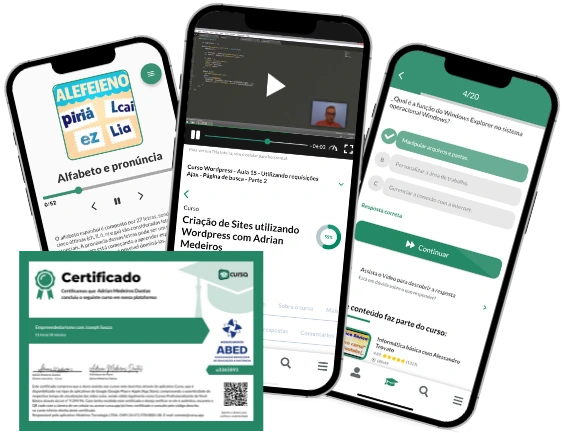
In the app you will also find...

Over 5,000 free courses
Programming, English, Digital Marketing and much more! Learn whatever you want, for free.

Study plan with AI
Our app's Artificial Intelligence can create a study schedule for the course you choose.

From zero to professional success
Improve your resume with our free Certificate and then use our Artificial Intelligence to find your dream job.
You can also use the QR Code or the links below.