Use req.params for URL segments such as /users/:id, and req.query for query strings such as ?filter=username.

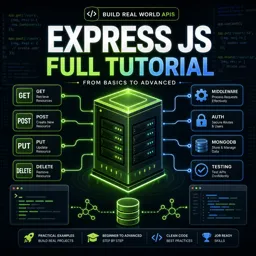
Duration of the online course: 7 hours and 57 minutes
New
Build real Express.js backend skills fast with this free course: routes, middleware, auth, MongoDB, cookies, sessions, and testing—ideal for job-ready APIs.
If you want to move from basic Node.js scripts to real-world backend development, Express.js is one of the fastest ways to get there. This free online course helps you turn ideas into working APIs by teaching you how to handle requests cleanly, shape predictable responses, and build server-side features that are used in professional applications every day. You will understand not only what to write, but why it works and how to structure an app so it stays maintainable as it grows.
Throughout the lessons, you will gain confidence with the essentials of building an HTTP API: defining routes, capturing dynamic values from the URL, reading query strings, and working with the request body for POST, PUT, PATCH, and DELETE operations. Just as importantly, you will learn the practical behavior expected from a well-built API, including how to handle invalid inputs, how to avoid requests hanging indefinitely, and how to return useful error responses that clients can act on.
As you progress, the course connects core Express concepts to the features users expect from modern products. You will work with middleware to control the flow of a request, validate incoming data to keep your API trustworthy, and organize code with routers so a growing codebase stays clear. You will also learn how to use cookies and sessions to maintain state between requests, then take the next step into authentication workflows, including local username/password logins and OAuth2 patterns commonly used for third-party sign-in.
To round out your backend skill set, the course introduces database integration using MongoDB and Mongoose, including practical data modeling concerns like unique constraints, plus secure password hashing with bcrypt so you can store credentials responsibly. Finally, you will see how to add automated testing with Jest and write higher-confidence end-to-end API tests with SuperTest, helping you ship changes without breaking existing behavior. By the end, you will be equipped to build, secure, and test a complete Express-based backend that feels close to what teams run in production.

Explore free online Express.js courses designed to help you build fast, scalable web applications and REST APIs with Node.js. Learn routing, middleware, authentication, databases, error handling, and deployment through practical lessons. Enroll today, develop job-ready backend skills, and earn a certificate with every completed course.

Explore the best free online JavaScript courses with certificates and build in-demand web development skills at your own pace. Learn JavaScript fundamentals, DOM manipulation, ES6, APIs, frameworks, and more through beginner-friendly and advanced classes. Enroll today, earn a certificate, and strengthen your resume for developer career opportunities.

7 hours and 57 minutes of online video course

Digital certificate of course completion (Free)

Exercises to train your knowledge

100% free, from content to certificate
How do you access route parameters and query parameters in Express.js?
Use req.params for URL segments such as /users/:id, and req.query for query strings such as ?filter=username.
What middleware is needed to read JSON data in an Express POST request?
Add app.use(express.json()) before routes that need to read JSON request bodies through req.body.
How should Express sessions be stored in production?
Use a database-backed session store rather than the default in-memory store, which is not suitable for production or multiple server instances.
Ready to get started?Download the app and get started today.
Install the app now
to access the course
Over 5,000 free courses
Programming, English, Digital Marketing and much more! Learn whatever you want, for free.

Study plan with AI
Our app's Artificial Intelligence can create a study schedule for the course you choose.

From zero to professional success
Improve your resume with our free Certificate and then use our Artificial Intelligence to find your dream job.
You can also use the QR Code or the links below.



Free CourseBackend REST API
5

(9)

5h24m

25 exercises
Free CourseNodeJS complete
5
(1)
1h30m
12 exercises
Free CourseAPIs
5
(5)
4h32m
20 exercises
Free CourseFlask
5
(1)
8h50m
14 exercises
Free CourseDjango for Everybody
5
(1)
18h32m
Free CoursePython Django Full Stack Developer
5
(2)
14h23m
27 exercises
Free CourseMaster Vue JS API
5
(-4)
6h14m
6 exercises
Free CoursePython Fast API
4.8
(5)
1h34m
14 exercises
Free CourseREST API
4.7

(6)
4h14m
10 exercises
Free CourseAPIs for beginners
4.5
(2)
3h07m
Carry knowledge in your pocket.
Download the Cursa app.
There are hundreds of free courses available, with a free certificate of completion that is saved in your mobile image gallery.
Download the app to access the Course Completion Certificate for Free.


+ 10 million
students

Free and Valid
Certificate

60 thousand free
exercises

4.8/5 rating in
app stores

Free courses in
video and ebooks