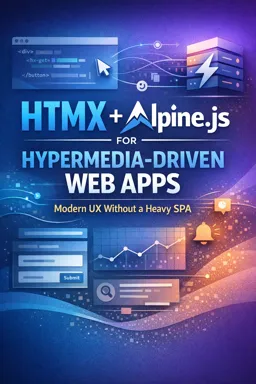


Free ebook on building hypermedia-driven web apps with HTMX and Alpine.js for modern UX without a heavy SPA.
Free ebook + audiobook content
-

Hypermedia-Driven Application Thinking with HTML as the Application Surface
+ Exercise: In a hypermedia-driven app using HTMX, what is the main advantage of having the server return HTML fragments (including validation errors) instead of returning JSON for the client to interpret? 14 minutes
-
HTMX Mental Model: Requests, Triggers, Targets, Swaps, and History
+ Exercise: In an HTMX product list, which history behavior best fits live-search as the user types while keeping the URL shareable without creating a new history entry for each keystroke? 13 minutes
-
Designing Server Endpoints for Fragments, Partials, and Reusable Templates
+ Exercise: When designing an HTMX fragment endpoint that updates a small DOM region, which response is most appropriate? 15 minutes
-
Progressive Enhancement Workflow: HTML-First UI, Then Incremental Interactivity
+ Exercise: In a progressive enhancement workflow using HTMX and Alpine.js, which approach best preserves a functional baseline when JavaScript is unavailable? 12 minutes


-
Core UI Patterns with HTMX: Partial Updates, Pagination, Search, and Filtering
+ Exercise: In an HTMX UI with Alpine.js local state, what is the best way to avoid losing client-side state during partial updates? 15 minutes
-
Forms and Validation Patterns: Inline Errors, Optimistic UI, and Reliable Submissions
+ Exercise: In an HTMX + Alpine.js form, what is the recommended way to provide reliable validation feedback while keeping the server authoritative? 14 minutes
-
Modal and Multi-Step Workflows: Dialog Content Loading, Confirmations, and Undo
+ Exercise: In a hypermedia-driven modal workflow, which approach best keeps the modal lifecycle predictable while allowing underlying page updates? 13 minutes
-
Infinite Scroll and Incremental Rendering Without Over-Fetching
+ Exercise: In an HTMX infinite scroll feed, which approach best prevents over-fetching while still moving the sentinel cursor forward? 13 minutes
-
Real-Time Updates with Server Events and Predictable Client Reconciliation
+ Exercise: In an HTMX plus Alpine app using Server-Sent Events, what approach best keeps the UI predictable when real-time events arrive during user interaction? 19 minutes
-
Alpine.js Essentials for Lightweight State and Component Patterns
+ Exercise: In an HTMX-oriented app, which use of Alpine.js best matches the recommended boundary between server-rendered truth and client-side state? 13 minutes
-
HTMX and Alpine.js Interoperability via Events and Lifecycle Hooks
+ Exercise: Which approach best keeps responsibilities split so Alpine controls local loading UI while HTMX controls the network request? 15 minutes
-
Accessibility and UX for Dynamic Interfaces: Focus, ARIA, and Keyboard Navigation
+ Exercise: In a live search where results update as the user types, what is the most accessible approach to keep the experience usable for keyboard and screen reader users? 15 minutes
-
Security and Reliability: CSRF, Authentication Flows, Idempotency, and Error States
+ Exercise: In an HTMX app, what is the best way to prevent duplicate creations when users retry or double-click a create action? 16 minutes
-
Performance Techniques: Fragment Caching, Streaming Responses, and Avoiding Layout Shift
+ Exercise: Which approach best prevents users from seeing incorrect HTML when using server-side fragment caching for an HTMX endpoint? 16 minutes
-
Testing Hypermedia Apps: Template Unit Tests, Swap Integration Tests, and End-to-End Coverage
+ Exercise: Which testing approach is most appropriate for catching issues that only appear after an HTMX fragment is swapped into an existing page, such as duplicate IDs or Alpine.js not re-initializing? 20 minutes
-
Reference Implementation: Building a Task Manager with Auth, CRUD, and Responsive Layout
+ Exercise: Why is it recommended to make fragments renderable on their own and also includable in full page templates? 13 minutes
-
Deployment-Ready Practices: Observability, Rate Limiting, Retries, and Maintainable Architecture
+ Exercise: Which response strategy best preserves a coherent user experience when an HTMX request is rate-limited? 22 minutes
About the free ebook with audio
HTMX + Alpine.js for Hypermedia-Driven Web Apps: Modern UX Without a Heavy SPA
This free ebook shows how to build responsive, server-driven web applications with HTMX and Alpine.js, without committing to the complexity of a large single-page application. Learn to treat HTML as the application surface while delivering fast, polished interactions.
Build dynamic interfaces with less client-side complexity
Explore the HTMX request lifecycle, including triggers, targets, swaps, history, and server-rendered fragments. The ebook explains how to design endpoints and reusable templates that support partial updates, search, filtering, pagination, infinite scrolling, forms, validation feedback, dialogs, and multi-step workflows.
Alpine.js complements HTMX by providing focused local state and small component behaviors. You will learn practical interoperability patterns based on events and lifecycle hooks, helping server-rendered pages remain interactive without creating a heavy JavaScript application layer.
Design for reliable, accessible production applications
- Use progressive enhancement so core flows remain HTML-first.
- Manage focus, ARIA attributes, and keyboard navigation after dynamic swaps.
- Handle CSRF, authentication, idempotency, error states, and dependable submissions.
- Improve performance with fragment caching, streaming, and layout-shift prevention.
- Test templates, swaps, and complete browser workflows with confidence.
Apply the approach in a realistic project
Follow a task manager reference implementation featuring authentication, CRUD operations, and a responsive layout. The final guidance covers deployment-ready concerns such as observability, rate limiting, retries, and maintainable architecture. This ebook is ideal for developers who want modern UX while keeping rendering, routing, and application logic close to the server.
How do HTMX and Alpine.js work together?
HTMX handles server requests and HTML swaps, while Alpine.js manages small amounts of local UI state and behavior.
Can HTMX applications support inline form validation?
Yes. Server-rendered fragments can return field errors, success states, and updated form sections without a full-page reload.
How can dynamic HTMX interfaces remain accessible?
Manage focus after swaps, use appropriate ARIA states, preserve keyboard access, and provide clear status and error feedback.
This ebook/audiobook includes:

4 hours and 27 minutes of audio content

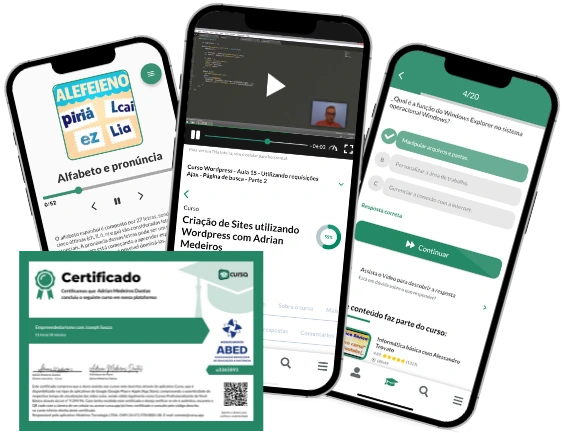
Digital certificate of course completion (Free)

Exercises to train your knowledge

100% free, from content to certificate
Ready to get started?

 recommended
In the app you will also find...

Over 5,000 free courses
Programming, English, Digital Marketing and much more! Learn whatever you want, for free.

Study plan with AI
Our app's Artificial Intelligence can create a study schedule for the course you choose.

From zero to professional success
Improve your resume with our free Certificate and then use our Artificial Intelligence to find your dream job.
You can also use the QR Code or the links below.