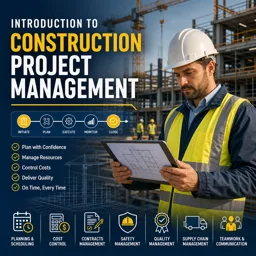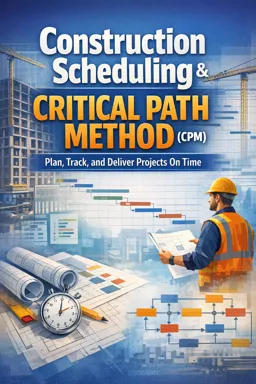


Free ebook on construction scheduling and Critical Path Method (CPM) for planning, tracking, and delivering projects on time.
Free ebook + audiobook content
-

Project Scope Definition and Scheduling Assumptions
+ Exercise: Which approach best makes scheduling assumptions useful and traceable in a CPM schedule? 20 minutes
-
Work Breakdown Structure and Deliverable-Based Planning
+ Exercise: Which statement best describes the relationship between a Work Breakdown Structure (WBS) and schedule activities in construction scheduling? 22 minutes
-
Activity Lists that Reflect Real Jobsite Work
+ Exercise: Which activity list best reflects real jobsite work and supports reliable tracking? 20 minutes
-
Logic Building with Predecessors, Successors, and Constraints
+ Exercise: Which approach best reflects the recommended way to model a significant, important waiting period between two activities in a CPM schedule? 18 minutes
-
Duration Estimating for Residential and Small-to-Mid Commercial Work
+ Exercise: Which situation best shows why duration is not the same as effort when estimating activity time? 25 minutes


-
Critical Path, Float, and What Really Drives the Finish Date
+ Exercise: In a CPM schedule, why might shortening a non-critical activity fail to move the project finish date? 19 minutes
-
Baseline Schedules and Milestone Commitments
+ Exercise: Which action best reflects correct use of a baseline schedule for project control? 19 minutes
-
Resource Loading and Crew-Level Feasibility Checks
+ Exercise: A schedule shows the same drywall hanging crew assigned to Drywall hang Level 1 in Week 11 and Drywall hang Level 2 in Week 11, but only one crew is available. What is the best next step to make the plan feasible? 20 minutes
-
Permits, Inspections, Subcontractor Availability, and Material Lead Times
+ Exercise: Which scheduling approach best prevents hidden delays caused by permits, inspections, subcontractor availability, and material lead times? 22 minutes
-
Procurement and Logistics Integration into the Schedule
+ Exercise: When linking procurement and logistics to installation in a CPM schedule, what predecessor relationship best prevents crews from starting work before materials are truly usable on site? 20 minutes
-
Progress Measurement with Percent Complete Rules and Quantity Tracking
+ Exercise: Which approach best reduces subjectivity when updating progress for a long, repetitive activity like drywall installation? 19 minutes
-
Look-Ahead Planning and Weekly Work Planning on Site
+ Exercise: Which action best reflects the core discipline of Weekly Work Planning to improve reliability on site? 18 minutes
-
Schedule Updating, Variance Tracking, and Recovery Planning
+ Exercise: Which approach best ensures a schedule update produces a reliable forecast rather than just improving appearance? 21 minutes
-
Delay Analysis Basics and Documentation for Time Impacts
+ Exercise: When performing a basic Time Impact Analysis (TIA) for a single delay event, what is the main purpose of inserting a modeled fragnet into the schedule at the time the event constrained work? 22 minutes
-
Communicating Schedules to Crews, Owners, and Stakeholders
+ Exercise: Which approach best applies the principle of one source of truth, multiple views when communicating a construction schedule? 20 minutes
-
Common Scheduling Mistakes and How to Prevent Them
+ Exercise: Which approach best prevents a project schedule from becoming a static document that stops predicting reality? 20 minutes
-
Templates, Checklists, and Sample Schedules for Immediate Use
+ Exercise: What is the main purpose of using a schedule QC checklist before issuing a baseline or publishing an update? 19 minutes
-
Mini Case Study: From Kickoff Schedule to Closeout and Punch List
+ Exercise: In the mini case study, what is the main reason the schedule includes an internal pre-inspection 1–2 days before the official above-ceiling inspection? 17 minutes
-
Software-Agnostic Implementation with Optional Spreadsheet and Tool Walkthroughs
+ Exercise: Which practice best supports a software-agnostic construction scheduling approach when switching between tools? 23 minutes
About the free ebook with audio
Construction Scheduling & Critical Path Method (CPM)
Build practical schedules that help construction projects move from kickoff to closeout with clearer commitments, better coordination, and fewer avoidable delays. This free ebook explains how to plan, track, and update schedules for residential and small-to-mid commercial work using Critical Path Method principles.
Turn scope into an executable jobsite plan
Learn to define scheduling assumptions, break deliverables into manageable work packages, and create activity lists that reflect how crews, subcontractors, inspections, materials, and site conditions actually affect the work. Establish logical relationships with predecessors, successors, constraints, and realistic durations.
Understand what controls the completion date
Explore critical path, total float, milestones, and baseline schedules so you can identify the activities that truly drive project completion. Use resource loading and crew-level feasibility checks to test whether a plan can be built as scheduled before problems reach the field.
Manage real-world constraints and change
Integrate permits, inspections, procurement, delivery logistics, subcontractor availability, and material lead times into the schedule. Apply progress-measurement rules, quantity tracking, look-ahead planning, weekly work planning, variance reviews, and recovery planning to keep the schedule useful throughout construction.
Communicate and document with confidence
Strengthen schedule communication for crews, owners, and stakeholders while learning the basics of delay documentation and time-impact analysis. Practical templates, checklists, sample schedules, a project case study, and software-agnostic implementation guidance support immediate use on the job.
What you will be able to do
- Create a deliverable-based construction schedule with workable activity logic.
- Identify critical activities and use float to prioritize attention.
- Track progress and respond to schedule variance with recovery actions.
- Coordinate field work, procurement, inspections, and stakeholder commitments.
How do I identify the critical path in a construction schedule?
Link activities with realistic logic, calculate float, and focus on the chain of zero- or lowest-float activities driving completion.
What should be included in a construction look-ahead schedule?
Include near-term activities, required crews, materials, permits, inspections, constraints, and clear weekly commitments.
How can material lead times be managed in a CPM schedule?
Add procurement, submittal, approval, fabrication, delivery, and installation activities with dependencies and verified dates.
This ebook/audiobook includes:

6 hours and 33 minutes of audio content

Digital certificate of course completion (Free)

Exercises to train your knowledge

100% free, from content to certificate
Ready to get started?

 recommended
In the app you will also find...

Over 5,000 free courses
Programming, English, Digital Marketing and much more! Learn whatever you want, for free.

Study plan with AI
Our app's Artificial Intelligence can create a study schedule for the course you choose.

From zero to professional success
Improve your resume with our free Certificate and then use our Artificial Intelligence to find your dream job.
You can also use the QR Code or the links below.