What a Baseline Schedule Is (and What It Is Not)
A baseline schedule is the approved, time-phased plan that becomes the reference point for measuring performance. It is the schedule you commit to manage against: planned start/finish dates, planned milestone dates, and the planned sequence of work as of a specific “data date” (the moment it is accepted). After baselining, you can still update the schedule, but you do not overwrite the original plan; you compare current forecasts to the baseline to see variance.
A baseline schedule is not “the latest update.” It is not a rough target that changes every week to make reports look good. It is also not a contract by itself (unless the contract explicitly says it is), but it often becomes a key exhibit or reference for progress payments, change discussions, and time-impact analysis. In practical project controls, the baseline is the yardstick: without it, you can’t quantify whether you are ahead, behind, or exactly on plan.
Baseline vs. Current Schedule vs. Forecast
- Baseline: The frozen plan at approval. Used for variance and commitments.
- Current schedule (statused schedule): The schedule with actuals entered and remaining durations updated as of the status date.
- Forecast: The schedule’s predicted finish dates based on current logic, remaining durations, productivity, and constraints. The forecast can move; the baseline should not.
Why Baselines Matter in Construction
Construction projects are exposed to weather, procurement variability, design clarifications, inspections, and trade coordination issues. Because change is normal, the baseline gives you a stable reference to answer questions that come up repeatedly:

- Are we slipping relative to what we promised?
- Which milestones are at risk, and by how much?
- Is the issue a one-time event or a trend?
- Are changes owner-driven, contractor-driven, or external?
- What is the time impact of a scope change or late submittal?
Without a baseline, teams often fall into “moving target management,” where dates are quietly pushed, and the project loses the ability to distinguish between legitimate change and avoidable delay.
Milestones and Commitments: Turning the Plan into Promises
Milestones are zero-duration markers that represent meaningful events: permits, mobilization, slab pour, dried-in, rough-in complete, inspection approvals, energization, substantial completion, turnover, and so on. A milestone commitment is an agreed date (or window) for one of those events, typically communicated to the owner, lender, tenants, AHJ, or internal leadership.
- Listen to the audio with the screen off.
- Earn a certificate upon completion.
- Over 5000 courses for you to explore!

Download the app
Not every milestone should be a commitment. Commitments should be limited to events that (1) matter to stakeholders, (2) can be objectively verified, and (3) are controllable enough that the team can manage to them. Too many committed milestones create noise and “commitment fatigue.” Too few can leave stakeholders without meaningful checkpoints.
Common Construction Milestone Types
- Contractual milestones: Notice to Proceed, Substantial Completion, Final Completion, liquidated damages dates, phased turnovers.
- Permitting/authority milestones: Permit issuance, inspections, certificate of occupancy, utility releases.
- Procurement milestones: Submittal approval, fabrication release, ship date, on-site delivery.
- Production milestones: Foundation complete, structure topped out, building dried-in, MEP rough-in complete.
- Commissioning/turnover milestones: Start commissioning, functional performance testing, owner training, punchlist complete.
Baseline Quality: What Must Be True Before You Freeze It
Baselining too early locks in a plan that is not buildable; baselining too late removes the baseline’s value as a performance reference. Before you baseline, verify that the schedule is “good enough” to manage and defend. The following checks focus on baseline readiness without rehashing earlier topics.
Baseline Readiness Checklist
- Milestones are defined and measurable: Each milestone has a clear acceptance condition (e.g., “Dry-in complete” means roof installed, exterior sheathing/wrap complete, windows/doors installed, and temporary weather protection removed).
- Calendars match reality: Workweek, holidays, and known site restrictions are reflected so milestone dates are meaningful.
- Long-lead items are represented: Procurement and fabrication activities exist with realistic lead times and delivery milestones.
- Constraints are intentional: Any “Must Finish On” or hard date is documented with a reason (permit, owner access, utility shutdown window). Avoid using constraints to force dates to look right.
- Resource/crew feasibility has been sanity-checked: Even if you are not doing full resource leveling, confirm that the plan does not assume the same crew is in two places at once.
- Interfaces are coordinated: Key handoffs between trades are explicit (e.g., “in-wall inspection passed” before “insulation install”).
- Schedule is statusable: Activities are sized so you can report progress weekly without guessing (not too granular, not too massive).
- Risk allowances are visible: Weather days, inspection buffers, and commissioning learning curves are represented as logic and durations, not hidden in a single “floaty” activity.
Step-by-Step: Creating and Approving a Baseline Schedule
The baseline process should be consistent and auditable. The goal is to create a baseline that stakeholders understand and that the field team can actually manage.
Step 1: Define the Baseline “Data Date” and Version
Pick the moment the baseline becomes effective (often NTP or mobilization). Label the file/version clearly (e.g., “Baseline v1.0 – Data Date 2026-02-01”). This prevents confusion later when multiple “baselines” circulate.
Step 2: Confirm the Milestone List and Owners
Create a milestone register: milestone name, planned date, responsible party, acceptance criteria, and required documentation. Example fields:
- Milestone: “Electrical rough-in complete”
- Planned date: 2026-04-18
- Owner: Electrical subcontractor PM
- Acceptance: All branch circuits installed, panels set, labeling complete, ready for rough inspection
- Evidence: Inspection request submitted + internal QC checklist
Step 3: Align Baseline with Contract Requirements
Verify that contractual dates, notice periods, and owner-driven access constraints are reflected. If the contract includes interim milestones (phased turnover, tenant delivery), ensure they are represented as milestones and tied logically to the work that enables them.
Step 4: Run a “Buildability Review” with the Field
Hold a short workshop with superintendent, key subs, and project engineer. The purpose is not to rebuild the schedule; it is to validate that the baseline is executable. Use targeted questions:

- What is the earliest realistic start for each major phase given site logistics?
- Which inspections are gating, and what is the typical AHJ turnaround?
- What are the top three long-lead items, and what dates must be hit to protect the finish?
- Where do trades typically stack up and lose productivity?
Capture any changes as a controlled revision before baselining.
Step 5: Document Assumptions and Basis of Dates
Even if assumptions were discussed earlier in the project, the baseline should include a short “basis of schedule” note set that is specific to the baseline version. Focus on items that affect commitments: calendar, weather allowances, inspection lead times, owner review durations, and procurement lead times. This documentation is what allows you to defend the baseline later when conditions change.
Step 6: Obtain Formal Approval
Baseline approval should be explicit: an email sign-off, meeting minutes, or a contract-required acceptance. Identify who approves (owner rep, GC PM, lender, internal leadership). If the owner refuses to approve, you can still establish an internal baseline, but label it clearly as “Contractor Control Baseline” and keep records of the transmittal.
Step 7: Freeze the Baseline and Protect It
In scheduling software, save a baseline copy (or set baseline fields). Lock the baseline file in a controlled location. From this point forward, updates should be separate versions (Update 1, Update 2, etc.). Never “re-baseline” casually; re-baselining should be a formal event tied to major scope change or a contract modification.
Milestone Commitments: How to Set Dates You Can Manage
Milestone commitments are most effective when they are treated like production promises, not optimistic targets. The commitment date should reflect a plan that includes realistic handoffs, review times, and known constraints.
Step-by-Step: Establishing a Milestone Commitment
Step 1: Define the Milestone in Operational Terms
Write a one-sentence definition that a superintendent can verify in the field. Avoid vague milestones like “MEP complete.” Prefer “MEP rough-in passed inspection” or “Permanent power available at main switchgear.”
Step 2: Identify the Gating Inputs
List what must be true before the milestone can occur. For example, “Dry-in complete” might require:
- Roof membrane installed and inspected
- Exterior framing/sheathing complete
- Windows delivered and installed
- Exterior doors installed
- Sealants and flashings complete
This list becomes a mini-checklist for weekly look-ahead planning.
Step 3: Add a Verification/Acceptance Step
Many milestones fail not because work isn’t done, but because it isn’t accepted. Add an activity or checklist step such as “Internal QC for dry-in” or “Request rough inspection” so the schedule reflects the real gate.
Step 4: Choose the Commitment Level (Hard Date vs. Date Range)
Some stakeholders require a single date; others accept a window. A practical approach:
- Hard date: Use when tied to a shutdown window, tenant move-in, or contractual damages.
- Date range: Use for internal control milestones where variability is high (e.g., “week of 4/14”).
If you commit to a range, define how you will report it (e.g., “on track if forecast remains within the window”).
Step 5: Validate Against Procurement and External Lead Times
Commitments often fail due to long-lead items. If a milestone depends on equipment delivery, confirm submittal approval dates, fabrication durations, shipping, and site readiness. A milestone date that ignores procurement reality is not a commitment; it is a wish.
Step 6: Assign a Single Accountable Owner
Each committed milestone should have one accountable owner (not a committee). That person coordinates inputs and escalates issues early. Multiple contributors can exist, but accountability should be singular.
How to Use the Baseline in Weekly and Monthly Control
Once baselined, the schedule becomes a management tool. The key is to compare the current forecast to the baseline and act on variance early.
Baseline Variance Metrics You Should Track
- Milestone variance (days): Forecast milestone date minus baseline milestone date.
- Start/finish variance for key phases: For example, “Framing start variance.”
- Planned vs. actual dates: For completed milestones, compare actual to baseline.
- Trend: Is variance growing each update or stabilizing?
Variance should be paired with cause and action. A report that says “+12 days” without explaining why and what you will do next is not control.
Example: Milestone Variance Table (Simple Format)
Milestone                     Baseline   Forecast   Variance   Owner     Action Next 7 Days  Status Date
Permit Issued                 03/01      03/05      +4         PE        Daily follow-up     02/20
Slab Pour Complete            03/18      03/18      0          Supt      Rebar inspection    03/10
Dry-in Complete               04/22      05/02      +10        Supt      Add crew to windows 04/05
Rough MEP Inspection Passed   05/20      05/28      +8         MEP PM    Resequence areas    04/26
Substantial Completion        07/15      07/25      +10        PM        Recovery plan       04/26
Managing Baseline Changes: When Re-Baselining Is Appropriate
Re-baselining should be rare and controlled. If you re-baseline every time the forecast slips, you erase accountability and lose the ability to measure performance. However, there are legitimate reasons to establish a new baseline.
Appropriate Reasons to Re-Baseline
- Major approved scope change: Added floor, major redesign, significant owner-directed change that alters the critical sequence.
- Contract modification: Time extension granted, revised milestone dates executed in writing.
- Project suspension or major external event: Extended stop-work order, major site access loss, or similar event that fundamentally resets the plan.
Controlled Re-Baseline Procedure
- Create a formal narrative: what changed, when, and why the old baseline is no longer representative.
- Keep the original baseline archived for historical analysis.
- Label the new baseline clearly (e.g., “Baseline v2.0 – Post-Change Order 7”).
- Update milestone commitments with stakeholders and document acceptance.
Baseline and Milestones in Payment, Reporting, and Stakeholder Communication
Milestones often tie directly to progress payments, lender draws, and owner reporting. The baseline provides the planned dates; the current schedule provides the forecast; the field provides actual completion evidence. To reduce disputes, align these three elements.
Practical Tips
- Define evidence for milestone completion: Inspection sign-off, commissioning report, photo log, or owner acceptance form.
- Use consistent milestone names across documents: Schedule, pay app, meeting minutes, and dashboards should match.
- Report both date and readiness: A milestone can be “forecast on time” but “not ready” if prerequisites are slipping. Track prerequisite completion percentage for near-term milestones.
- Separate internal production milestones from external commitments: Internal milestones drive daily work; external commitments manage stakeholder expectations.
Common Failure Modes (and How to Prevent Them)
Failure Mode 1: Baselining an Unreviewed Schedule
If the baseline is created by one person at a desk without field validation, it often contains unrealistic sequencing, missing acceptance steps, or procurement blind spots. Prevention: require a short buildability review and a milestone register sign-off.
Failure Mode 2: Milestones That Are Not Verifiable
“MEP complete” can mean different things to different people. Prevention: define milestones with objective acceptance criteria and evidence.
Failure Mode 3: Using Constraints to “Hit the Date”
Hard constraints can mask logic problems and create a false sense of security. Prevention: document every constraint with a reason and prefer logic-driven dates; treat constraints as exceptions.
Failure Mode 4: Quiet Re-Baselining
Teams sometimes overwrite baseline fields or replace the baseline file with the latest update. Prevention: lock baseline files, control access, and require a formal re-baseline approval process.
Failure Mode 5: Commitments Without Ownership
If no one is accountable, milestones drift until they become emergencies. Prevention: assign a single accountable owner and review milestone readiness weekly.
Worked Example: Setting a Baseline and Committing to “Dry-In”
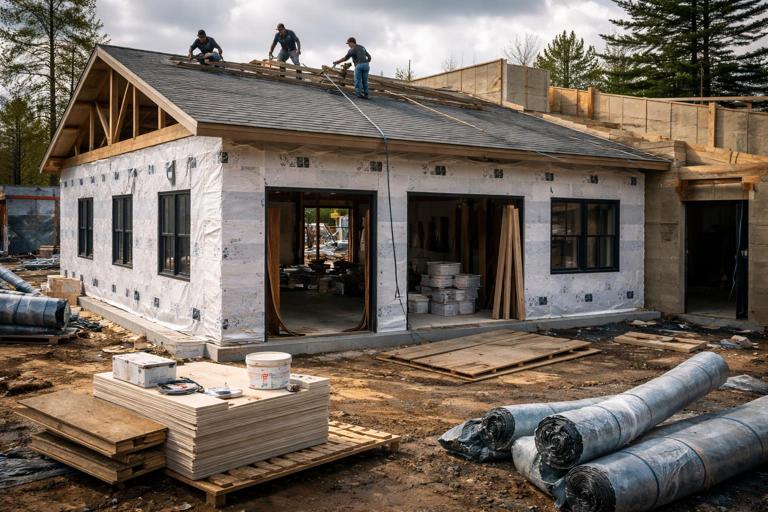
Assume a small commercial build where the owner’s key concern is getting the building dried-in to protect interior finishes and allow MEP rough-in to proceed without weather impacts.
Define the Milestone
Milestone: Dry-in complete (weather-tight). Acceptance: Roof complete and inspected; exterior walls sheathed/wrapped; windows and exterior doors installed; penetrations sealed; temporary protection removed; internal QC checklist signed.
Identify Gating Inputs
- Roof framing complete
- Roofing material delivered
- Roof membrane installed
- Exterior sheathing complete
- House wrap installed
- Windows delivered and staged
- Windows installed and flashed
- Exterior doors installed
- Sealant/caulking complete
- QC walk + punch corrections
Set the Baseline Date and Commitment
After reviewing trade input and procurement lead times, you baseline “Dry-in complete” for 2026-05-02. You commit this date to the owner because it drives interior start and reduces weather risk. You also set an internal “Dry-in readiness review” milestone one week earlier (2026-04-25) to force early verification of window delivery, roofing progress, and sealing scope.
Control Using Baseline
In weekly updates, you track:
- Window delivery forecast vs. baseline
- Roof inspection request date vs. baseline
- Exterior wrap progress by elevation
If the forecast slips to 2026-05-10, you report a +8 day variance, identify the cause (window fabrication delay), and propose actions (partial dry-in by elevation, temporary weather protection, resequencing interior rough-in to areas that can be protected). The baseline remains unchanged, allowing you to quantify the slip and communicate it consistently.