

Free ebook for educators on prompt engineering to create AI-powered lessons, assessments, feedback, and responsible classroom workflows.
Free ebook + audiobook content
-

Prompt Engineering Foundations for Educators
+ Exercise: Which prompt element best prevents an AI from generating classroom materials with inappropriate scenarios? 17 minutes
-
Prompt Structure: Roles, Context, Constraints, and Success Criteria
+ Exercise: An AI-generated quiz comes back in the wrong format and does not include the required number of question types. Which part of a structured prompt should you revise first? 20 minutes
-
Rubrics, Examples, and Iteration to Improve Output Quality
+ Exercise: Which prompt change best addresses an AI-generated quiz that feels too generic? 17 minutes


-
AI-Assisted Lesson Design Aligned to Objectives and Standards
+ Exercise: What is the best way to use AI to keep a lesson aligned to objectives and standards? 19 minutes
-
Mini Project: Build a 45-Minute Lesson with Materials and Timing
+ Exercise: What is the best reason to build the timing skeleton before generating handouts or slides for a 45-minute lesson? 17 minutes
-
Differentiation for Mixed-Ability Classrooms: Scaffolding and Enrichment
+ Exercise: Which approach best reflects effective enrichment in a mixed-ability classroom? 20 minutes
-
Accommodations and Accessibility: Clear Language and Inclusive Supports
+ Exercise: Which prompt instruction best ensures accessibility without lowering rigor? 19 minutes
-
Assessment Creation: Question Banks, Distractors, and Depth of Knowledge
+ Exercise: Which approach best supports quickly creating multiple quizzes and retakes while keeping assessment quality and coverage balanced? 16 minutes
-
Performance Tasks and Project Rubrics Without Ambiguity
+ Exercise: Which change most directly reduces ambiguity in a performance task? 18 minutes
-
Assessment Quality Control: Avoiding Answer Leakage and Misalignment
+ Exercise: Which review step best checks whether a student can guess the correct answer using grammar cues or option patterns without knowing the content? 16 minutes
-
Feedback at Scale: Comment Banks and Formative Feedback Loops
+ Exercise: Which approach best represents effective feedback at scale? 15 minutes
-
Growth-Mindset Feedback While Maintaining Academic Integrity
+ Exercise: Which feedback approach best supports a growth mindset while also protecting academic integrity in AI-supported writing tasks? 14 minutes
-
Reducing Hallucinations: Verification, Sourcing, and Cross-Checks
+ Exercise: Which approach best reduces the risk of hallucinations when creating a quiz from provided classroom materials? 16 minutes
-
Bias and Safety Controls: Guardrails for Classroom-Ready Content
+ Exercise: In a three-layer guardrails approach for classroom-ready AI output, what is the main purpose of Layer 3? 18 minutes
-
Policies and Ethics for Classroom AI Use: Privacy, Transparency, and Citations
+ Exercise: Which action best follows a privacy-first approach when using an AI tool to give feedback on student writing? 14 minutes
-
Student Use Guidelines: Responsible Collaboration and Integrity Boundaries
+ Exercise: Which student action best fits the Core vs. Support integrity boundary for AI use? 12 minutes
-
Subject-Specific Prompt Packs for Mathematics
+ Exercise: Which prompt-pack feature best reduces the risk of subtle math errors like sign mistakes or domain issues? 18 minutes
-
Subject-Specific Prompt Packs for Languages and Literacy
+ Exercise: Why should a language and literacy prompt pack separate student-facing outputs from teacher-facing outputs? 17 minutes
-
Subject-Specific Prompt Packs for Science
+ Exercise: What makes a science-specific prompt pack different from a generic prompt set for classroom materials? 18 minutes
-
Subject-Specific Prompt Packs for Humanities and Social Studies
+ Exercise: Which prompt pack design choice best helps students distinguish interpretation from invention in humanities and social studies tasks? 17 minutes
-
Template Library: Copy-and-Paste Prompts for Weekly Planning Workflows
+ Exercise: Why is it recommended to name prompt templates by workflow step (for example, Weekly Overview, Daily Agendas, Materials and Copies) instead of by the tool you use? 15 minutes
-
Checklists and Good vs. Bad Prompt Examples for Reliable Results
+ Exercise: Which prompt addition most directly improves reliability by preventing the AI from inventing details not present in your materials? 14 minutes
About the free ebook with audio
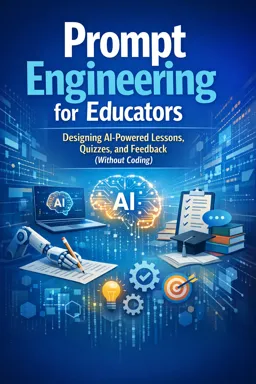
Prompt Engineering for Educators: Designing AI-Powered Lessons, Quizzes, and Feedback (Without Coding)
This free ebook helps educators use AI more intentionally to create classroom-ready materials without writing code. Learn how to turn instructional goals into clear prompts that guide AI toward useful, accurate, and age-appropriate results.
Design stronger prompts for teaching and learning
Build prompts with defined roles, relevant context, constraints, examples, rubrics, and success criteria. Use practical iteration techniques to improve outputs for lesson plans, learning activities, assessments, and feedback.
Create inclusive, aligned classroom materials
Explore AI-assisted lesson design aligned with objectives and standards, including a practical 45-minute lesson-building project. Apply differentiation, scaffolding, enrichment, accommodations, accessible language, and inclusive supports for mixed-ability classrooms.
Develop reliable assessments and feedback
Learn to generate question banks, plausible distractors, performance tasks, and unambiguous rubrics. Strengthen quality control by checking alignment, depth of knowledge, answer leakage, and academic integrity. Create reusable comment banks and formative-feedback workflows that support student growth.
Use AI responsibly in education
Address common risks through verification, sourcing, cross-checks, bias controls, and classroom safety guardrails. The ebook also examines privacy, transparency, citations, student-use guidelines, and responsible collaboration boundaries.
Adapt prompts across subjects
Use subject-focused prompt approaches for mathematics, languages and literacy, science, humanities, and social studies. Finish with reusable planning templates, checklists, and good-versus-bad prompt examples to make weekly AI-supported workflows more dependable.
Designed for educators who want practical, ethical, and repeatable ways to use generative AI in the classroom.
How can teachers prompt AI to create standards-aligned lesson plans?
Specify the grade level, objective, standard, lesson length, materials, constraints, and measurable success criteria.
How do educators prevent AI-generated quiz questions from revealing answers?
Request separate student and teacher versions, then check distractors, wording, answer placement, and alignment before use.
What should teachers verify before using AI-generated classroom content?
Check facts, sources, bias, accessibility, age appropriateness, privacy requirements, and consistency with local policies.
This ebook/audiobook includes:

6 hours and 18 minutes of audio content

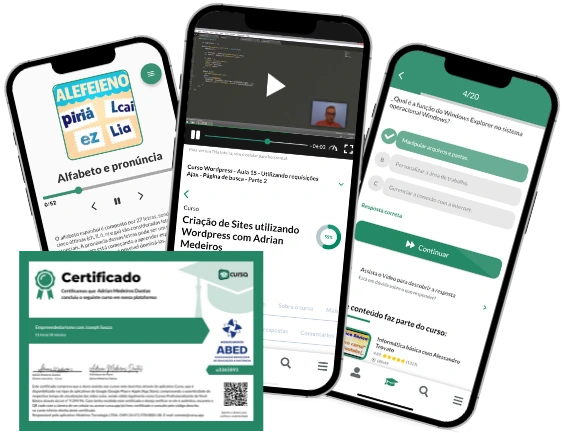
Digital certificate of course completion (Free)

Exercises to train your knowledge

100% free, from content to certificate
Ready to get started?

 recommended
In the app you will also find...

Over 5,000 free courses
Programming, English, Digital Marketing and much more! Learn whatever you want, for free.

Study plan with AI
Our app's Artificial Intelligence can create a study schedule for the course you choose.

From zero to professional success
Improve your resume with our free Certificate and then use our Artificial Intelligence to find your dream job.
You can also use the QR Code or the links below.