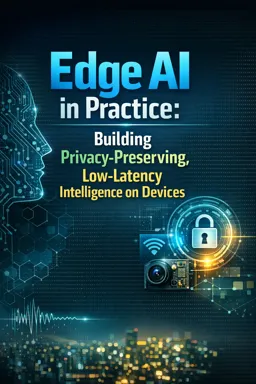


Free ebook on building private, low-latency edge AI models for devices, from optimization and deployment to monitoring and production.
Free ebook + audiobook content
-

Edge AI Use Cases and Privacy-First Requirements
+ Exercise: Which design choice best reflects a privacy-first approach for an edge AI safety camera that detects restricted-area entry? 18 minutes
-
System Architecture for On-Device Intelligence
+ Exercise: Why does an on-device inference pipeline often use bounded queues between stages like capture, preprocessing, inference, and postprocessing? 19 minutes
-
Data Collection and Labeling for Edge Scenarios
+ Exercise: When collecting data for an edge AI model, which approach best supports privacy-preserving iteration when you may need to update labels over time? 19 minutes


-
Model Architectures Optimized for Edge Constraints
+ Exercise: Which design choice best reflects an edge-optimized architecture rather than just a small model? 19 minutes
-
Compression Techniques: Quantization, Pruning, and Distillation
+ Exercise: In edge deployments, why does structured pruning typically produce more reliable inference speedups than unstructured pruning? 21 minutes
-
Hardware-Aware Optimization and Accelerator Utilization
+ Exercise: Why can a model that runs mostly on an NPU still be slower than running entirely on the CPU or GPU on an edge device? 17 minutes
-
Latency Budgeting and Real-Time Performance Engineering
+ Exercise: In a streaming edge AI pipeline that prioritizes freshness, which overload policy best helps cap worst-case latency when inference is the bottleneck? 18 minutes
-
Energy Profiling and Power-Constrained Inference
+ Exercise: When optimizing an edge inference pipeline for battery life, why is it important to measure both peak power and total energy per inference? 17 minutes
-
Deployment Runtimes: TensorFlow Lite, ONNX Runtime, and Core ML
+ Exercise: Why is operator coverage an important factor when choosing an edge deployment runtime and its accelerator path? 18 minutes
-
Secure Model Packaging, Delivery, and On-Device Updates
+ Exercise: Which on-device verification order best ensures a model update is authentic and unmodified before it can be activated? 17 minutes
-
Edge Monitoring, Drift Detection, and Field Debugging
+ Exercise: Which monitoring design best supports privacy-preserving, low-latency edge telemetry while still enabling field debugging? 20 minutes
-
Responsible AI on Devices: Privacy, Bias, Safety, and Failure Modes
+ Exercise: Which approach best reflects a responsible on-device safety design for high-impact actions? 19 minutes
-
Mini-Project: Keyword Spotting with On-Device Audio Pipelines
+ Exercise: Why is a ring buffer used in an on-device keyword spotting audio pipeline with overlapping windows? 20 minutes
-
Mini-Project: IoT Anomaly Detection with Intermittent Connectivity
+ Exercise: Which design choice best prevents duplicate anomaly events from being created in the cloud after a device reconnects and retries uploads? 17 minutes
-
Mini-Project: Real-Time Vision on a Camera Module
+ Exercise: In a two-thread real-time vision pipeline using a bounded queue, what is the main reason to drop older frames when the queue is full? 17 minutes
-
Production Checklists, Architecture Diagrams, and Troubleshooting Playbooks
+ Exercise: What is the main purpose of implementing a production checklist as an automated CI/CD gate for an Edge AI release? 19 minutes
About the free ebook with audio
Edge AI in Practice: Building Privacy-Preserving, Low-Latency Intelligence on Devices
This free ebook is a practical guide to designing, optimizing, deploying, and maintaining machine-learning systems that run directly on devices. Learn how edge AI can reduce response times, limit data exposure, and keep critical intelligence available even when connectivity is limited.
Build AI for real-world device constraints
Explore privacy-first use cases and the system architecture behind on-device intelligence. The ebook explains how to prepare edge-specific datasets, select compact model architectures, and balance accuracy with memory, compute, battery, and thermal limits.
Develop a deployment-focused optimization workflow using quantization, pruning, knowledge distillation, hardware-aware tuning, accelerator utilization, latency budgeting, and energy profiling. Understand how to evaluate real-time performance rather than relying on model accuracy alone.
Deploy and operate models securely
Learn practical considerations for TensorFlow Lite, ONNX Runtime, and Core ML, along with secure model packaging, controlled delivery, and on-device update strategies. The ebook also covers monitoring, model drift, field debugging, responsible AI risks, and failure-mode planning.
Apply the techniques through projects
- Keyword spotting with on-device audio pipelines
- IoT anomaly detection under intermittent connectivity
- Real-time computer vision on a camera module
For builders of production edge AI
Use the included production checklists, architecture guidance, and troubleshooting playbooks to make informed trade-offs and create reliable AI experiences on phones, sensors, cameras, embedded hardware, and connected products.
What model compression methods are used for edge AI deployment?
The ebook covers quantization, pruning, and knowledge distillation to reduce model size, compute demands, and inference latency.
Which runtimes are covered for deploying machine learning models on devices?
It examines deployment considerations for TensorFlow Lite, ONNX Runtime, and Core ML.
How can on-device AI protect user privacy?
Processing data locally can reduce the need to transmit sensitive audio, images, or sensor data to cloud services.
This ebook/audiobook includes:

5 hours and 4 minutes of audio content

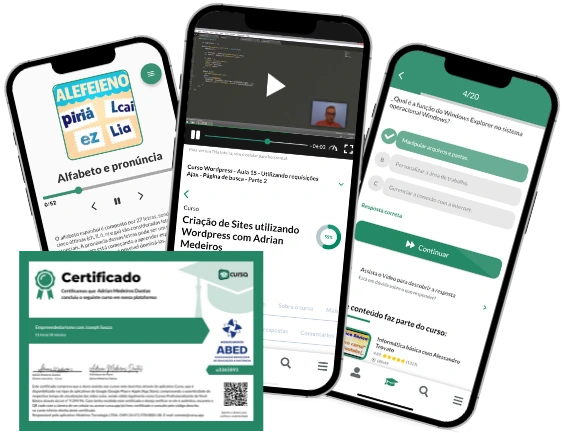
Digital certificate of course completion (Free)

Exercises to train your knowledge

100% free, from content to certificate
Ready to get started?

 recommended
In the app you will also find...

Over 5,000 free courses
Programming, English, Digital Marketing and much more! Learn whatever you want, for free.

Study plan with AI
Our app's Artificial Intelligence can create a study schedule for the course you choose.

From zero to professional success
Improve your resume with our free Certificate and then use our Artificial Intelligence to find your dream job.
You can also use the QR Code or the links below.