What “Subject-Specific Prompt Packs” Mean for Languages and Literacy
A subject-specific prompt pack is a curated set of reusable prompts designed for one discipline and its recurring tasks. For languages and literacy, that means prompts that reliably generate reading passages, discussion questions, vocabulary work, writing models, feedback, and language practice—while staying consistent with your classroom routines and the specific skills you teach (comprehension, craft, argument, grammar, speaking and listening, multilingual development, and genre knowledge). Instead of writing a new prompt from scratch each time, you select a prompt “card,” fill in a few variables (grade band, text type, target skill, theme, length, language level), and run it. The value is consistency: students experience predictable task formats, and you get outputs that align to your literacy moves (close reading, annotation, evidence-based responses, revision cycles, and language practice).
In literacy, small changes in wording can shift cognitive demand: “summarize” differs from “analyze,” “identify” differs from “evaluate,” and “explain with evidence” differs from “opine.” A prompt pack reduces that drift by standardizing the verbs, the response frames, and the constraints (text length, complexity, number of questions, and required evidence). It also helps you build parallel materials: the same skill taught with different topics, or the same topic taught with different skills, without losing coherence.
Design Principles for Language and Literacy Prompt Packs
1) Build around recurring literacy moves, not one-off activities
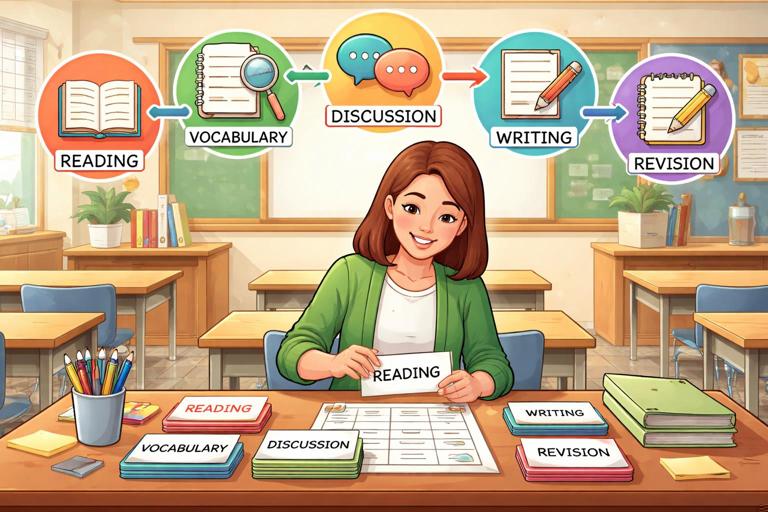
Strong prompt packs mirror what you do repeatedly: preview vocabulary, read a text, annotate, discuss, write, revise, and reflect. Organize your pack into these “moves” so you can assemble a lesson sequence quickly. For example, a single text can feed multiple prompts: vocabulary preview, comprehension checks, text-dependent questions, a writing task, and feedback prompts.
2) Treat text as data: control length, complexity, and genre
Languages and literacy outputs depend heavily on the input text. Your pack should include prompts that either (a) generate a text with specified constraints or (b) accept a teacher-provided text and produce tasks from it. Include explicit controls such as word count range, genre (narrative, informational, argument), point of view, and complexity indicators (sentence length, figurative language density, or a rough grade-band target). When you need predictable results, prefer teacher-provided texts or tightly constrained generated texts.
3) Separate “student-facing” from “teacher-facing” outputs
In literacy, you often need two versions: student materials (clean, minimal hints) and teacher materials (answer keys, rationales, misconceptions). Your prompt pack should include paired prompts that generate both versions from the same text and skill focus. This reduces accidental answer leakage and keeps your classroom materials consistent.
- Listen to the audio with the screen off.
- Earn a certificate upon completion.
- Over 5000 courses for you to explore!

Download the app
4) Make language level a first-class variable
For multilingual learners and mixed proficiency groups, your pack should include a “language level” variable (for example: newcomer, developing, expanding, bridging) and specify supports (glossary, sentence frames, simplified syntax, or bilingual word banks). This is not the same as “making it easier”; it is about making the language accessible while preserving the target thinking skill.
Step-by-Step: How to Build Your Languages and Literacy Prompt Pack
Step 1: Choose 6–10 high-frequency tasks
Start with the tasks you assign most often. A practical starter set for languages and literacy might include: (1) leveled reading passage generator, (2) text-dependent question set, (3) vocabulary and morphology work, (4) discussion protocol prompts, (5) writing task + planning organizer, (6) revision checklist + targeted feedback, (7) grammar and style mini-lesson, (8) speaking practice scripts, (9) translation/contrastive analysis for multilingual classes, (10) quick formative checks (exit tickets).
Step 2: Define your variables (the “fill-in blanks”)
Create a consistent variable list you reuse across prompts. Typical variables for literacy include: grade band, genre, topic/theme, target skill, word count, complexity target, vocabulary focus (Tier 2/Tier 3), language level, response length, and product format (paragraph, essay, dialogue, annotation notes). Keep the variable names identical across prompts so you can copy-paste quickly.
Step 3: Write one “master prompt” per task with tight constraints
Each prompt should specify: what to produce, how to format it, and what to avoid. For literacy, formatting matters because you will paste outputs into handouts. Use structured output requests such as numbered questions, tables (if your environment supports them), or clearly labeled sections. If tables are unreliable, request bullet lists with consistent labels.
Step 4: Add “quality checks” inside the prompt
Instead of hoping the output is aligned, instruct the model to self-check: verify that questions are text-dependent, that the answer key cites line numbers or quotes, that vocabulary words appear in the passage, and that the writing prompt matches the genre. These checks make your pack more dependable.
Step 5: Store prompts as “cards” with a short name and use-case
Give each prompt a short label (for example, LIT-READ-01, LIT-VOC-02). Add a one-sentence note: “Use after selecting a theme; generates a 450–550 word informational text with 8 TDQs and an answer key.” This turns your pack into a practical toolkit rather than a document you rarely open.
Prompt Pack Cards (Ready-to-Use Prompts)
Card 1: Leveled Reading Passage Generator (Same Topic, Multiple Levels)
Use this when you want parallel texts on the same topic for different reading levels while keeping key ideas consistent.
You are a literacy curriculum writer. Create THREE versions of the same informational passage on: [TOPIC]. Audience: Grade [GRADE_BAND]. Versions: A (on-level), B (slightly simplified language), C (more complex language). Constraints: Each version 350–450 words. Keep the same 6 key facts across all versions (list the 6 facts first). Use headings (2–3). Include 6 domain terms and 6 Tier 2 words; bold them in the passage. Avoid sensitive or graphic content. Output format: 1) “Key facts” list, 2) Version A, 3) Version B, 4) Version C, each clearly labeled.Card 2: Text-Dependent Questions + Answer Key with Evidence
Use this with a teacher-provided text to generate questions that require students to cite evidence rather than guess.
You are an ELA assessment writer. Using the text below, write 10 text-dependent questions aligned to [TARGET_SKILL] (e.g., central idea, inference, author’s craft, structure, argument). Mix: 4 literal comprehension, 4 inferential, 2 analysis of craft/structure. For each question, provide: (a) the correct answer, (b) a short rationale, (c) a direct quote from the text as evidence (or a line/paragraph reference). Do NOT include any hints in the student version. Output two sections: “Student Questions” (questions only) and “Teacher Key” (answers, rationales, evidence). Text: [PASTE_TEXT]Card 3: Vocabulary, Morphology, and Usage (Tier 2 + Domain)
Use this to turn a passage into vocabulary practice that goes beyond definitions and includes morphology, context, and usage.
You are a vocabulary coach. From the text below, select 8 words: 5 Tier 2 and 3 domain-specific. For each word, provide: student-friendly definition, part of speech, one sentence from the text that contains the word, a new example sentence in a different context, one non-example, and a morphology note (prefix/root/suffix or related forms). Then create 6 practice items: 2 matching, 2 fill-in-the-blank using short original sentences, 2 “choose the best synonym” multiple choice with plausible distractors. Output in two sections: “Student Handout” and “Teacher Key.” Text: [PASTE_TEXT]Card 4: Close Reading Annotation Guide (What to Mark and Why)
Use this to create a consistent annotation routine that students can follow across texts.
You are an ELA teacher creating an annotation guide. For the text below, create a close-reading annotation task aligned to [TARGET_SKILL]. Provide: (1) a 5-step annotation checklist (what to underline/circle/box and what to write in the margin), (2) 6 annotation prompts that point students to specific features (claims, evidence, imagery, transitions, tone shifts, key details), and (3) a short model of 3 annotated notes (as if written in the margin) without giving away full answers. Keep student directions concise and classroom-ready. Text: [PASTE_TEXT]Card 5: Discussion Protocol Pack (Academic Talk Moves + Roles)
Use this to generate structured discussion prompts that support speaking and listening goals.
You are a classroom discussion designer. Create a 12-minute discussion protocol for the text/topic: [TEXT_OR_TOPIC]. Target skill: [TARGET_SKILL]. Include: (1) discussion question sequence (3 questions: opening, deepening, synthesis), (2) roles for groups of 4 (facilitator, evidence-finder, connector, summarizer) with 2 responsibilities each, (3) 8 sentence starters for academic talk (agree/disagree, ask for evidence, build on an idea, clarify), and (4) a quick self-assessment checklist (4 items). Output as a student-facing handout.Card 6: Writing Task Generator (Genre-Specific) + Planning Organizer
Use this to create writing prompts that match genre expectations and include planning support without writing the essay for students.
You are a writing instructor. Create a writing task aligned to genre: [GENRE] (argument, informational, narrative) on the topic/text: [TOPIC_OR_TEXT]. Audience: Grade [GRADE_BAND]. Provide: (1) prompt, (2) success criteria checklist (6–8 items) specific to the genre, (3) a planning organizer (bullet outline with labeled sections), and (4) 6 sentence frames that support academic language without supplying content. Keep it student-facing. If a source text is provided, require evidence from it. Source (optional): [PASTE_TEXT]Card 7: Revision and Editing Targets (From a Student Draft)
Use this to generate actionable revision goals and editing practice from real student writing while keeping the student voice intact.
You are a writing coach. Analyze the student draft below. Do NOT rewrite the whole piece. Provide: (1) 3 revision priorities (ideas/organization/voice) with one example quote from the draft for each, (2) 3 editing priorities (grammar/usage/mechanics) with a brief rule reminder and one corrected example, (3) a “next draft” checklist of 8 items, and (4) two short mini-lessons (each 5 minutes) targeting the most important needs. Keep feedback specific, kind, and focused on growth. Student draft: [PASTE_DRAFT]Card 8: Grammar and Style Mini-Lesson Builder (Contextualized)
Use this to teach grammar in context rather than as isolated drills.
You are an ELA mini-lesson writer. Create a 10-minute mini-lesson on [GRAMMAR_FOCUS] (e.g., sentence variety, comma splices, verb tense consistency, pronoun-antecedent agreement) using the topic: [TOPIC]. Include: (1) a short explanation (no more than 120 words), (2) 4 examples and 4 non-examples, (3) a guided practice of 6 items that gradually increases difficulty, and (4) an exit ticket with 2 items. Provide a teacher key. Keep sentences age-appropriate for Grade [GRADE_BAND].Card 9: Multilingual Support Card (Bilingual Glossary + Contrastive Notes)
Use this to support multilingual learners by anticipating language interference and providing targeted supports.
You are a language support specialist. For the text/topic below, create supports for students whose home language is [HOME_LANGUAGE] learning English at level [LANGUAGE_LEVEL]. Provide: (1) a bilingual glossary of 10 key words/phrases with simple definitions, (2) 5 sentence frames for the target task: [TASK] (discussion, summary, argument), (3) 3 contrastive notes (common transfer issues between English and [HOME_LANGUAGE]) with examples, and (4) a short practice activity (5 minutes) focusing on one high-impact structure (e.g., because/so, although, relative clauses). Text/topic: [PASTE_TEXT_OR_TOPIC]Card 10: Literature Circle Pack (Roles + Prompts + Evidence Tracker)
Use this for novels, short stories, or poems to keep groups accountable and focused on analysis.
You are designing literature circles. For the text: [TITLE/EXCERPT], create a literature circle packet for groups of 4. Include: (1) role sheets for Discussion Director, Passage Picker, Theme Tracker, Craft Analyst (each with 4 prompts), (2) an evidence tracker template (quote, page/line, what it shows, why it matters), and (3) a 5-question whole-group debrief that moves from comprehension to theme/craft. Keep it student-facing and avoid giving interpretive answers.How to Use the Pack in Real Planning (Two Practical Workflows)
Workflow A: Build a coherent reading-to-writing sequence from one text
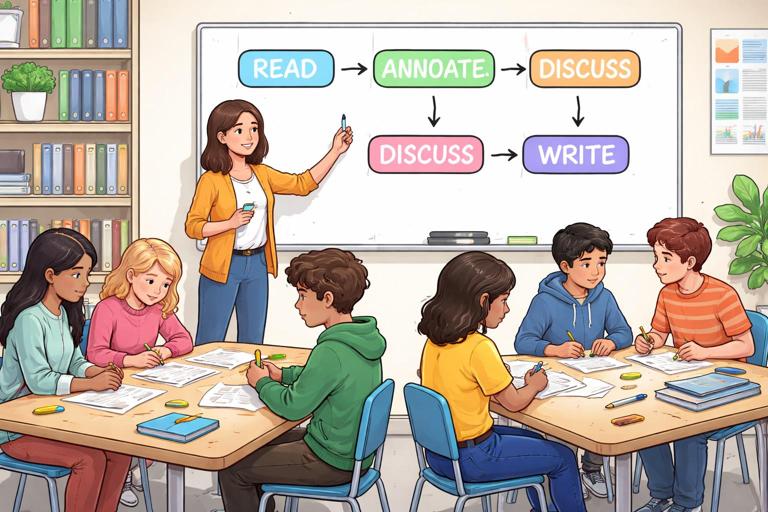
Start with a text you already trust (class novel excerpt, article, or teacher-written passage). Run Card 2 to generate text-dependent questions and a teacher key. Then run Card 4 to create the annotation routine aligned to the same target skill. Next, run Card 5 to structure a short discussion that uses evidence. Finally, run Card 6 to create a writing task that requires students to use the same evidence they discussed. This workflow keeps the cognitive thread consistent: students read for a purpose, talk with evidence, and write with evidence.
Workflow B: Create parallel materials for small groups without changing the objective
Choose one topic and one target skill (for example, identifying central idea and supporting details). Use Card 1 to generate three leveled versions of the passage with the same key facts. Then use Card 2 separately on each version to generate questions that match the text. Keep the question types consistent across levels (same number of literal, inferential, and craft questions), so groups can share strategies even if they read different versions. Use Card 3 on each version to ensure vocabulary practice matches what students actually encountered.
Practical Tips to Keep Literacy Outputs Classroom-Ready
Prevent “generic” comprehension questions
If questions feel interchangeable across texts, add constraints: require evidence quotes, require references to specific paragraphs, and require at least two questions about structure or craft (transitions, tone, imagery, or argument moves). Card 2 already includes this; if needed, add “At least 6 questions must be unanswerable without quoting the text.”
Keep writing prompts from becoming “write anything” prompts
Genre writing improves when the prompt includes a clear purpose, audience, and constraints. In Card 6, specify the product (one paragraph, multi-paragraph essay, letter to the editor), required evidence count (for example, “use at least two quotes”), and a success criteria checklist that matches your expectations.
Use consistent language for skills across the pack
Decide on your classroom terms (claim, evidence, reasoning; central idea; theme; author’s purpose; tone) and keep them stable. If you teach multiple grades or collaborate with a team, agree on shared labels so students do not have to relearn vocabulary for the same concept.
Build a “swap list” for quick customization
Create a small list you can paste into any prompt: acceptable topics, banned topics, preferred names for student roles, and your standard time limits. For example: “Use neutral, school-appropriate topics (community, science, sports, arts). Avoid politics, violence, or medical advice.” This keeps outputs aligned with your setting without rewriting prompts.
Mini Library: Fill-and-Run Templates for Common Literacy Products
Exit Ticket Generator (Skill-Focused)
Create a 5-minute exit ticket aligned to [TARGET_SKILL] using the text/topic: [TEXT_OR_TOPIC]. Include 3 items: (1) one selected-response question with 4 options, (2) one short constructed response requiring evidence, (3) one metacognitive reflection prompt (“What strategy helped you today?”). Provide a teacher key and a 2-point scoring guide for the constructed response.Poetry Craft Focus (Sound and Figurative Language)
Write an original poem suitable for Grade [GRADE_BAND] on the theme [THEME], 14–20 lines. Include at least 3 examples of figurative language (label them in the teacher key only) and at least 2 sound devices (alliteration, assonance, consonance, internal rhyme). Then create: (1) 6 text-dependent questions (student-facing), (2) a teacher key with evidence, (3) a short writing imitation task (“Write your own stanza using the same craft move”). Student materials must not label the devices.Reading Fluency Practice (Reader’s Theater)
Create a reader’s theater script for Grade [GRADE_BAND] on [TOPIC] with 4 roles and a narrator. Length: 3–5 minutes when read aloud. Include repeated phrases for fluency, clear stage directions in parentheses, and 8 target vocabulary words embedded naturally. Provide a teacher note with 3 fluency coaching tips and a simple rubric (accuracy, rate, expression).