What Differentiation Means in Mixed-Ability Classrooms
Differentiation is the deliberate design of multiple pathways so students can reach the same essential learning goals with varying levels of support, complexity, pace, or product options. In a mixed-ability classroom, students differ in prior knowledge, language proficiency, processing speed, confidence, and background experiences. Differentiation addresses those differences without lowering expectations for the core target. In practice, you keep the “must-learn” outcomes consistent, then adjust the route students take to get there.
When using AI to support differentiation, the goal is not to generate entirely separate lessons for every student. Instead, you create a small set of well-designed variants: scaffolds for students who need more structure, and enrichment for students who are ready for greater challenge. This chapter focuses on two complementary moves: scaffolding (temporary supports that fade) and enrichment (extensions that deepen or broaden learning).

Scaffolding vs. Enrichment: Two Sides of the Same Design
Scaffolding: Temporary Supports That Fade
Scaffolding helps students access grade-level work by reducing unnecessary barriers. It can include chunking tasks, providing sentence frames, modeling, guided practice, visual supports, vocabulary previews, worked examples, checklists, and strategic hints. The key is that scaffolds are removable: as students gain competence, you gradually reduce the support so independence grows.
Enrichment: Deeper Thinking, Not Just “More Work”
Enrichment is not extra pages of the same worksheet. It increases cognitive demand by asking students to transfer, analyze, evaluate, create, or connect ideas in new contexts. Enrichment can take the form of open-ended problems, alternative representations, student-designed investigations, debate, critique, or creating products for an authentic audience. The best enrichment still aligns to the same essential goal, but invites students to go beyond the minimum.
Common Pitfalls to Avoid
- Changing the learning goal instead of the support: scaffolding should not replace the target with a simpler target unless you are intentionally modifying expectations.
- Over-scaffolding: too many hints can remove productive struggle and prevent growth.
- Enrichment as busywork: adding volume without adding depth can demotivate advanced learners.
- Tracking by ability: fixed groups can become labels; use flexible grouping based on current evidence.
A Practical Workflow: Differentiate One Task into Three Tiers
A reliable way to differentiate without overwhelming planning time is to start with one high-quality core task and then create two variants: a scaffolded version and an enriched version. You can think of it as Tier A (scaffold), Tier B (core), Tier C (enrichment). Students can move between tiers as needed, even within the same lesson.
- Listen to the audio with the screen off.
- Earn a certificate upon completion.
- Over 5000 courses for you to explore!

Download the app
Step 1: Identify the “Non-Negotiable” Learning Target
Write one sentence describing what all students must demonstrate by the end. Keep it observable. Example: “Students will explain how evidence supports a claim in a short text.” Or: “Students will solve linear equations and justify each step.” This target anchors your tiers so you do not accidentally drift into three different lessons.
Step 2: Choose a Single Core Task Worth Differentiating
Pick a task that naturally reveals understanding: a short constructed response, a problem set with reasoning, a lab analysis, or a discussion protocol with an exit ticket. If the task is too trivial, differentiation becomes meaningless; if it is too complex, you will spend all your time managing variants. Aim for a task that can be completed in 10–25 minutes.
Step 3: Decide What to Vary (Support, Complexity, or Product)
For scaffolding, vary support: provide structure, prompts, models, or reduced cognitive load in non-essential areas. For enrichment, vary complexity: add constraints that require deeper reasoning, require multiple representations, or ask students to critique and improve an argument. Sometimes you vary product: students show learning through different formats (written explanation, diagram, oral recording), while still meeting the same criteria.
Step 4: Generate Tiered Versions with AI Using a “Single Source” Input
To keep tiers aligned, provide the AI with the same source material (text, data set, problem context) and ask for three versions that preserve the same target. This reduces drift and ensures fairness. You can also ask the AI to label which supports are included so you can remove them later.
Task: Create three tiered versions of the same assignment (scaffold, core, enrichment) aligned to this learning target: [paste target]. Use the same source text/data below. Keep the essential question the same. For the scaffolded version, add sentence frames, a glossary of 6 key terms, and chunk the steps. For the enrichment version, add one extension that requires evaluating an alternative claim and citing evidence. Output in three clearly labeled sections.Step 5: Add “Fade Points” to the Scaffolded Tier
Scaffolds should come with a plan to remove them. Build in fade points such as: “First question includes sentence frames; second question offers optional frames; third question has no frames.” Or: “Provide a worked example for problem 1; partially worked for problem 2; independent for problem 3.” This helps students transition rather than remain dependent.
Step 6: Plan Quick Checks to Move Students Between Tiers
Flexible movement is what keeps tiers from becoming labels. Use a 2–3 minute check: one question, one mini-problem, one short oral explanation. If a student shows readiness, they move to core or enrichment. If they struggle, they receive scaffolded supports. AI can help you generate these checks quickly and in multiple formats.
Create 6 quick-check questions (2 easy, 2 medium, 2 hard) for this learning target: [target]. Each question should be answerable in under 2 minutes. Provide an answer key and a brief note on what misconception each question diagnoses.Scaffolding Strategies You Can Generate and Customize with AI
1) Chunking and Micro-steps
Chunking breaks a task into smaller steps with clear stopping points. This is especially helpful for students with executive function challenges, emerging language proficiency, or limited background knowledge. Ask AI to rewrite directions into numbered micro-steps and to add “checkpoints” where students verify they are on track.
Rewrite these directions into 6–10 numbered micro-steps. After steps 3 and 6, add a checkpoint question that helps students self-verify. Keep the task rigor the same. Directions: [paste].2) Sentence Frames and Language Supports
Sentence frames support academic language without giving away thinking. They are most effective when they cue reasoning moves: claim, evidence, reasoning, comparison, cause-effect, or counterargument. Ask AI for frames at two levels: “guided” (more structured) and “light” (more open), so you can fade support.
Generate sentence frames for students to explain their reasoning for this task: [task]. Provide two levels: Level 1 (high support) and Level 2 (light support). Include 6 frames per level. Avoid giving content answers.3) Worked Examples and Partially Completed Models
Worked examples reduce cognitive load by showing the process. To avoid students copying without understanding, pair a worked example with “explain the step” prompts. AI can create a model response and then annotate it with questions that force attention to reasoning.
Create a worked example for problem/task: [paste]. Then add 5 prompts that ask students to explain why each step was taken. Also create a partially completed version where students must fill in 3 missing steps.4) Vocabulary Preview and Concept Cards
Vocabulary can be a hidden barrier. A quick preview of key terms, with student-friendly definitions and examples, can make grade-level texts accessible. Ask AI to create “concept cards” that include definition, non-example, and a quick check question.
From this text/topic: [paste], identify 6 essential terms. For each, create a concept card with: student-friendly definition, one example, one non-example, and one quick check question. Keep language concise.5) Hints That Preserve Thinking
Good hints point students toward a strategy without doing the work. For example: “Look for a contrast word,” “Try drawing a diagram,” or “Check units.” Ask AI to generate a hint ladder: Hint 1 is minimal, Hint 2 is more direct, Hint 3 is nearly explicit. Students can request hints as needed, supporting autonomy.
Create a 3-level hint ladder for each of these 4 questions: [paste questions]. Hint 1 should be a general strategy cue, Hint 2 should point to a specific step, Hint 3 can be close to the answer but not fully reveal it.Enrichment Strategies That Add Depth (Not Volume)
1) “What If” Variations and Constraint Changes
Enrichment can come from changing a condition and asking students to predict, test, or justify. In math, change a parameter; in science, change a variable; in literacy, change a narrator or audience; in social studies, change a stakeholder perspective. AI can generate a set of “what if” prompts that still target the same skill.
Generate 5 enrichment “what if” variations for this core task: [paste]. Each variation should require deeper reasoning but still assess the same learning target: [target]. Provide a one-sentence teacher note explaining the added complexity.2) Counterclaim, Critique, and Revision
Advanced learners benefit from evaluating alternatives and improving work. Ask students to critique a flawed argument, identify weak evidence, or revise for clarity and precision. AI can produce a “nearly correct” response with subtle issues for students to diagnose.
Create a student response that is plausible but contains 4 issues (e.g., weak evidence, logical leap, unclear reasoning, misuse of a term) related to this prompt: [paste]. Then provide an answer key listing the issues and suggested revisions.3) Multiple Representations
Enrichment can require students to express the same idea in different forms: graph, table, equation, diagram, summary, or analogy. This deepens understanding and reveals gaps. AI can propose representation options and provide templates students can use.
For this concept/skill: [paste], propose 4 different representations students can create. For each, provide a simple template or outline and one quality checklist item that defines success.4) Student Choice with Guardrails
Choice increases engagement, but it needs guardrails so students still meet the target. Offer a menu of enrichment options that all require the same core skill. AI can generate a choice board with clear deliverables and time estimates so it remains manageable.
Create a 2x3 choice board for enrichment aligned to this target: [target]. Each option should take 15–25 minutes and require evidence of reasoning. For each option, list the deliverable and a 3-item checklist.Flexible Grouping and Rotation Models (Without Overcomplicating)
Use Evidence, Not Labels
Flexible grouping works when groups are formed based on specific needs for a specific task: vocabulary support, strategy practice, or extension. Avoid naming groups by level. Instead, name by focus (e.g., “Evidence Finders,” “Reasoning Builders,” “Critique Team”). AI can help you generate group tasks that are parallel and aligned.
A Simple Three-Station Rotation
One practical structure is a three-station rotation: teacher-led scaffold station, independent core station, and enrichment station. Students rotate based on quick-check results. The teacher station targets the most common barrier with explicit modeling and guided practice. The independent station reinforces the core task. The enrichment station extends thinking through critique or application.
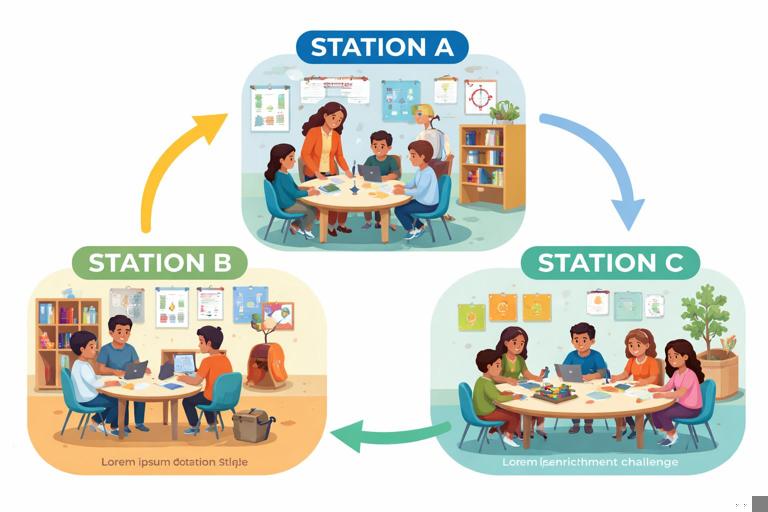
Design a 3-station rotation for a 45-minute class aligned to this target: [target]. Station A: teacher-led scaffold (10–12 min). Station B: independent core practice (10–12 min). Station C: enrichment (10–12 min). Include directions for students, materials needed, and a 2-minute transition routine.Differentiated Questioning for Discussions
Build a Question Ladder
In whole-class or small-group discussions, differentiation can happen through question ladders: entry questions that ensure access, probing questions that deepen reasoning, and challenge questions that require synthesis. AI can generate ladders tied to your text or problem so you can call on students strategically and support equitable participation.
Create a discussion question ladder for this text/topic: [paste]. Include 4 entry questions, 4 probing questions, and 4 challenge questions. For each question, add a follow-up prompt that encourages students to cite evidence or explain reasoning.Talk Moves and Participation Supports
Some students need language to enter the conversation. Provide talk moves such as “I agree because…,” “I want to add…,” “Can you clarify…,” and “A counterexample is….” For enrichment, add moves like “Let’s test that assumption” or “What evidence would change your mind?” AI can generate a set of talk moves aligned to your content and language goals.
Differentiated Feedback: Faster, More Targeted Responses
Feedback Banks Aligned to Common Errors
In mixed-ability settings, the same misconceptions appear repeatedly. Create a feedback bank: short comments tied to specific errors, each paired with a next step. AI can help you draft these comments so you can paste them quickly while still sounding human and supportive. Keep feedback focused on the next action, not a full re-teach.
Generate a feedback bank for this assignment: [paste]. Identify 8 common errors or misconceptions. For each, write: (1) a 1–2 sentence feedback comment, (2) a specific next step, and (3) one question to ask the student to prompt revision.Two-Level Feedback: Access and Extension
For students who need scaffolding, feedback should prioritize clarity and one manageable improvement at a time. For students ready for enrichment, feedback should push precision, alternative approaches, and stronger justification. Ask AI to produce two versions of feedback for the same student work: one that supports access and one that extends thinking, then choose what fits the student’s current need.
Mini Examples: Differentiating the Same Core Task Across Subjects
Example 1: Reading and Writing (Evidence-Based Explanation)
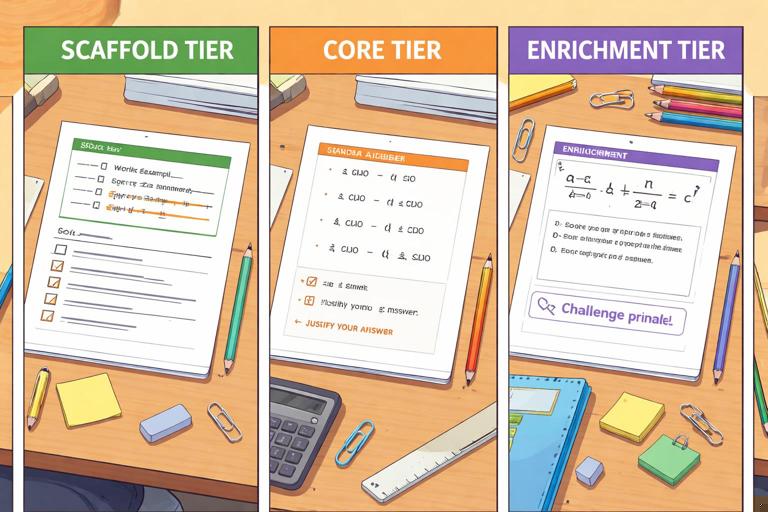
Core task: Students read a short passage and write a paragraph explaining how one piece of evidence supports a claim. Scaffolded tier: provide a glossary, highlight two candidate evidence sentences, and give sentence frames for claim and reasoning. Core tier: students select evidence independently and write the paragraph with a checklist. Enrichment tier: students address a counterclaim or compare two pieces of evidence and evaluate which is stronger.
Example 2: Math (Solving and Justifying)
Core task: Solve a set of linear equations and justify steps. Scaffolded tier: include a worked example, a step checklist, and problems ordered from similar to less similar. Core tier: standard problems with a requirement to write one justification sentence per problem. Enrichment tier: include an equation with parameters, ask students to create an equation that has no solution or infinitely many solutions, and justify conditions.
Example 3: Science (Data Interpretation)
Core task: Interpret a data table and explain a trend. Scaffolded tier: provide a labeled graph template, define key terms (variable, trend), and include guided questions that point to specific rows/columns. Core tier: students graph and explain the trend with evidence. Enrichment tier: students propose an alternative explanation, identify what additional data would test it, and critique limitations of the data.
Quality Control: Ensuring Tiers Stay Fair and Aligned
Alignment Check
Before using tiered materials, verify that all tiers assess the same essential skill. A quick test is to ask: “Could a student complete the scaffolded tier and still demonstrate the target?” and “Does the enrichment tier still require the target, or does it drift into a different skill?” If drift occurs, revise the prompt and regenerate.
Rigor Check for Scaffolds
Scaffolds should reduce barriers, not thinking. If the scaffolded version includes highlighted answers, overly leading questions, or removes the need to reason, it may undermine learning. Replace answer-giving supports with process supports: checklists, hints, and models that require explanation.
Workload Check for Enrichment
Enrichment should not simply add time. Keep the core task length similar and add one high-value extension. If students are finishing early, offer optional enrichment tasks that deepen reasoning rather than adding repetitive practice.
Ready-to-Use Prompt Pack: Differentiation Toolkit
Tiered Task Generator
Create three versions of this task aligned to the same learning target. Target: [paste]. Task/source: [paste]. Version A (scaffold): add chunked steps, a 6-term glossary, and Level 1 sentence frames. Version B (core): keep directions concise and include a 5-item success checklist. Version C (enrichment): add one extension requiring critique or alternative approach and require evidence/justification. Keep all versions comparable in length.Fade Plan Builder
Given this scaffolded task: [paste], propose a 3-day fade plan. Day 1: full supports. Day 2: remove 30–50% of supports. Day 3: remove most supports while keeping a minimal checklist. Specify exactly what to remove each day and what student behaviors to watch for.Choice Board for Enrichment
Create a choice board of 6 enrichment options aligned to this target: [target]. Each option must require higher-order thinking (analyze, evaluate, create) and include a clear deliverable. Keep each option 15–25 minutes. Provide a brief teacher note on what to look for when assessing.