What a “Subject-Specific Prompt Pack” Means in Humanities and Social Studies
A subject-specific prompt pack is a reusable set of prompts designed for recurring tasks in a particular discipline. In humanities and social studies, the recurring tasks are distinctive: interpreting texts and artifacts, building evidence-based claims, comparing perspectives, analyzing cause and consequence, evaluating sources, and communicating arguments to an audience. A good prompt pack does not try to “teach everything.” Instead, it gives you reliable prompt templates that you can quickly adapt to any unit, time period, region, or theme.
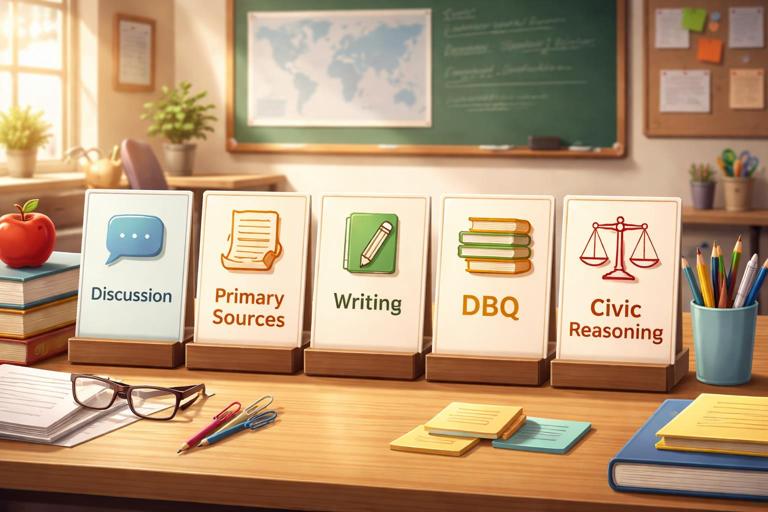
In practice, a humanities/social studies prompt pack is a small library of “ready-to-run” prompts grouped by teacher workflow: planning discussion and inquiry, preparing primary-source work, supporting writing and argumentation, building document-based tasks, and creating materials for civic reasoning. Each prompt is written so you can paste in your specific content (a text excerpt, an image description, a set of sources, or a topic) and get outputs that match your classroom needs.
Design Principles Unique to Humanities and Social Studies Prompt Packs
1) Evidence is not optional
Humanities outputs should be anchored in evidence from provided texts, excerpts, or source summaries. Your prompt pack should repeatedly instruct the AI to quote or reference only what you provide, and to label each claim with the supporting evidence. This helps students see the difference between interpretation and invention.
2) Perspective and context are part of the answer
In social studies, “what happened” is rarely enough. Students must consider who is speaking, for whom, under what conditions, and with what incentives. Prompts should routinely ask for point of view, intended audience, purpose, and historical/cultural context—without turning into a generic checklist. The pack should also support comparing perspectives across groups and time.
3) Claims must be arguable and bounded
Humanities writing often fails when prompts produce claims that are too broad (“War is bad”) or too factual (“The law was passed in 1965”). Your prompt pack should generate thesis statements that are arguable, specific, and limited to the evidence set you provide.
- Listen to the audio with the screen off.
- Earn a certificate upon completion.
- Over 5000 courses for you to explore!

Download the app
4) Vocabulary and concepts are discipline-specific
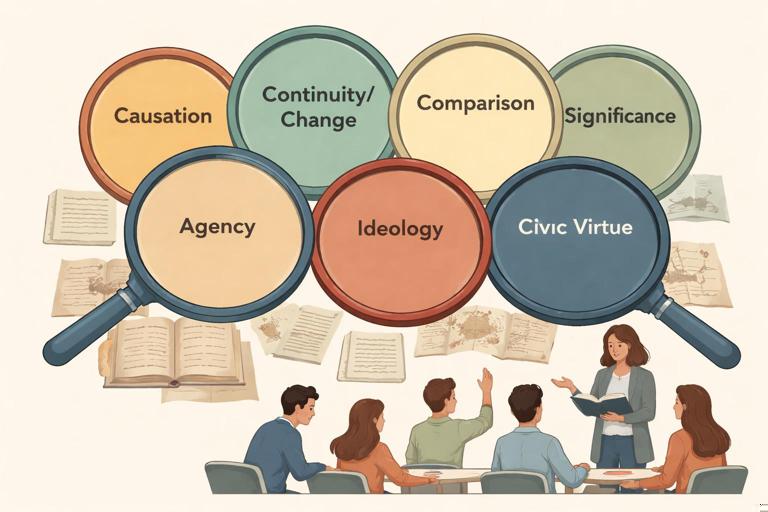
Humanities and social studies rely on concepts like continuity and change, causation, corroboration, significance, agency, ideology, and civic virtue. A prompt pack should embed these concepts as selectable “lenses” so you can quickly tailor tasks to the skill you are teaching.
How to Build and Use a Prompt Pack (Step-by-Step)
Step 1: Choose 6–10 recurring classroom tasks
Start by listing what you do repeatedly in humanities/social studies. Typical tasks include: creating discussion questions, preparing primary-source analysis guides, generating short writing prompts, building argument outlines, creating DBQ-style source sets (from sources you provide), designing role-play or structured academic controversy, and drafting feedback for claims and evidence.
Step 2: Create “slots” for what changes each time
Each prompt should have explicit placeholders you can fill in quickly. For example:
- [GRADE/LEVEL]
- [UNIT TOPIC]
- [TEXT/EXCERPT] (or [SOURCE SUMMARIES])
- [TARGET SKILL] (e.g., causation, sourcing, counterargument)
- [OUTPUT FORMAT] (table, bullets, paragraph frames)
Step 3: Decide the “lens” for thinking
Humanities tasks become clearer when you specify a lens. Build a short menu you can paste into prompts, such as: causation, continuity/change, comparison, significance, ethical reasoning, civic decision-making, or rhetorical analysis. Then instruct the AI to use only the chosen lens for the output.
Step 4: Standardize output formats
Prompt packs work best when outputs are predictable. Choose a few standard formats you like: a two-column chart (claim/evidence), a three-part paragraph frame (claim–evidence–reasoning), a timeline with cause/effect notes, or a “perspective matrix” comparing groups. Standard formats reduce your editing time and help students recognize patterns.
Step 5: Save prompts with names and “when to use” notes
Store each prompt with a short label (e.g., “Primary Source Sourcing Guide,” “Counterclaim Builder,” “Seminar Question Ladder”) and a one-sentence note about when it’s useful. The goal is speed: you should be able to pick the right prompt in seconds.
Prompt Pack: Primary Source Analysis and Document Work
Prompt 1: Sourcing and Context Mini-Guide (for any excerpt)
Use this when you have a primary source excerpt and want a student-facing guide that teaches sourcing without giving away “the answer.”
Task: Create a student-facing sourcing guide for a primary source. Level: [GRADE/LEVEL]. Unit topic: [UNIT TOPIC]. Primary source excerpt: [TEXT/EXCERPT]. Output: (1) 5 sourcing questions (author, audience, purpose, context, limitations) written in student-friendly language; (2) a short “how to answer” hint for each question that points students back to the excerpt; (3) a 6–10 word sentence starter for each question; (4) do not add outside facts not in the excerpt.Prompt 2: Annotation Plan with Color-Coded Focus
Use this to turn a dense excerpt into an annotation routine aligned to a skill (bias, claims, evidence, rhetoric, or civic values).
Task: Build an annotation plan for the excerpt. Level: [GRADE/LEVEL]. Skill focus: [TARGET SKILL]. Excerpt: [TEXT/EXCERPT]. Output: (1) 4 annotation categories with “marking rules” (e.g., underline claims, circle loaded language); (2) a model of 3 annotated lines using bracketed tags like [CLAIM], [EVIDENCE], [BIAS]—use only words from the excerpt; (3) 3 follow-up questions that require citing specific phrases.Prompt 3: Corroboration Matrix (multiple sources)
Use this when students must compare sources for agreement, tension, and gaps.
Task: Create a corroboration matrix. Level: [GRADE/LEVEL]. Question: [INQUIRY QUESTION]. Sources (summaries or excerpts): [SOURCE A], [SOURCE B], [SOURCE C]... Output: a table with rows = sources and columns = (Main claim, Key evidence/quote, Perspective/interest, What it supports about the question, What it complicates, What we still need to know). Only use information from the provided sources.Prompt Pack: Discussion, Seminar, and Inquiry
Prompt 4: Question Ladder for Seminar (from accessible to advanced)
Use this to generate a sequence of questions that moves from comprehension to interpretation to evaluation, without repeating generic stems.
Task: Generate a seminar question ladder. Level: [GRADE/LEVEL]. Text(s) or topic: [TEXT/EXCERPT or TOPIC SUMMARY]. Lens: [CHOSEN LENS]. Output: 12 questions in 4 tiers (3 per tier): Tier 1 comprehension, Tier 2 interpretation, Tier 3 analysis using the lens, Tier 4 evaluation/decision. For each question, include (a) what students must cite (a phrase, a detail, a comparison), and (b) a likely misconception to watch for.Prompt 5: Structured Academic Controversy (SAC) Setup
Use this to create balanced, student-ready positions and evidence lists from sources you provide, especially for civic or policy questions.
Task: Create a Structured Academic Controversy packet. Level: [GRADE/LEVEL]. Central question: [CONTROVERSIAL QUESTION]. Sources provided: [SOURCE SUMMARIES/EXCERPTS]. Output: (1) Position A claim + 3 evidence points with citations to the provided sources; (2) Position B claim + 3 evidence points with citations; (3) 6 cross-examination questions that require evidence; (4) a “common ground” synthesis prompt; (5) do not introduce new facts beyond the sources.Prompt 6: Inquiry Arc Builder (questions only, not a full unit)
Use this when you want a tight set of inquiry questions that can guide a short investigation or mini-lesson sequence.
Task: Build an inquiry arc as questions only. Level: [GRADE/LEVEL]. Topic: [UNIT TOPIC]. Output: (1) one compelling question; (2) 4 supporting questions that build in complexity; (3) for each supporting question, list the type of evidence students should use (primary quote, statistic, map detail, law/policy excerpt, oral history); (4) include one question that explicitly asks for multiple perspectives.Prompt Pack: Argument Writing and Evidence-Based Responses
Prompt 7: Thesis Generator with Boundaries and Counterclaim
Use this to produce thesis options that are arguable and constrained to the evidence set you provide.
Task: Generate thesis options for an evidence-based response. Level: [GRADE/LEVEL]. Prompt/question: [WRITING PROMPT]. Evidence set (quotes or source notes): [EVIDENCE LIST]. Output: 5 thesis statements that (a) take a clear position, (b) preview 2–3 reasons, (c) include a built-in counterclaim phrase (e.g., “Although...”), and (d) do not rely on facts outside the evidence set.Prompt 8: Claim–Evidence–Reasoning Paragraph Frames (multiple levels)
Use this to support students who need structure while still requiring thinking.
Task: Create paragraph frames for claim–evidence–reasoning. Level: [GRADE/LEVEL]. Question: [WRITING PROMPT]. Evidence available: [EVIDENCE LIST]. Output: (1) a basic frame with sentence starters; (2) an intermediate frame that adds sourcing language (“According to...,” “This suggests...”); (3) an advanced frame that adds a counterclaim sentence and rebuttal sentence; (4) include a short checklist of what must be cited.Prompt 9: Revision Coach for Specific Moves (not generic editing)
Use this when you want targeted revision suggestions tied to argument quality rather than grammar-only feedback.
Task: Act as a revision coach for argument quality. Level: [GRADE/LEVEL]. Student paragraph: [STUDENT TEXT]. Allowed evidence (quotes/notes): [EVIDENCE LIST]. Focus moves: [choose 2: clearer claim, stronger evidence integration, reasoning explanation, counterclaim, sourcing language]. Output: (1) identify 2 strengths; (2) identify 2 high-impact revisions; (3) rewrite only one sentence as a model, using evidence from the allowed list; (4) ask the student 2 questions that would help them improve; (5) do not add new factual content.Prompt Pack: Media Literacy, Civic Reasoning, and Contemporary Issues
Prompt 10: Source Reliability and Claim Testing (for articles, posts, or speeches)
Use this to help students evaluate credibility and separate claims from evidence, especially with modern media.
Task: Create a claim-testing guide for a media text. Level: [GRADE/LEVEL]. Media text (excerpt or summary): [TEXT/EXCERPT]. Output: (1) list 6 claims made or implied; (2) for each claim, label it as fact-claim, value-claim, or policy-claim; (3) for each, suggest what evidence would verify it (data type, document type, expert testimony) without naming specific external sources; (4) identify loaded language and explain its effect using examples from the excerpt.Prompt 11: Civic Decision Memo (stakeholders, tradeoffs, recommendation)
Use this when students must make a recommendation and justify it with values and evidence.
Task: Draft a student-facing civic decision memo template. Level: [GRADE/LEVEL]. Issue: [CIVIC ISSUE]. Stakeholders to include: [LIST]. Evidence students have: [EVIDENCE LIST]. Output: a memo outline with headings: Background (2 sentences max), Stakeholders and concerns, Options (at least 3), Criteria/values (choose 3 and define them), Recommendation, Evidence citations, Tradeoffs and unintended consequences, Questions for further research. Do not fill in the memo with new facts; provide sentence starters and placeholders.Prompt Pack: Culture, Literature-in-Context, and Visual/Material Analysis
Prompt 12: Rhetorical and Cultural Analysis (speech, letter, manifesto, poem)
Use this to connect language choices to purpose and audience while staying grounded in the text.
Task: Create a rhetorical analysis guide. Level: [GRADE/LEVEL]. Text: [TEXT/EXCERPT]. Output: (1) identify 3 rhetorical moves (e.g., repetition, contrast, appeals) using direct quotes; (2) explain the likely purpose and intended audience supported by quoted evidence; (3) provide 5 short-answer questions that require quoting; (4) provide a paragraph frame for a rhetorical analysis response.Prompt 13: Visual or Artifact Analysis (image described in words)
Use this when you have an image, poster, political cartoon, photograph, or artifact and want a structured analysis without needing the AI to “see” the image. You provide a description.
Task: Create an artifact analysis worksheet. Level: [GRADE/LEVEL]. Artifact description: [DETAILED DESCRIPTION YOU PROVIDE]. Lens: [CHOSEN LENS]. Output: (1) observation list prompts (what you can literally see); (2) interpretation prompts (what it might mean) tied to the lens; (3) 3 questions about creator, audience, and purpose; (4) one prompt asking what additional information would confirm the interpretation; (5) a short writing prompt requiring claim + 2 observed details as evidence.How to Customize a Prompt Pack for Different Humanities Courses
World/Regional History
Emphasize causation, continuity and change, and comparison. Add placeholders for time period and region, and include prompts that require students to distinguish short-term triggers from long-term conditions. When you paste sources, include at least one prompt that forces corroboration across different types (law code excerpt, traveler account, economic data summary).
Civics/Government
Emphasize decision-making, stakeholder analysis, constitutional principles, and policy tradeoffs. Your pack should include memo templates, hearing questions, and argument prompts that separate value claims from policy claims. Include a recurring requirement that students define criteria (fairness, liberty, safety, efficiency) before recommending an action.
Geography and Human-Environment Topics
Emphasize spatial reasoning and evidence from maps, charts, and place-based descriptions. Add placeholders like [MAP DESCRIPTION], [DATA SUMMARY], and [REGION CHARACTERISTICS]. Use prompts that ask students to connect patterns (migration, settlement, trade) to constraints and opportunities.
Ethnic Studies and Cultural Studies
Emphasize perspective, identity, power, and narrative. Include prompts that compare dominant and marginalized viewpoints using provided texts. Add a “language care” placeholder for terms students should use (or avoid) and a prompt that asks students to distinguish between describing a perspective and endorsing it.
Classroom Implementation: A Practical Workflow for a New Unit
Workflow A: Building a document set activity in 20 minutes
1) Choose your inquiry question. 2) Paste 2–4 short excerpts or source summaries. 3) Run Prompt 1 (sourcing guide) for each excerpt. 4) Run Prompt 3 (corroboration matrix) across all sources. 5) Run Prompt 7 (thesis generator) using only the evidence you provided. 6) Select one thesis and pair it with Prompt 8 (paragraph frames) to create the writing task. This sequence produces a coherent student experience: source work leads directly into argument writing.
Workflow B: Preparing a discussion that produces usable writing
1) Paste the central excerpt or topic summary. 2) Run Prompt 4 (question ladder) with your chosen lens. 3) Choose 4–6 questions: two from Tier 2, two from Tier 3, one from Tier 4. 4) After discussion, assign a short response using Prompt 8’s intermediate or advanced frame. This keeps discussion from becoming “talking” and turns it into evidence-based thinking students can write.
Workflow C: Teaching media literacy with contemporary texts
1) Paste a short article excerpt or a transcript segment. 2) Run Prompt 10 (claim testing). 3) Have students pick two claims and list what evidence would verify them. 4) Use Prompt 11 (civic decision memo template) if the text implies a policy choice. This sequence helps students practice skepticism and reasoning without requiring you to provide a full research packet.
Mini Library: Copy-and-Paste Placeholder Blocks
Evidence block (for quick pasting)
[EVIDENCE LIST] = Quote 1 (Source A): “...” | Quote 2 (Source B): “...” | Note (Source C): ...Source summary block (when excerpts are too long)
[SOURCE SUMMARIES] = Source A: author/date/type + 2–3 sentence summary; Source B: ...Lens menu (choose one)
[CHOSEN LENS] = causation | continuity/change | comparison | significance | ethical reasoning | civic decision-making | rhetorical analysis