What a “Science Prompt Pack” Is (and Why It’s Different)
A subject-specific prompt pack is a curated set of reusable prompts designed for recurring teaching tasks in one discipline. In science, prompt packs work best when they are built around scientific practices: asking testable questions, modeling systems, analyzing data, constructing explanations, and arguing from evidence. That focus makes science prompt packs different from generic “make a worksheet” prompts. A science pack should reliably produce outputs that preserve scientific reasoning, respect units and uncertainty, and keep claims tied to evidence.
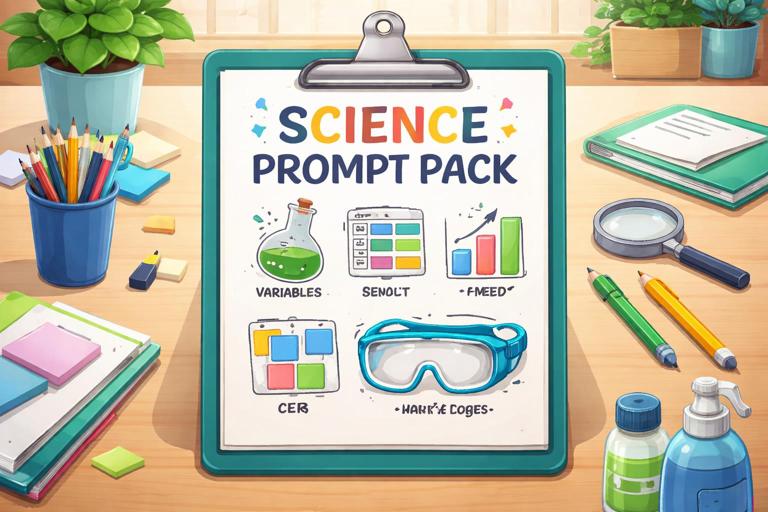
Think of a science prompt pack as a small toolkit you can copy, paste, and lightly edit. Each prompt is written to generate a specific type of classroom artifact: a phenomenon-based warm-up, a lab plan, a data table template, a graphing task, an error analysis, or a claim-evidence-reasoning (CER) writing frame. The goal is speed and consistency: you spend your time choosing the right scientific idea and classroom context, not rewriting instructions every time.
Core Design Principles for Science Prompt Packs
1) Anchor outputs in phenomena and mechanisms
Science learning is strongest when students explain how and why something happens. Prompts should request mechanism-based explanations (particle interactions, forces, energy transfer, cellular processes, feedback loops) rather than lists of facts. When you ask the AI for materials, questions, or feedback, include the phenomenon and the mechanism you want students to use.
2) Require measurable variables and operational definitions
Many science tasks hinge on defining variables clearly. Your prompts should explicitly request independent/dependent variables, controls, constants, and how each variable will be measured (tools, units, sampling frequency). This prevents vague “do an experiment” outputs.
3) Build in units, uncertainty, and data quality
Science prompt packs should routinely ask for units, significant figures expectations (when appropriate), measurement uncertainty, and common sources of error. Even in middle school, you can ask for “likely measurement errors and how to reduce them.” This keeps AI-generated labs and data tasks realistic.
- Listen to the audio with the screen off.
- Earn a certificate upon completion.
- Over 5000 courses for you to explore!

Download the app
4) Separate observation, inference, and explanation
Students often blur what they saw with what they think it means. Prompts can enforce structure: “Provide observation statements, then inferences, then a mechanism-based explanation.” This is especially useful for lab write-ups and discussion prompts.
5) Include safety and feasibility checks
Science activities must be safe and classroom-feasible. Your pack should include prompts that force the AI to propose safe materials, identify hazards, and provide alternatives. For example: “No open flames, no hazardous chemicals, no animal dissection, and materials must be available in a typical classroom.”
How to Build Your Science Prompt Pack (Step-by-Step)
Step 1: Choose your “repeatable tasks”
List the science tasks you do repeatedly. Common categories include: phenomenon introductions, inquiry questions, lab planning, data analysis, graph interpretation, CER writing, vocabulary in context, model-building, and review questions that emphasize reasoning. Pick 8–12 tasks to start; you can expand later.
Step 2: Create a consistent input form
Make each prompt begin with a short “teacher input” block so you can quickly customize it. For science, useful inputs include: grade band, topic, phenomenon, key mechanism, available materials, time, constraints (no flames, limited sensors), and what students already know. Keeping the same inputs across prompts makes the pack easy to use.
Step 3: Decide the output format you want every time
Science outputs are easier to use when they follow a predictable structure. For example, a lab plan could always include: question, hypothesis, variables, materials, procedure, data table, safety notes, analysis questions, and extension. A data analysis task could always include: dataset, graphing instructions, guiding questions, and an answer key with reasoning.
Step 4: Add “science quality constraints”
Include constraints that prevent common AI mistakes: require units, avoid impossible equipment, avoid claiming certainty without data, and keep explanations at the right level (particle model vs. molecular biology vs. calculus-based physics). These constraints are what make the pack “science-grade.”
Step 5: Store prompts as named templates
Name each prompt by task and unit, such as “SCI-PHENOMENON-WARMUP,” “SCI-LAB-PLAN,” or “SCI-CER-FEEDBACK.” Keep them in a document you can search quickly. The value of a pack is retrieval speed.
Prompt Pack Templates for Science (Copy/Paste Ready)
Template A: Phenomenon-Based Warm-Up (5–10 minutes)
Use this to start a lesson with a puzzling observation and questions that lead into the target mechanism.
Role: You are a science teacher creating a phenomenon-based warm-up. Task: Create a 5–10 minute warm-up that sparks curiosity and leads into the target mechanism. Teacher inputs: Grade band: [ ] Topic: [ ] Phenomenon students can observe or watch in a short clip: [ ] Target mechanism/model to build: [ ] Prior knowledge students have: [ ] Constraints: no controversial topics; classroom-safe; no specialized equipment. Output format: 1) Phenomenon description (2–3 sentences) 2) “Notice/Wonder” prompts (6–8) 3) 3 guiding questions that progress from observation to mechanism 4) Likely student ideas/misconceptions (4–6) 5) Teacher move: one follow-up question for each misconception.Example teacher inputs: Grade band: 8 Topic: Thermal energy Phenomenon: A metal spoon feels colder than a wooden spoon in the same room Target mechanism: Heat transfer and thermal conductivity Prior knowledge: Particles move faster when warmer; heat moves from warm to cool.
Template B: Testable Question and Hypothesis Generator
Use this when students need help turning curiosity into a testable investigation with measurable variables.
Role: You are a science coach for student investigations. Task: Turn a broad curiosity into testable questions and hypotheses. Teacher inputs: Grade band: [ ] Broad topic/curiosity: [ ] Materials available: [ ] Time available: [ ] Measurement tools available (ruler, stopwatch, thermometer, scale, pH strips, etc.): [ ] Safety constraints: [ ] Output format: 1) 5 testable questions 2) For each: independent variable, dependent variable, constants, and how to measure the dependent variable (units) 3) A sample hypothesis for each question written as “If…, then…, because…” 4) One note on feasibility or safety for each.Practical use: Paste student “wonderings” into the broad topic field and let the AI propose measurable versions you can approve or revise.
Template C: Classroom-Safe Lab Plan (Investigation Blueprint)
Use this to generate a complete lab plan that you can adapt to your materials and time.
Role: You are a science teacher writing a classroom-safe investigation. Task: Create a lab plan that tests a relationship between variables and supports evidence-based conclusions. Teacher inputs: Grade band: [ ] Unit/topic: [ ] Research question: [ ] Target concept: [ ] Materials available: [ ] Time: [ ] Student grouping: [ ] Constraints: no open flames; no hazardous chemicals; no food tasting; include safety notes; use realistic measurements. Output format: 1) Purpose and question 2) Background (3–5 sentences at grade level) 3) Variables (IV, DV, controls/constants) 4) Materials list 5) Procedure (numbered steps) 6) Data table template with units 7) Graphing instructions (what type of graph and axes labels) 8) Analysis questions (6–8, including one about error/uncertainty) 9) Expected results pattern (not exact numbers) 10) Cleanup and safety checklist.Tip: If you teach multiple sections, keep the same lab plan but change the phenomenon context (sports, weather, cooking, engineering) to maintain engagement without rewriting the whole activity.
Template D: Data Set + Analysis Questions (No Lab Needed)
Use this when you want students to practice analysis without running an experiment. This is especially useful for limited time, limited equipment, or remote learning days.
Role: You are a science teacher creating a data analysis task. Task: Provide a realistic dataset and questions that require interpretation and reasoning. Teacher inputs: Grade band: [ ] Topic: [ ] Context (real-world scenario): [ ] Variables and units: [ ] Desired graph type: [ ] Include uncertainty? (yes/no): [ ] Output format: 1) Short scenario (4–6 sentences) 2) Data table with 12–20 data points (include units; include 1–2 anomalies) 3) Student directions for graphing 4) 8–10 analysis questions (trend, rate, comparison, anomaly explanation, claim with evidence) 5) Teacher key with reasoning and notes on common mistakes.Science-specific quality check: Ask for anomalies on purpose so students must think about measurement error, uncontrolled variables, or data entry mistakes.
Template E: CER Writing Frame + Exemplars at Two Levels
Use this to support scientific writing while keeping the focus on evidence and reasoning.
Role: You are a science writing coach. Task: Create a CER prompt and supports for students. Teacher inputs: Grade band: [ ] Phenomenon or investigation summary: [ ] Data/evidence students have (brief): [ ] Target concept/mechanism: [ ] Vocabulary to include (optional): [ ] Output format: 1) CER question 2) Sentence starters for Claim, Evidence, Reasoning 3) Checklist for strong CER (6–8 items) 4) Two exemplar responses: one “developing” and one “proficient” (both accurate; proficient has stronger reasoning) 5) 3 feedback comments you would give a student whose reasoning is incomplete.Note: Request that both exemplars remain scientifically accurate; the “developing” version should be shorter or less connected, not wrong.
Template F: Model-Building Task (Diagram + Explanation)
Use this to generate modeling prompts that require students to represent systems and explain interactions.
Role: You are a science teacher designing a modeling task. Task: Create a model-building activity that helps students explain a system. Teacher inputs: Grade band: [ ] Topic/system: [ ] Phenomenon the model should explain: [ ] Required components (e.g., particles, forces, organs, reservoirs): [ ] Required interactions (e.g., energy transfer, matter cycling): [ ] Output format: 1) Student prompt with clear modeling goal 2) Required labels and arrows (list) 3) 5 guiding questions that connect model parts to the phenomenon 4) A “model revision” prompt after new evidence 5) Teacher notes: common incomplete models and how to probe.Practical classroom move: Have students build an initial model, then revise after a short reading, demo, or dataset. The prompt’s “revision” section makes that routine easy.
Template G: Scientific Argumentation (Claim–Evidence–Reasoning–Rebuttal)
Use this for structured debate and to practice evaluating competing explanations.
Role: You are a science teacher facilitating argument from evidence. Task: Create an argumentation task with two competing claims and evidence students must evaluate. Teacher inputs: Grade band: [ ] Topic: [ ] Phenomenon/question: [ ] What evidence sources are allowed (lab data, provided dataset, short text): [ ] Output format: 1) Two plausible claims (both initially believable) 2) Evidence set (data snippets or short statements) that supports one claim more strongly 3) Student directions: choose a claim, justify with evidence, explain reasoning, and rebut the alternative 4) Discussion norms and sentence frames 5) Teacher key: which claim is better supported and why; likely rebuttals.Science-specific guardrail: Ask for “plausible but incomplete” alternative claims rather than obviously wrong ones, so students must reason carefully.
Template H: Error Analysis and Method Improvement
Use this after labs or data tasks to deepen thinking about reliability and validity.
Role: You are a science teacher focusing on experimental design and data quality. Task: Create an error analysis activity based on a described investigation. Teacher inputs: Grade band: [ ] Investigation summary (what students did): [ ] Measurements taken (units): [ ] Common issues observed (optional): [ ] Output format: 1) 6–8 prompts that distinguish random vs. systematic error 2) Identify 5 likely sources of error (measurement, procedure, control variables) 3) For each error: how it affects results (direction or variability) 4) 5 concrete method improvements students could implement next time 5) A short reflection prompt: “What would you trust about your results and why?”This template is especially useful when results are messy. It turns “the lab didn’t work” into a scientific conversation about evidence quality.
How to Organize Prompt Packs by Science Domain
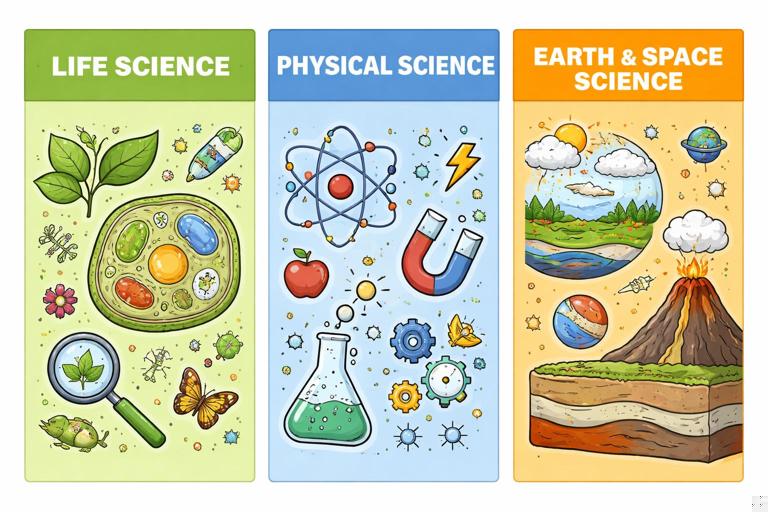
Life science pack: systems, structure–function, and regulation
Life science prompts should emphasize structure–function relationships, homeostasis, and cause-and-effect in systems. Add domain-specific inputs such as: level of organization (cell, organ, organism, ecosystem), key variables (population size, resource availability), and constraints (no live animal experiments). Useful pack add-ons include: “food web modeling prompt,” “enzyme activity dataset prompt,” and “cell transport analogy critique prompt” that asks students to evaluate where an analogy breaks down.
Physical science pack: energy, forces, and particle models
Physical science prompts benefit from explicit unit requirements and clear variable definitions. Add inputs like: expected mathematical level (proportional reasoning vs. linear relationships), measurement tools, and whether friction/air resistance should be included or ignored. Useful add-ons include: “free-body diagram practice set,” “energy bar chart prompt,” and “particle model explanation prompt” that forces students to connect macroscopic observations to microscopic interactions.
Earth and space science pack: cycles, scale, and evidence over time
Earth and space science often involves large scales, indirect evidence, and time-based processes. Add inputs like: spatial scale (local watershed vs. global circulation), time scale (days vs. millions of years), and evidence types (rock layers, satellite data, temperature records). Useful add-ons include: “interpret a climate graph prompt,” “watershed runoff investigation prompt,” and “hazard mitigation scenario prompt” that asks students to justify a plan using evidence and constraints.
Classroom Workflows: Using the Pack Efficiently
Workflow 1: Phenomenon → Questions → Investigation
Start with Template A to generate a warm-up, then feed the best student “wonders” into Template B to produce testable questions. Choose one question and generate a lab plan with Template C. This workflow keeps coherence: the investigation grows naturally from the phenomenon rather than feeling like a disconnected activity.
Workflow 2: Investigation → Data → CER → Argumentation
After a lab (Template C), use Template H for error analysis, then Template E for CER writing. If you want a discussion day, convert the same evidence into Template G for argumentation. The pack helps you reuse the same core evidence across multiple scientific practices without reinventing materials.
Workflow 3: No-lab day data practice
Use Template D to generate a dataset aligned to your current topic, then follow with Template E for a short CER. This is a practical way to maintain science reasoning when time, weather, or materials prevent hands-on work.
Quality Checks Specific to Science Outputs
Check 1: Are variables measurable and realistic?
Scan for vague variables like “amount of heat” without a measurement plan. Replace with measurable proxies (temperature change in degrees, time to melt, mass change). Ensure tools match the classroom (thermometer vs. calorimeter).
Check 2: Are units consistent and appropriate?
Look for mixed units (grams and kilograms) or missing units. Require axis labels with units in graph tasks. If the prompt involves rates, ensure the output includes “per” units (cm/s, °C/min).
Check 3: Does the explanation match the intended mechanism?
AI may drift into unrelated explanations. If you want conduction, it might mention “coldness moving.” Your prompts should force the mechanism language you want (energy transfer, particle collisions). If needed, add a constraint: “Do not describe cold as a substance; describe energy transfer.”
Check 4: Are safety notes explicit?
Even simple labs can have hazards (glassware, hot water, allergens). Ensure the output includes safety steps and substitutions. If you cannot supervise a step safely, revise the procedure.
Check 5: Is the task scientifically honest about uncertainty?
For data tasks, include variability and occasional anomalies. For conclusions, avoid absolute certainty. Prompts that request “expected pattern” rather than “exact results” help keep outputs realistic.
Mini Pack Example: One Topic, Multiple Reusable Prompts (Thermal Energy)
Phenomenon warm-up prompt instance
Teacher inputs: Grade band: 8 Topic: Thermal energy Phenomenon: Metal vs. wood spoon feeling colder Target mechanism: Conduction and energy transfer Constraints: no specialized equipment. Output you should expect: notice/wonder prompts, guiding questions that move from sensation to energy transfer, and misconceptions like “metal is naturally colder.”

Investigation prompt instance
Teacher inputs: Research question: How does material type affect the rate of temperature change of an object placed in warm water? Materials: cups, warm water, thermometers, spoons of different materials, timer. Output you should expect: a controlled procedure, a data table with time and temperature (°C), and analysis questions about rate and sources of error (starting temperature differences, thermometer placement).
CER prompt instance
Teacher inputs: Evidence: temperature vs. time data for metal and plastic spoons. Target mechanism: particle collisions and conductivity. Output you should expect: a CER question that forces students to cite data points and explain why metal transfers energy faster, plus a proficient exemplar that links evidence to mechanism.