The course uses Python, Jupyter Notebooks, virtual environments, and Scikit-learn to build and test models.

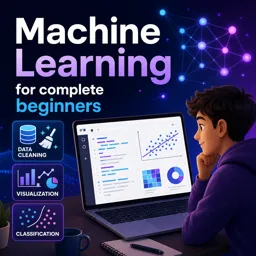
Duration of the online course: 1 hours and 9 minutes
4.6


(5)
Build real machine learning skills from scratch in a free online course: set up Python, clean data, visualize insights, and train regression models.
If you are curious about machine learning but feel blocked by jargon, this course is designed to get you moving fast, with clarity and confidence. You will start with a beginner-friendly explanation of what machine learning is, why it matters, and how it connects to the broader story of artificial intelligence. Instead of assuming a technical background, the lessons build intuition first, helping you recognize what problems ML can solve and what it cannot.
From there, you will shift into hands-on practice in Python with an environment that makes experimentation easy. You will learn how to prepare your tools, work comfortably in notebooks, and create a clean workflow so your projects stay organized. Just as important, you will develop the habit of thinking like a practitioner: define the goal, look at the data, and decide what approach fits before writing code.
As you work with real datasets, you will practice the steps that often determine whether a model succeeds: analyzing what the data actually contains, cleaning messy values, and making information visible through simple, effective visualizations. This approach helps you understand patterns instead of blindly training models, and it prepares you for everyday ML work where data quality and interpretation are everything.
You will then progress through core regression techniques, gaining a practical understanding of linear regression, correlation, and the tradeoffs that appear when the relationship between variables is not perfectly linear. You will also see how to move beyond basic assumptions using polynomial regression, and how to handle categories in a way that models can learn from. Along the way, you will rely on widely used libraries such as scikit-learn to implement models with best practices.
Finally, you will learn how classification differs from prediction of numeric values by stepping into logistic regression. You will prepare data for classification, understand why evaluation can be tricky with imbalanced datasets, and use tools like ROC curves to interpret model performance more thoughtfully. By the end, you will be able to follow the full beginner workflow: set up your environment, explore and prepare data, choose an approach, train a model, and evaluate results with confidence.
Explore the best free online machine learning courses with certificates and build job-ready AI skills at your own pace. Learn supervised and unsupervised learning, neural networks, data analysis, Python, and real-world model development through beginner-friendly and advanced classes from trusted learning platforms.

Explore the best free online Data Science courses and build job-ready skills in Python, statistics, machine learning, data analysis, and visualization. Learn at your own pace with beginner-friendly lessons, practical projects, and expert guidance. Enroll today in free Data Science courses with a certificate and advance your career.

1 hours and 9 minutes of online video course

Digital certificate of course completion (Free)

Exercises to train your knowledge

100% free, from content to certificate
What tools are used to build the first machine learning models in this course?
The course uses Python, Jupyter Notebooks, virtual environments, and Scikit-learn to build and test models.
What machine learning projects are covered in the course?
You will work with diabetes and pumpkin datasets to practice linear regression, polynomial regression, data cleaning, visualization, and classification.
How does the course explain logistic regression and ROC curves?
It shows how logistic regression classifies data, prepares categorical features, evaluates imbalanced datasets, and uses ROC curves to assess model performance.
Ready to get started?Download the app and get started today.
Install the app now
to access the course
Over 5,000 free courses
Programming, English, Digital Marketing and much more! Learn whatever you want, for free.

Study plan with AI
Our app's Artificial Intelligence can create a study schedule for the course you choose.

From zero to professional success
Improve your resume with our free Certificate and then use our Artificial Intelligence to find your dream job.
You can also use the QR Code or the links below.



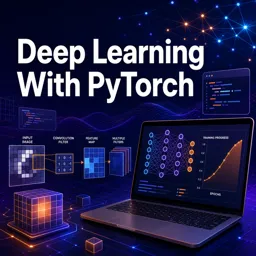
Free CourseDeep Learning With PyTorch
5
(6)

3h39m

19 exercises
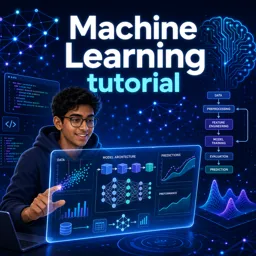
Free CourseMachine Learning tutorial
5
(2)
10h20m
6 exercises
Free CourseGoogle Prompting Essentials
4.8
(5)
3h24m
10 exercises
Free CourseData Science
4.8
(4)
5h58m
38 exercises
Free CourseArtificial intelligence
4.7
(69)
12h40m
7 exercises
Free CourseFundamentals of Artificial Intelligence
4.6
(11)
25h26m
34 exercises
Free CourseGenerative AI
4.6
(5)
1h43m
11 exercises
Free CourseArtificial Intelligence Masterclass: Search, Logic, Machine Learning and Deep Learning
4.6
(9)
31h57m
57 exercises
Free CourseGoogle AI Essentials
4.5
(17)
3h40m
13 exercises
Free CourseR programming for Data Science
4.5
(6)
1h07m
6 exercises
Carry knowledge in your pocket.
Download the Cursa app.
There are hundreds of free courses available, with a free certificate of completion that is saved in your mobile image gallery.
Download the app to access the Course Completion Certificate for Free.


+ 10 million
students

Free and Valid
Certificate

60 thousand free
exercises

4.8/5 rating in
app stores

Free courses in
video and ebooks