
Free ebook on cognitive biases, mental shortcuts, and practical ways to make clearer decisions in work, money, relationships, and media.
Free ebook content
-

Cognitive Biases 101: How Biases Shape Everyday Decisions
+ Exercise: In the four-step decision loop (inputs → interpretation → choice → outcome), which action best targets the interpretation step to reduce bias?
-
Recognizing Your Mind’s Shortcuts: Patterns Behind Cognitive Biases
+ Exercise: Which situation best illustrates an identity-driven mental shortcut rather than speed, emotion, or social proof?


-
Confirmation Bias: Seeing What You Expect to See
+ Exercise: Which response best reduces confirmation bias when you suspect a teammate is unreliable based on mixed performance signals?
-
Availability Heuristic: When Vivid Examples Feel Like Facts
+ Exercise: Which approach best counters the availability heuristic when a vivid story makes a risk feel common?
-
Anchoring: How First Numbers and First Impressions Pull Decisions
+ Exercise: Which approach best reduces the influence of an employer’s first salary offer during a negotiation?
-
Sunk Cost and Escalation: Why It’s Hard to Let Go
+ Exercise: When using the Decision Reset Method, which approach best prevents the sunk cost fallacy from driving your next choice?
-
Overconfidence and Calibration: When Certainty Outruns Accuracy
+ Exercise: In the calibration drill, what does it indicate if your 80% confidence ranges contain the true outcome only 4 out of 10 times?
-
Framing, Loss Aversion, and Reference Points in Money and Choices
+ Exercise: Which approach best helps neutralize framing effects when evaluating a subscription advertised as “only $9.99/month”?
-
Social and Identity Biases: How Groups and Self-Image Steer Judgment
+ Exercise: In a team meeting, a senior leader proposes a plan and everyone quickly agrees, partly because disagreeing feels disloyal and contrary data seems like an attack on "who we are." Which structured approach best reduces these pressures?
-
Biases in Relationships: Assumptions, Attribution, and Misread Signals
+ Exercise: In the “Check the story” method, what is the best next step after noticing a partner’s behavior that upsets you?
-
Biases at Work: Hiring, Meetings, Performance, and Strategy Decisions
+ Exercise: A team notices that meeting decisions often depend on who speaks first and how persuasive they sound. Which change best makes the judgment more auditable and less driven by charisma or timing?
-
Biases in Money and Consumer Choices: Spending, Investing, and Subscriptions
+ Exercise: When reviewing recurring subscriptions, which action best reduces the mistake of treating each one as “only $9.99” and ignoring the bigger impact?
-
Media, Misinformation, and Fast Takes: Avoiding Bias-Driven Sharing
+ Exercise: After seeing an emotionally charged post with a dramatic statistic and a personal anecdote, what is the best next step before sharing it?
About the free ebook
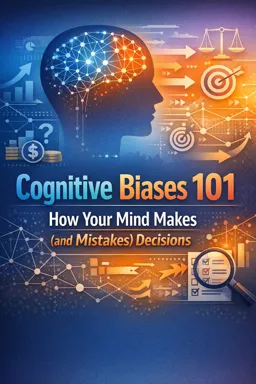
Cognitive Biases 101: How Your Mind Makes (and Mistakes) Decisions
This free ebook explores the mental shortcuts that help people make fast judgments—and the predictable errors those shortcuts can create. Cognitive biases affect how we interpret information, estimate risk, remember events, spend money, evaluate others, and make choices every day.
Understand the patterns behind biased thinking
Learn how confirmation bias can make expected evidence seem more convincing, why vivid stories can distort perceptions of likelihood, and how first impressions or numbers can become powerful anchors. The ebook also examines sunk costs, overconfidence, framing effects, loss aversion, and social influences on judgment.
Apply psychology to real decisions
Clear everyday examples connect cognitive biases to relationships, workplace decisions, media habits, consumer choices, and financial thinking. Rather than treating bias as a personal flaw, this ebook shows how these patterns arise from normal features of human cognition.
Build more thoughtful decision habits
Practical debiasing tools help you pause before reacting, seek disconfirming evidence, compare alternatives, define decision criteria, and review outcomes. Use simple checklists and decision journals to make assumptions more visible and improve judgment over time.
What you will gain
- A practical vocabulary for recognizing common cognitive biases
- Examples of how biases influence personal and professional choices
- Strategies for questioning first impressions and confident predictions
- Tools for making more deliberate, evidence-aware decisions
What is confirmation bias and how can I spot it?
Confirmation bias is the tendency to favor information that supports existing beliefs. Look for ignored counterevidence or one-sided searches.
Why does the sunk cost fallacy make decisions difficult?
Past time, money, or effort can feel like a reason to continue, even when the best future choice is to stop or change course.
How can a decision journal reduce cognitive bias?
It records your assumptions, predictions, and reasons before outcomes are known, making it easier to review and improve your judgment.
This ebook includes:

14 content chapters

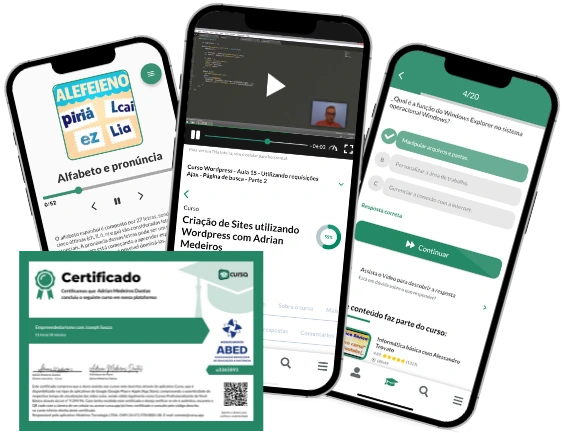
Digital certificate of course completion (Free)

Exercises to train your knowledge

100% free, from content to certificate
Ready to get started?

 recommended
In the app you will also find...

Over 5,000 free courses
Programming, English, Digital Marketing and much more! Learn whatever you want, for free.

Study plan with AI
Our app's Artificial Intelligence can create a study schedule for the course you choose.

From zero to professional success
Improve your resume with our free Certificate and then use our Artificial Intelligence to find your dream job.
You can also use the QR Code or the links below.