
Sublimation is the process of redirecting primitive or destructive impulses into socially valuable and constructive activities.

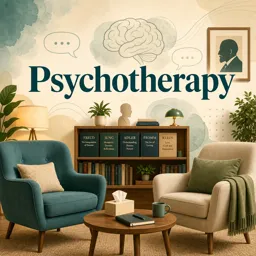
Duration of the online course: 1 hours and 2 minutes
4.5


(8)
Build insight into human behavior with a free psychotherapy course—learn key psychoanalytic ideas, boost self-awareness, and earn a certificate to showcase skills.
Understanding psychotherapy means understanding how people change. This free online course invites you into the central questions that have shaped modern psychology: Why do we repeat patterns that hurt us? What motivates our choices beyond what we can easily explain? And how do relationships, childhood experiences, and inner conflict shape the way we love, work, cope, and grow?
Through an accessible tour of major thinkers, you will explore psychotherapy as more than a set of techniques. You will see it as a structured way of listening, making meaning, and reducing suffering by bringing hidden assumptions and emotional dynamics into awareness. The learning experience balances big ideas with practical reflection, helping you connect foundational concepts to everyday life—your own and the lives of others.
The course introduces key psychoanalytic perspectives, including Freud’s view of the mind and the tension between immediate impulses and the demands of reality, as well as the transformative role of sublimation—how difficult or chaotic energies can be redirected into creative and socially constructive pathways. You will also encounter Anna Freud’s work on defence mechanisms and their protective purpose, and you will learn how these inner strategies can be both helpful and limiting depending on when and how they are used.
As the course moves forward, it broadens into approaches that emphasize development and relationships. You will reflect on early emotional life, attachment, and the environment that supports a stable sense of self. Ideas associated with Klein, Bowlby, and Winnicott deepen your understanding of maturity, bonding, and what makes a healthy individual—and, by extension, a healthier society. You will also consider Lacan’s account of how identity forms and why self-image can bring a persistent sense of mismatch between inner experience and outward presentation.
To ground theory in recognizable human concerns, the course revisits famous concepts with a modern lens, treating them as interpretive frameworks rather than rigid claims. It also highlights an influential alternative tool for studying the unconscious: Jung’s word association method, which approaches inner material differently from purely interpretive analysis. By the end, you will have a richer vocabulary for describing mental life, greater empathy for complexity, and a clearer map of psychotherapy’s most influential ideas—useful for students, professionals, and anyone investing in self-understanding.

1 hours and 2 minutes of online video course

Digital certificate of course completion (Free)

Exercises to train your knowledge

100% free, from content to certificate
What is Freud’s concept of sublimation in psychotherapy?
Sublimation is the process of redirecting primitive or destructive impulses into socially valuable and constructive activities.
What is the mirror stage in Jacques Lacan’s psychoanalysis?
The mirror stage is an early childhood moment when a child identifies with their reflected image, helping form the self while also creating potential alienation.
How did Carl Jung’s word association test explore the unconscious mind?
Jung measured a person’s response times and reactions to stimulus words to identify emotionally charged unconscious complexes.
Ready to get started?Download the app and get started today.
Install the app now
to access the course
Over 5,000 free courses
Programming, English, Digital Marketing and much more! Learn whatever you want, for free.

Study plan with AI
Our app's Artificial Intelligence can create a study schedule for the course you choose.

From zero to professional success
Improve your resume with our free Certificate and then use our Artificial Intelligence to find your dream job.
You can also use the QR Code or the links below.



Free CourseIntro to Psychology
5
(7)

3h28m

18 exercises
Free CourseIntroduction to Psychology Lecture Videos
5
(2)
16h21m
34 exercises
Free CourseThe Future of Neuromarketing
5
(1)
1h01m
6 exercises
Free CourseIntroduction to Psychology
4.9
(102)
18h43m
30 exercises
Free CourseIntroduction to Psychology
4.9
(7)
18h43m
20 exercises
Free CourseChild and Adolescent Mental Health
4.8
(26)
46m
21 exercises
Free CourseCognitive Psychology
4.8
(5)
21h18m
38 exercises
Free CoursePsychology Class
4.8
(127)
12h34m
22 exercises
Free CourseIntroduction to Psychology
4.7
(7)
24h28m
23 exercises

Free CourseFundamentals of Psychology
4.7
(10)
6h41m
34 exercises
Carry knowledge in your pocket.
Download the Cursa app.
There are hundreds of free courses available, with a free certificate of completion that is saved in your mobile image gallery.
Download the app to access the Course Completion Certificate for Free.


+ 10 million
students

Free and Valid
Certificate

60 thousand free
exercises

4.8/5 rating in
app stores

Free courses in
video and ebooks
Course comments: Psychotherapy
Mencen Zamora
very informative
my kids my show
love ❤️
Claudette Cobbins
I'd like to get in gear with other people and develop the best way to get in gear without feeling under pressure on myelaborating my thoughts properly