

Free ebook introducing neurons, synapses, emotion, stress, memory, and neuroplasticity through a clear, myth-aware neuroscience framework.
Free ebook content
-

Neuroscience for Beginners: Building a Clear Mental Model of the Brain
+ Exercise: In the input–processing–output model, what does the “test an alternative” step aim to do when you feel stressed or confused?
-
Neuroscience for Beginners: Neurons as Living Signal Builders
+ Exercise: Why do action potentials travel down an axon without fading, unlike the small voltage changes in dendrites?
-
Neuroscience for Beginners: Synapses and How Connections Shape Experience
+ Exercise: Why do neurons typically communicate across a synaptic cleft instead of directly touching?
-
Neuroscience for Beginners: Neurotransmitters Without the Myths
+ Exercise: Why does the idea “one neurotransmitter = one fixed feeling” fail?
-
Neuroscience for Beginners: Brain Regions as Team Roles in a Network
+ Exercise: In the “team roles” model, what is the most effective first step when you notice your performance is being disrupted by very high arousal right before speaking?


-
Neuroscience for Beginners: Attention and Working Memory as Limited Brain Resources
+ Exercise: Which situation best illustrates task-switching costs rather than true multitasking?
-
Neuroscience for Beginners: Emotion as Body–Brain Prediction and Meaning
+ Exercise: Which statement best describes how the brain constructs an emotion like anxiety or excitement from a racing heart?
-
Neuroscience for Beginners: Stress Systems and Why They Change Thinking
+ Exercise: Which outcome best describes how recovery shifts the brain after a period of high stress?
-
Neuroscience for Beginners: Neuroplasticity and How Brains Change With Experience
+ Exercise: Which situation best illustrates structural neuroplasticity rather than short-term tuning or synaptic weight changes?
-
Neuroscience for Beginners: Memory Systems From Moments to Skills
+ Exercise: A student says, “I definitely studied this, but during the test the short-answer questions didn’t trigger what I knew, even though the same topics looked familiar in multiple-choice practice.” Which explanation best fits this problem?
-
Neuroscience for Beginners: From Neurons to Thoughts—Putting It All Together
+ Exercise: In the tuning-and-network model of stress, what best explains why someone might "blank" on prepared points during a high-stakes presentation?
About the free ebook
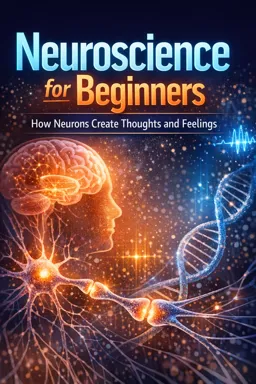
Neuroscience for Beginners: How Neurons Create Thoughts and Feelings
This free online ebook offers a clear, evidence-informed introduction to how the brain turns electrical and chemical activity into perception, memory, emotion, attention, and behavior. It replaces oversimplified “left brain/right brain” stories and neurotransmitter myths with a practical mental model of the nervous system as a changing network.
Understand the brain without unnecessary jargon
Learn how neurons receive, transform, and send signals, and why synapses matter for learning and experience. The ebook explains neural communication as a dynamic process: brain cells work together in circuits, while the body, environment, goals, and past experiences influence what those circuits do.
Rather than treating single brain regions or chemicals as isolated causes, this guide shows how networks, context, and prediction shape mental life. You will explore attention and working memory as limited resources, emotion as an interpretation of body–brain signals, and stress as a state that can alter focus, decisions, and recall.
Connect neuroscience to everyday experience
Memory is presented as more than a storage system: different memory processes help people remember events, facts, habits, and skills. Neuroplasticity is explained realistically, highlighting how experience can change the brain over time while avoiding promises of instant transformation.
A foundation for thoughtful learning
By connecting neurons, synapses, neurotransmitters, brain networks, stress, emotion, and memory, this ebook helps readers ask better questions about thoughts and feelings. It is educational material, not medical advice, diagnosis, or a substitute for professional mental health care.
How do neurons create thoughts and feelings?
Thoughts and feelings emerge from coordinated activity across neural networks, shaped by body signals, context, memory, and experience.
Are neurotransmitters responsible for specific emotions?
No. Neurotransmitters influence signaling in many circuits; emotions cannot be reduced to one chemical.
What does neuroplasticity mean in everyday life?
Neuroplasticity is the brain’s capacity to change with experience, practice, learning, injury, and environmental conditions.
This ebook includes:

11 content chapters

Digital certificate of course completion (Free)

Exercises to train your knowledge

100% free, from content to certificate
Ready to get started?

 recommended
In the app you will also find...

Over 5,000 free courses
Programming, English, Digital Marketing and much more! Learn whatever you want, for free.

Study plan with AI
Our app's Artificial Intelligence can create a study schedule for the course you choose.

From zero to professional success
Improve your resume with our free Certificate and then use our Artificial Intelligence to find your dream job.
You can also use the QR Code or the links below.