
Young people may show irritability, frequent physical complaints, withdrawal, declining school performance, or behavior changes rather than only persistent sadness.

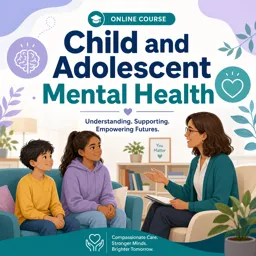
Duration of the online course: 46 minutes
4.8

(18)
Build skills to spot youth depression, anxiety and ADHD early. Take this free mental health course online and learn screening, referral and support.
Supporting children and adolescents starts with knowing what is typical, what is concerning, and what steps actually help. This course explores how common emotional and behavioral difficulties can be during development and why many young people struggle silently. You will learn to think in a practical, age-aware way about mental health, recognizing that stressors for children and teens often look different from those faced by adults, and that early identification can change long-term outcomes.
Throughout the lessons, the focus is on building confident clinical and caregiving judgment: how to notice patterns that signal risk, why routine screening matters, and how to respond when symptoms are mild versus when they indicate the need for specialist care. You will also examine real-world barriers that prevent families from accessing treatment, including limited services and stigma, and consider how these obstacles shape what support looks like in schools, clinics, and at home.
The course clarifies how depression and anxiety may present differently across ages, helping you move beyond stereotypes and recognize developmentally appropriate warning signs. You will become familiar with commonly used screening approaches and how they fit into responsible, compassionate care. Treatment is discussed in terms of what tends to work for young people, with special attention to therapeutic methods that target unhelpful patterns of thoughts, feelings, and behaviors, as well as strategies that reduce avoidance and build coping skills over time.
You will also learn how caregivers can meaningfully support therapy without trying to replace it, and how strong collaboration can improve consistency, motivation, and follow-through. The course addresses disruptive behavior disorders and ADHD with an emphasis on careful assessment, understanding the function of behavior, and choosing effective interventions. In particular, you will explore behavioral parent training and practical supports in educational settings that can improve daily functioning and reduce conflict.
Finally, the course highlights resilience as a protective force and explains how supportive relationships and stable environments can buffer risk. It also examines the link between parent mental health and child well-being, including the impact of parental burnout. By the end, you will have a clearer framework for screening, referral decisions, treatment-support strategies, and prevention-oriented thinking that strengthens outcomes for children, adolescents, and the families who care for them.

46 minutes of online video course

Digital certificate of course completion (Free)

Exercises to train your knowledge

100% free, from content to certificate
How does depression often look different in children and adolescents than in adults?
Young people may show irritability, frequent physical complaints, withdrawal, declining school performance, or behavior changes rather than only persistent sadness.
What screening tools are used for depression and anxiety in children and teens?
Clinicians may use age-appropriate questionnaires such as the Pediatric Symptom Checklist (PSC) and validated depression or anxiety screening measures, alongside clinical assessment.
When should a child with anxiety or depression symptoms be referred to a mental health specialist?
Referral should be considered when symptoms are persistent, worsening, impair daily functioning, involve safety concerns, or do not improve with initial support.
Ready to get started?Download the app and get started today.
Install the app now
to access the course
Over 5,000 free courses
Programming, English, Digital Marketing and much more! Learn whatever you want, for free.

Study plan with AI
Our app's Artificial Intelligence can create a study schedule for the course you choose.

From zero to professional success
Improve your resume with our free Certificate and then use our Artificial Intelligence to find your dream job.
You can also use the QR Code or the links below.



Free CourseIntro to Psychology
5
(7)

3h28m

18 exercises
Free CourseIntroduction to Psychology Lecture Videos
5
(2)
16h21m
34 exercises
Free CourseThe Future of Neuromarketing
5
(1)
1h01m
6 exercises
Free CourseIntroduction to Psychology
4.9
(102)
18h43m
30 exercises
Free CourseIntroduction to Psychology
4.9
(7)
18h43m
20 exercises
Free CourseCognitive Psychology
4.8
(5)
21h18m
38 exercises
Free CoursePsychology Class
4.8
(127)
12h34m
22 exercises
Free CourseIntroduction to Psychology
4.7

(7)
24h28m
23 exercises
Free CourseFundamentals of Psychology
4.7
(10)
6h41m
34 exercises
Free CourseIntroduction to Psychology
4.7
(15)
23h01m
23 exercises
Carry knowledge in your pocket.
Download the Cursa app.
There are hundreds of free courses available, with a free certificate of completion that is saved in your mobile image gallery.
Download the app to access the Course Completion Certificate for Free.


+ 10 million
students

Free and Valid
Certificate

60 thousand free
exercises

4.8/5 rating in
app stores

Free courses in
video and ebooks
Course comments: Child and Adolescent Mental Health
Nokwazi Mbanjwa
everything is explained and there's so much more to learn
Candis Swinney
Thank You