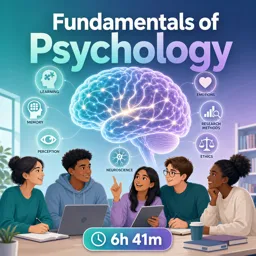
Free Course Image Fundamentals of Psychology

Free online courseFundamentals of Psychology

Duration of the online course: 6 hours and 41 minutes

5

StarStarStarStarStar

(2)

Explore the core concepts of psychology with this comprehensive free online course. Topics include research methods, brain structures, memory, learning, and psychological disorders.

In this free course, learn about

  • Foundations and Research Methods in Psychology
  • Biological Bases of Behavior and Consciousness
  • Sensation and Perception
  • Learning and Behavior
  • Memory and Cognition
  • Lifespan Development and Social Development
  • Motivation, Emotion, Stress, and Personality
  • Psychological Disorders and Their Treatment

Course Description

Welcome to the "Fundamentals of Psychology" course, an extensive and meticulously designed program. Exclusively categorized under Health, this course delves deep into the intriguing world of Psychology. With a total duration of 6 hours and 41 minutes, this comprehensive curriculum is your gateway to understanding the core principles and various branches of psychology.

The journey begins with an introduction to Psychology, setting the stage with foundational knowledge essential for deeper exploration. The course seamlessly transitions into Research Methods in Psychology, equipping you with the tools needed for scientific inquiry and understanding researcher biases that can influence study outcomes.

Grasping the concept of Statistical Analysis in Psychology is crucial, followed by an in-depth discourse on the Ethical Guidelines that govern psychological research. This ensures a solid grounding in both the methodology and ethical considerations crucial to the field.

The next segment intricately details the Endocrine System and Nervous System. The lessons on Action Potential in the Neuron and the role of Agonists further deepen your understanding. An exploration of Brain Structures, Split-Brain studies, and Neuroplasticity unveils the complexities of our neural architecture.

Your voyage continues through the fascinating realms of the Sleep Cycle and Dreams, elucidating how these states influence our daily lives. Sensory perception is another pivotal focus, covering the Human Eye and Ear, the Sense of Touch, and the cultural influences on perception.

The curriculum advances to Learning theories, including Classical and Operant Conditioning, and introduces the subtleties of Social Learning. An exploration of memory mechanics covers different Types of Memories, Retrieval processes, and the biological underpinnings of memory formation, delving into why we forget and how memories are biologically encoded.

Moving ahead, the course examines the evolution of intelligence, psychometric assessments, and cognitive biases. Key developmental stages are outlined — from childhood to adolescence, adulthood, and aging, emphasizing Social Development in childhood and Piaget’s Stages of Development.

Theories of motivation and emotion, including the Biopsychosocial Approach and renowned perspectives by Hans Selye, equip you to understand the driving forces behind human behavior. The comprehensive overview of personality theories spans Psychoanalytic, Behaviorism, Humanistic, and Trait theories, elucidating methods for measuring personality traits.

In its final stages, the course tackles Psychological Disorders, encompassing Neurodevelopmental Disorders, Bipolar Disorders, Anxiety, OCD, and more. A thorough review of treatment methods and biological perspectives on disorders rounds off your understanding of psychological well-being.

Join this unparalleled exploration of psychological fundamentals, designed for those eager to comprehend the intricacies of the human mind and behavior. While the course has not yet received reviews, its rich content promises a rewarding learning experience.

Course content

  • Video class: Introducing Psychology [AP Psychology Review Unit 1 Topic 1] 15m
  • Exercise: Which approach to psychology focuses on the influence of our biological makeup and processes on our behaviors and mental states?
  • Video class: Research Methods In Psychology [AP Psychology Review Unit 1 Topic 2] 07m
  • Exercise: What distinguishes experiments from other research methods in psychology?
  • Video class: Researcher Bias In Psychology [AP Psychology Review Unit 1 Topic 4] 04m
  • Exercise: What is an example of confirmation bias?
  • Video class: Statistical Analysis in Psychology [AP Psychology Review Unit 1 Topic 5] 08m
  • Exercise: Based on statistical analysis in psychology, which of the following statements is accurate?
  • Video class: Ethical Guidelines in Psychology [AP Psychology Review Unit 1 Topic 6] 03m
  • Exercise: What is the role of the Institutional Review Board (IRB) in psychological research?
  • Video class: The Endocrine System [AP Psychology Unit 2 Topic 2] 04m
  • Exercise: What is a key difference between the endocrine and nervous systems?
  • Video class: Nervous System 07m
  • Exercise: Which two main parts comprise the nervous system according to the provided text?
  • Video class: Action Potential In The Neuron [AP Psychology Unit 2 Topic 4] 10m
  • Exercise: What is the main role of sensory neurons in the nervous system?
  • Video class: Agonists 04m
  • Exercise: Which of the following is an agonist drug?
  • Video class: Brain Structures 14m
  • Exercise: Which structure in the brain is responsible for language comprehension and is located in the temporal lobe?
  • Video class: Split-Brain 07m
  • Exercise: Which neuroimaging technique involves injecting radioactive glucose to study brain activity?
  • Video class: Neuroplasticity 04m
  • Exercise: What is the concept referring to the brain's ability to change and adapt?
  • Video class: Sleep Cycle, Dreams 09m
  • Exercise: Which theory suggests dreams are our brain's attempt to make sense of random neural activity?
  • Video class: Sensation and Perception [AP Psychology Unit 3 Topic 1] 13m
  • Exercise: What is an example of the Gestalt principle of closure?
  • Video class: How Culture 07m
  • Exercise: What is Perceptual Constancy in Psychology?
  • Video class: The Human Eye 08m
  • Exercise: Which part of the eye is responsible for maintaining pressure within the eye and providing nourishment to the cornea and lens?
  • Video class: Top-Down 03m
  • Exercise: What is Top-Down Processing in Visual Perception?
  • Video class: The Human Ear 05m
  • Exercise: How does the ear process sound?
  • Video class: The Process Of Smelling 02m
  • Exercise: What is the term used for the sensation of taste?
  • Video class: Sensation of Touch, Layers of Skin 04m
  • Exercise: What is the primary function of the epididermis?
  • Video class: An Introduction To Learning [AP Psychology Unit 4 Topic 1] 06m
  • Video class: Classical Conditioning [AP Psychology Unit 4 Topic 2] 06m
  • Exercise: Which of the following is an example of stimulus generalization in the context of classical conditioning?
  • Video class: Operant Conditioning [AP Psychology Unit 4 Topic 3] 10m
  • Video class: Social 07m
  • Video class: Introduction to Memory [AP Psychology Unit 5 Topic 1] (5.1) 09m
  • Exercise: According to the introduction to memory video, what best illustrates the concept known as 'task switching'?
  • Video class: Memory 05m
  • Video class: Types of Memories 04m
  • Video class: Retrieving Memories [AP Psychology Unit 5 Topic 4] (5.4) 05m
  • Exercise: Which of the following is an example of recognition, as described in the video on memory retrieval?
  • Video class: Why Do We Forget Things? [AP Psychology Unit 5 Topic 5] (5.5) 07m
  • Video class: Biological Bases For Memory [AP Psychology Unit 5 Topic 6] (5.6) 03m
  • Video class: Different Ways Of Thinking 07m
  • Exercise: Which psychological concept is described as a mental framework that helps organize and understand the world around us, and is based on our past experiences?
  • Video class: How Biases and Errors in Thinking Occur [AP Psychology Unit 5 Topic 8] (5.8) 07m
  • Video class: The Evolution Of Intelligence [AP Psychology Unit 5 Topic 9] (5.9) 07m
  • Video class: Psychometric Principles 04m
  • Exercise: Which type of validity is concerned with the extent to which a test measures a specific trait or concept?
  • Video class: Children 06m
  • Video class: The Lifespan 04m
  • Video class: Social Development in Childhood [AP Psychology Unit 6 Topic 2] (6.2) 09m
  • Exercise: According to Harry Harlow's experiment with infant monkeys, what determines the bond between a child and their caregiver?
  • Video class: Piaget's Stages of Development 05m
  • Video class: Stages of Adolescent Development [AP Psychology Unit 6 Topic 4] (6.4) 06m
  • Video class: Adulthood and Aging [AP Psychology Unit 6 Topic 5] (6.5) 03m
  • Exercise: According to Erik Erikson's stages of psychosocial development, what is the primary focus during the 'Intimacy vs. Isolation' stage?
  • Video class: Lawrence Kohlberg 04m
  • Video class: Gender 05m
  • Video class: Theories of Motivation [AP Psychology Unit 7 Topic 1] (7.1) 12m
  • Exercise: Which of the following best represents an example of the overjustification effect?
  • Video class: Biopsychosocial Approach 04m
  • Video class: Theories of Emotion [AP Psychology Unit 7 Topic 3] (7.3) 05m
  • Video class: Hans Selye 05m
  • Exercise: According to the video, which of the following is NOT a stage in Hans Selye's General Adaptation Syndrome?
  • Video class: Different Theories of Personality [AP Psychology Unit 7 Topic 5] (7.5) 08m
  • Video class: Psychoanalytic Theories Of Personality [AP Psychology Unit 7 Topic 6] (7.6) 05m
  • Video class: Behaviorism 03m
  • Exercise: Which of the following best describes Julian Rotter's expectancy theory?
  • Video class: Humanistic Theories Of Personality [AP Psychology Unit 7 Topic 8] (7.8) 04m
  • Video class: Trait Theories of Personality [AP Psychology Unit 7 Topic 9] (7.9) 03m
  • Video class: Measuring Personality [AP Psychology Unit 7 Topic 10] (7.10) 03m
  • Exercise: Which type of personality assessment is designed to have limited answers and seeks certain responses from the individual taking the test?
  • Video class: Introduction to Psychological Disorders [AP Psychology Unit 8 Topic 1] 04m
  • Video class: Psychological Perspectives 05m
  • Video class: Nerodevelopmental Disorders [AP Psychology Unit 8 Topic 3] 04m
  • Exercise: Which of the following disorders is NOT classified as a neurodevelopmental disorder?
  • Video class: Bipolar, Depressive, Anxiety, OCD 06m
  • Video class: Stressor Related, Dissociative 05m
  • Video class: Anxiety, Personality 06m
  • Exercise: Which of the following personality disorders is characterized by a lack of conscience, impulsivity, aggressiveness, and a disregard for the safety of others, and is sometimes referred to as sociopathy?
  • Video class: Treatment of Psychological Disorders [AP Psychology Unit 8 Topic 7] 06m
  • Video class: Psychological Perspectives 09m
  • Video class: Biological Perspective of Disorders 04m
  • Exercise: What is considered a major form of biomedical treatment for psychological disorders as discussed in the text?
  • Video class: Evaluating Treatments of Disorders [AP Psychology Unit 8 Topic 10] 04m

This free course includes:

6 hours and 41 minutes of online video course

Digital certificate of course completion (Free)

Exercises to train your knowledge

100% free, from content to certificate

Ready to get started?Download the app and get started today.

Install the app now

to access the course
Icon representing technology and business courses

Over 5,000 free courses

Programming, English, Digital Marketing and much more! Learn whatever you want, for free.

Calendar icon with target representing study planning

Study plan with AI

Our app's Artificial Intelligence can create a study schedule for the course you choose.

Professional icon representing career and business

From zero to professional success

Improve your resume with our free Certificate and then use our Artificial Intelligence to find your dream job.

You can also use the QR Code or the links below.

QR Code - Download Cursa - Online Courses

Course comments: Fundamentals of Psychology

Tami Agosto

Mr. Sinn's delivery or voice kept me motivated and attentive. I could relate with a lot of the topics bc of myself and persons I know going through it

More free courses at Psychology

Download the App now to have access to + 3300 free courses, exercises, certificates and lots of content without paying anything!

  • 100% free online courses from start to finish

    Thousands of online courses in video, ebooks and audiobooks.

  • More than 48 thousand free exercises

    To test your knowledge during online courses

  • Valid free Digital Certificate with QR Code

    Generated directly from your cell phone's photo gallery and sent to your email

Cursa app on the ebook screen, the video course screen and the course exercises screen, plus the course completion certificate

+ 9 million
students

Free and Valid
Certificate

60 thousand free
exercises

4.8/5 rating in
app stores

Free courses in
video and ebooks