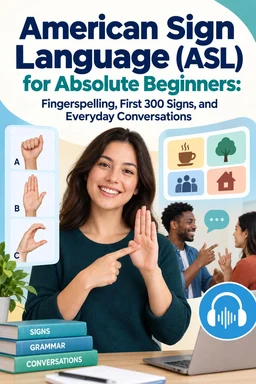


Free ebook: Learn American Sign Language from scratch. Fingerspelling, 300+ signs, grammar, and everyday conversations with audio narration.
Free ebook + audiobook content
-

What ASL Really Is: A Full Language and the Deaf Community Behind It
+ Exercise: Why does the chapter emphasize that ASL is a language rather than a code or system for English? 11 minutes
-
The Five Parameters of an ASL Sign: Handshape, Location, Movement, Orientation, and Face
+ Exercise: Why is it important that a signer maintains the same dominant hand throughout their signing, rather than switching between hands during a conversation? 9 minutes
-
The ASL Manual Alphabet: Fingerspelling Every Letter From A to Z
+ Exercise: When fingerspelling a word like 'coffee' that contains a double letter, why should a beginner avoid simply holding the handshape longer? 9 minutes
-
Reading Fast Fingerspelling in ASL: Rhythm, Double Letters, and When to Spell
+ Exercise: Why is watching the signer's face more helpful than watching their hand when reading fingerspelling? 11 minutes
-
ASL Numbers 1 to 100: Counting, Ages, and Phone Numbers
+ Exercise: When you sign a phone number, why should the numbers one through five face outward toward the person you are talking to, rather than inward toward yourself? 11 minutes


-
ASL Greetings and Courtesy: Hello, Thank You, and Introducing Yourself
+ Exercise: When introducing yourself in ASL, why is it important to point at your own chest when signing HEARING and LEARN SIGN? 10 minutes
-
ASL Pronouns and Pointing: Talking About People and Setting Them in Space
+ Exercise: When introducing a friend to a Deaf person, why do you point back to the same spot in space whenever you refer to that friend again? 10 minutes
-
ASL Sentence Order: Topic-Comment Structure and Putting Time First
+ Exercise: Why does an ASL signer put the time sign at the beginning of a sentence rather than marking the verb itself, as English does with word endings like -ed or -ing? 10 minutes
-
Asking Questions in ASL: Yes/No Eyebrows, WH-Questions, and Rhetorical Questions
+ Exercise: When you ask a WH-question in ASL, what determines whether the question is understood as a genuine request for information rather than just a statement with a question word? 10 minutes
-
ASL Family Signs: Talking About Your Relatives
+ Exercise: When signing about family members in ASL, why would you assign each relative to a specific spot in the space in front of you and then point to that spot rather than repeating the sign each time? 10 minutes
-
Feelings, Likes, and Dislikes in ASL: Expressing Emotion and Saying No
+ Exercise: Why is it important to match your facial expression to the emotion signs you make with your hands in ASL? 11 minutes
-
Time and Calendar in ASL: Days, Months, Clock Time, and the Timeline
+ Exercise: Why do signers move the WEEK sign forward away from the body to create NEXT-WEEK, rather than moving it in some other direction? 12 minutes
-
Food and Drink in ASL: Ordering, Cooking, and Talking About Meals
+ Exercise: When refusing food politely in ASL, why is it important to execute the negation headshake across the entire refusal phrase rather than only at the end? 11 minutes
-
Home, Colors, and Describing Things in ASL
+ Exercise: When describing a person in ASL, what is the correct order to organize the descriptive information? 11 minutes
-
Work and School in ASL: Jobs, Subjects, and Daily Routines
+ Exercise: When you want to tell someone that you gave them something yesterday, which directional verb movement would you use and why? 11 minutes
-
Health and Emergencies in ASL: Body Parts, Symptoms, and Asking for Help
+ Exercise: When signing HURT to describe different types of pain, what makes it clear which body part is affected? 11 minutes
-
Places and Directions in ASL: An Introduction to Classifiers
+ Exercise: When giving directions in ASL using classifiers and a spatial map, why is it important to establish which point of view you're using before starting? 11 minutes
-
Everyday ASL Conversations: Facial Expression, Body Shift, and Keeping the Conversation Going
+ Exercise: When you use body shift to report what your boss said to you, what is the main reason you need to add a pause at each turn? 12 minutes
-
Common Beginner Mistakes in ASL and How to Fix Them
+ Exercise: Why do beginners often mouth full English sentences while signing, and what does the chapter recommend to address this habit? 10 minutes
About the free ebook with audio
Learn American Sign Language: From Your First Sign to Real Conversations
American Sign Language (ASL) is a complete, rich language used by the Deaf community in North America. Unlike just learning signs, this ebook teaches you how ASL actually works—its grammar, structure, and the cultural foundation behind it.
Whether you want to communicate with Deaf friends and family, work in an inclusive environment, or simply learn a new language, this free guide takes you from complete beginner to having everyday conversations in sign.
What You'll Learn
- Fingerspelling and the manual alphabet: Master all 26 letters and read fast fingerspelling in real-world situations
- Essential 300+ signs: Greetings, numbers, family, food, work, health, and more
- ASL grammar that makes sense: How word order works differently than English, question formation, pronouns, and spatial setup
- Facial expressions and body language: The non-manual signals that change meaning and show emotion
- Real conversations: Practice ordering food, introducing yourself, asking for directions, and keeping dialogue flowing naturally
- Deaf culture awareness: Understand the community and communicate respectfully
What You'll Be Able to Do
After working through this ebook, you will be able to:
- Fingerspell smoothly and read fingerspelled words at conversational speed
- Use 300+ practical signs for daily life
- Form grammatically correct ASL sentences
- Ask questions and understand answers
- Have short, real conversations about yourself, your family, work, food, and feelings
- Recognize and use facial expressions that convey meaning in ASL
- Navigate common beginner mistakes before they become habits
Who This Is For
This ebook is designed for absolute beginners with no prior ASL knowledge. It works whether you're learning for personal connection, professional reasons, or pure interest. The step-by-step approach builds from foundational concepts to real usage, so you can learn at your own pace.
How It Works
Each chapter includes clear explanations of ASL concepts, vocabulary broken down by topic, and guidance on when and how to use signs correctly. The audio narration helps you understand pronunciation and rhythm, while visual descriptions support learning. Unlike many sign language resources, this focuses on understanding the language's logic rather than just memorizing isolated signs.
Topics Covered
| Topic | What You'll Learn |
|---|---|
| The Five Parameters | The building blocks of every ASL sign |
| Numbers and Counting | 1–100, ages, phone numbers, and quantities |
| Greetings and Courtesy | Hello, thank you, introductions, and polite conversation |
| Grammar and Sentence Structure | Topic-comment order, question formation, and pronouns |
| Everyday Vocabulary | Family, food, work, school, health, places, and descriptions |
| Conversation Skills | Facial expressions, body shift, turn-taking, and flow |
Start for Free
This entire ebook with audio narration is completely free. No subscription, no payment required. Begin learning ASL today and open yourself to a rich language and vibrant community.
What's the difference between ASL and just learning signs?
ASL is a complete language with its own grammar, sentence structure, and cultural context. Learning just isolated signs won't let you communicate; this ebook teaches you how ASL actually works—word order, facial expressions, spatial setup, and why signs are used the way they are.
Can I really have conversations after this ebook?
Yes, but at a beginner level. You'll be able to introduce yourself, ask and answer basic questions, talk about family and daily life, order food, and keep simple conversations going. Building fluency takes ongoing practice, but this gives you the real foundation to do it.
Do I need to already know any sign language?
No, this is designed for absolute beginners with zero prior ASL knowledge. It starts with the alphabet and basic concepts, then builds up to conversational ability step by step.
This ebook/audiobook includes:

3 hours and 30 minutes of audio content

Digital certificate of course completion (Free)

Exercises to train your knowledge

100% free, from content to certificate
Ready to get started?

 recommended
In the app you will also find...

Over 5,000 free courses
Programming, English, Digital Marketing and much more! Learn whatever you want, for free.

Study plan with AI
Our app's Artificial Intelligence can create a study schedule for the course you choose.

From zero to professional success
Improve your resume with our free Certificate and then use our Artificial Intelligence to find your dream job.
You can also use the QR Code or the links below.