In Chapter One you learned what American Sign Language is and how to behave respectfully with Deaf people. Now you need a way to learn actual signs. By the end of this chapter you will be able to break any sign into five parts, and you will know the exact order this book uses to describe every sign in words, so you can follow along whether you are looking at the illustrations or only listening.
Every sign is built from five parts
A spoken word is built from sounds. A sign is built from five things happening at the same time: the shape of the hand, where it is, how it moves, which way the palm faces, and what the face and body are doing. Linguists call these the five parameters. Change one of them and you often change the word completely, the way changing one sound turns bat into pat. That is why a vague description like "touch your face" is not enough, and why the descriptions in this book are so specific.
First, choose your dominant hand
Your dominant hand is the one you write with. It does the fingerspelling, and in two-handed signs where only one hand moves, it is the one that moves. Your non-dominant hand is the quiet partner. Sometimes it copies the dominant hand exactly, and sometimes it holds still and acts as a base or surface that the dominant hand touches.
Pick one dominant hand and keep it for life. Switching back and forth mid-conversation is confusing to watch. Every description in this book assumes a right-handed signer. If you are left-handed, simply mirror everything: where the book says right, you do left. Left-handed signing is completely correct and Deaf people read it without any trouble.
Parameter one: handshape
Handshapes are named after letters and numbers of the manual alphabet, which you will learn in the next two chapters. You do not need the alphabet yet. Here are the handshapes this book uses most, each with a plain description:
- Listen to the audio with the screen off.
- Earn a certificate upon completion.
- Over 5000 courses for you to explore!

Download the app
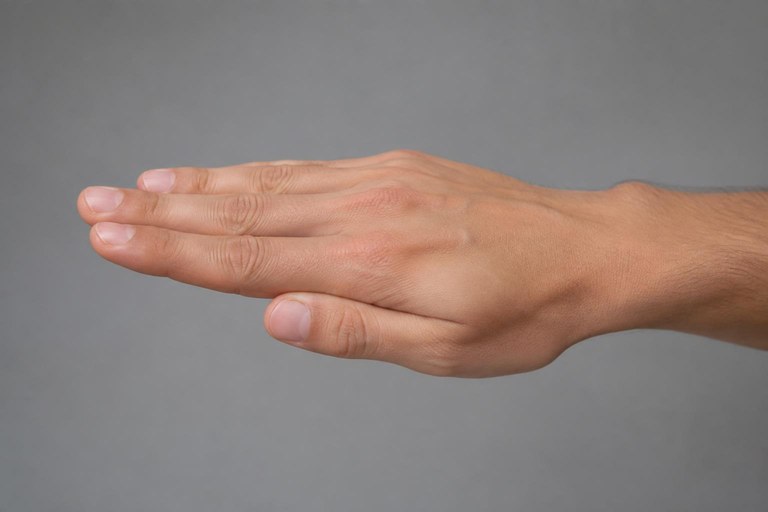
- Flat B hand: all four fingers straight and together, thumb folded across the palm. Like a flat paddle.
- Open B hand: the same flat hand, but with the thumb out to the side.
- Bent B hand: flat hand with the fingers bent forward at the big knuckles, like a shelf bracket.
- 5 hand: all five fingers spread wide apart.
- Claw 5 hand: fingers spread and curved, like holding a grapefruit.
- 1 hand: index finger straight up, other fingers curled into a fist.
- X hand: index finger curled into a hook, other fingers closed.
- V hand: index and middle fingers straight and spread apart in a V, other fingers closed.
- Bent V hand: the same V, but both fingers bent like two little claws.
- 3 hand: thumb, index and middle finger extended, ring and pinky closed.
- A hand: a closed fist with the thumb resting along the side.
- S hand: a closed fist with the thumb across the front of the fingers.
- C hand: fingers together and thumb curved to form the shape of the letter C.
- O hand: fingertips and thumb touching to make a round O.
- Flat O hand: fingertips and thumb pinched together and flattened, like picking up a coin.
- F hand: index finger and thumb touching in a small circle, the other three fingers up and spread.
- Y hand: thumb and pinky out, three middle fingers folded down.
- L hand: index finger up and thumb out to the side, making an L.
Practise these in front of a mirror until your hand can find each one without you looking at it. Crisp handshapes are the fastest way to look like a careful signer rather than a guessing one.
Parameter two: location
Location is where the sign is made. The main locations in this book are:
- Neutral space: the open area in front of your chest, roughly between your shoulders and between chin and waist. Most signs live here.
- Forehead or temple
- Cheek or the side of the face
- Chin or lips
- Chest
- The non-dominant hand, used as a surface or base that the dominant hand touches, brushes or circles.
Keep your signing inside a comfortable box in front of your body. Beginners often sign too big, waving their arms out wide, which is tiring to watch and hard to read.
Parameter three: movement
Movement is what the hand does. The words this book will use are simple and literal: tap for a short contact, tap twice for a repeated contact, brush for sliding contact across the skin or the other hand, circle for a round path, shake or wiggle for a small rapid back-and-forth, move forward, move down, arc, twist, and open or close when the fingers change shape during the sign. If a movement repeats, the description will say so, because repetition alone can change the meaning.
Parameter four: palm orientation
Palm orientation is the direction your palm faces. This book uses five plain terms: palm up, palm down, palm in toward your own body, palm out toward the person you are talking to, and palm to the side, meaning facing left or right. Orientation is the parameter beginners forget most often. It is also why the numbers one to five are usually signed with the palm toward yourself, while palm out is the correct choice in contexts such as phone numbers, addresses and prices, a pattern you will meet in the numbers chapter.
Parameter five: non-manual markers
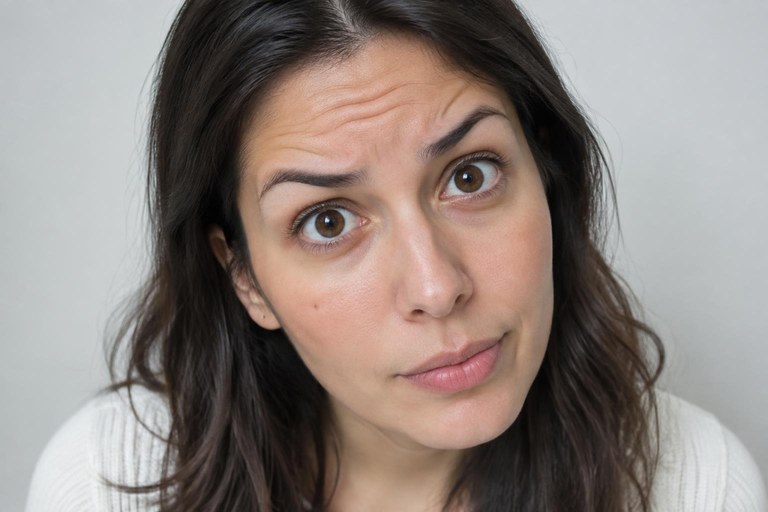
Non-manual markers are everything the face, head and body do while the hands sign. This is grammar, not decoration. Raised eyebrows turn a statement into a yes-or-no question. Furrowed eyebrows go with question words like who and where. A head tilt can mark a topic. A headshake negates a whole phrase. Mouth movements add meaning too: a puffed cheek can mean very large, tight lips can mean small and careful. Where the face matters, the description will end with a sentence telling you exactly what your eyebrows and mouth should do.
Proof that precision matters: minimal pairs
A minimal pair is two signs that differ in exactly one parameter. Here are five that beginners really do mix up.
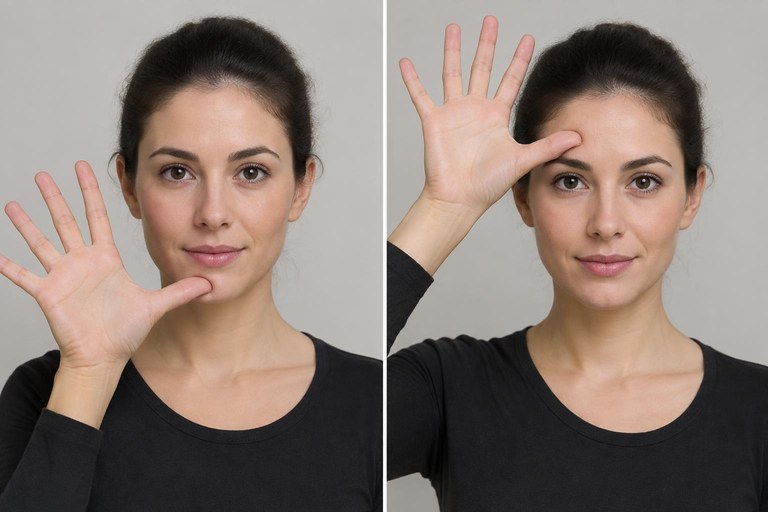
- Location. Open 5 hand, palm facing to the left, thumb taps the chin twice: that is MOTHER. The identical hand tapping the forehead is FATHER. Same handshape, same movement, same orientation. Only the height on the face has changed.
- Location again. An X hand drawn sideways across the forehead is SUMMER. Drawn across the nose and cheek it is UGLY. Drawn across the chin it is DRY. One hand, three faces, three unrelated words.
- Handshape. A 1 hand with the fingertip on the cheek, twisting, is CANDY. Keep the very same cheek location and the very same twist, but hook that finger into an X hand, and it becomes APPLE.
- Palm orientation. Two flat hands in neutral space patting gently downward, palms down, means CHILDREN. Turn both palms up and make small outward arcs and you have THINGS.
- Non-manual markers. Some sign pairs differ only in the face. The same hand movement can mean LATE with a neutral face, or NOT YET when you add a headshake and the tongue resting just past the lips.
You do not need to memorise these words now. They are here to convince you that a sloppy sign is not a slightly wrong word. It is often a different word.
The description format used in this book
From here on, every sign is described in the same order, so your ear learns the pattern: handshape, palm orientation, location, movement, and then the face if it matters. Two examples of the format:
Dominant hand in a flat B hand, palm facing down, held at the chest, brushes forward twice.
Both hands in bent V hands, palms facing down, in neutral space in front of the chest; the dominant hand taps down onto the non-dominant hand once. Eyebrows neutral.
When only one hand is mentioned, use your dominant hand and let the other rest. When the non-dominant hand holds still as a base, the description will say so. If you ever hear a description and cannot picture it, break it into the five parameters one at a time, build the sign slowly, then speed it up.
Recap and review checklist
Signs are made of handshape, location, movement, palm orientation and non-manual markers, all at once. One hand leads, the other supports, and left-handed signers mirror everything. Change one parameter and you usually change the word, as MOTHER and FATHER prove.
- I can name the five parameters of a sign without looking.
- I have chosen my dominant hand and know I will keep it consistent.
- I can form the flat B, open B, bent B, 5, claw 5, 1, X, V, bent V, 3, A, S, C, O, flat O, F, Y and L handshapes in a mirror.
- I can name the main locations: neutral space, forehead, cheek, chin, chest, and the non-dominant hand.
- I can describe palm direction using up, down, in, out, and to the side.
- I understand that eyebrows, mouth and head movements carry grammar, not just mood.
- I can explain one minimal pair to another person and show why precision matters.
- I know the order this book will use to describe every sign: handshape, orientation, location, movement, face.