In the last two chapters you learned your first signs and how to point. Now you will put them in order. By the end of this chapter you will be able to build simple ASL statements using topic-comment structure, drop the English words that ASL does not use, and set the tense of a whole sentence by putting a time sign first. You will also add about a dozen high-frequency signs, including nine everyday verbs.
Three Things English Does That ASL Does Not
Before word order, clear away three habits. First, ASL has no signs for is, are, am, was or were. The English sentence "My friend is Deaf" becomes MY FRIEND, then DEAF. Nothing goes in between.
Second, ASL has no articles. There is no sign for a, an or the. "The doctor" is simply DOCTOR.
Third, signs do not take English word endings. There is no letter S added for plurals, no ed for the past, no ing for the present. Number goes in front of the noun, as you learned with counting, so "three students" is THREE STUDENT. Tense comes from a time sign at the front of the sentence, which we will get to shortly.
Topic-Comment: The Main Pattern
Topic-comment means you name what you are talking about first, then say something about it. Think of it as "here is my subject, and here is my news." English can do this too, in sentences like "My car, I sold it last week." In ASL this is the normal, comfortable way to build a sentence.
- Listen to the audio with the screen off.
- Earn a certificate upon completion.
- Over 5000 courses for you to explore!

Download the app
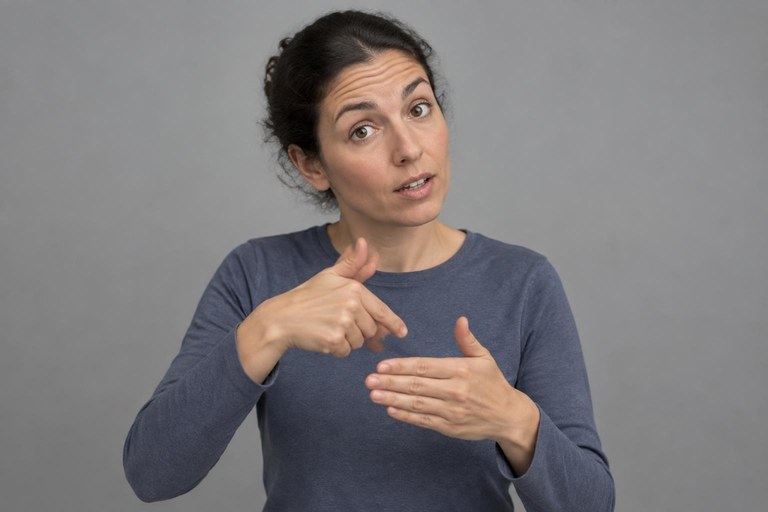
The topic is marked on the face, not with a sign. Raise your eyebrows slightly while you sign the topic, tilt your head a little, then pause for a beat and lower your eyebrows for the comment. Those raised eyebrows are a topic marker, and they are grammar, not decoration. Without them, a topic-comment sentence looks like two unconnected thoughts.
Try it with a sign you already have. Sign MY FRIEND with eyebrows up, hold that tiny pause, then sign DEAF with a normal face. That is a complete ASL sentence meaning "My friend is Deaf."
Subject, Verb, Object Also Works
For short, simple statements, ASL is happy with subject, then verb, then object, the same basic order as English. I WANT COFFEE-style sentences are perfectly good ASL. So "I know your teacher" can be signed I KNOW YOUR TEACHER.
As a beginner, use this rule of thumb. If the sentence is short and nothing needs highlighting, sign subject, verb, object. If the sentence is longer, or if you want to set up what you are talking about before commenting on it, put the topic first with raised eyebrows. Both are correct. What is not correct is following English word for word, keeping the little function words, and mouthing full English sentences over the top.
Put Time First
ASL sets tense once, at the beginning, and that tense stays in force until you change it. So you sign the time, then the rest of the sentence, and every verb that follows is understood as happening then. "I worked yesterday" is YESTERDAY I WORK. "I will study tomorrow" is TOMORROW I STUDY. You never go back and add a past-tense ending to the verb.
Here are the four time signs for this chapter, in the book's description format of handshape, palm orientation, location, movement, then face.
- NOW. Both hands in the Y handshape, thumb and pinky extended, palms facing up, held in neutral space in front of the chest. Drop both hands downward a short distance one time. Neutral face.
- TODAY. The same two Y hands, palms up in neutral space, dropping downward twice instead of once. Many signers sign NOW and then DAY; the double drop is the quick everyday version.
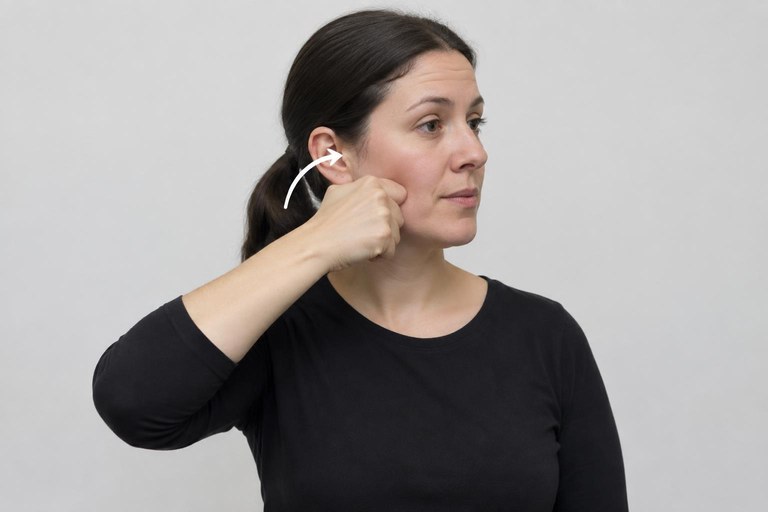
- YESTERDAY. Dominant hand in the A handshape with the thumb extended upward, palm facing to the side, thumb touching the chin on the dominant side. Arc the thumb backward to touch the cheek near the ear. Neutral face.
- TOMORROW. Dominant hand in the A handshape, thumb up, palm facing to the side, thumb resting on the chin or lower cheek. Rotate the hand forward so the thumb arcs out and away from the face. Neutral face.
Notice the logic: yesterday moves backward, up the cheek toward the ear, while tomorrow moves forward, away from the face. That front-to-back line is the ASL timeline, and the full calendar vocabulary builds on it later.
Nine Verbs to Build Sentences With
- HAVE. Both hands in the bent B handshape, fingers bent at the knuckles, palms facing in. Tap the fingertips onto the upper chest.
- WANT. Both hands in the claw 5 handshape, palms facing up in neutral space. Pull both hands in toward the body while curling the fingers a little tighter.
- LIKE. Dominant hand open, palm facing in, with the thumb and middle finger touching the chest. Pull the hand forward off the chest while the thumb and middle finger close together. Pleasant face.
- GO. Both hands in the 1 handshape, index fingers pointing forward, palms facing in toward each other. Move both hands away from the body in the direction of travel.
- COME. Both hands in the 1 handshape, index fingers pointing up and slightly forward, palms angled up. Draw both hands in toward your own chest.
- LIVE. Both hands in the A handshape, thumbs up, palms facing in at the waist. Slide both hands upward along the torso to chest height.
- WORK. Both hands in the S handshape, fists closed, palms facing down. Tap the wrist of the dominant fist on top of the wrist of the non-dominant fist twice.
- STUDY. Non-dominant hand flat B, palm up, held in neutral space. Dominant hand 5 handshape, palm down, held just above it, fingers wiggling toward the flat palm.
- KNOW. Dominant hand bent B, palm facing in. Tap the fingertips against the forehead.
Ten Sentences, English to ASL
Read each English sentence, then the gloss, then sign it. Where a comma appears in the gloss, pause briefly. If the part before the comma is the topic, as in sentences one and nine, raise your eyebrows on it; where the comma simply joins two clauses, as in sentence two, the pause alone is enough and your eyebrows stay neutral.
- My friend is Deaf. Gloss: MY FRIEND, DEAF.
- I am hearing and I am learning sign language. Gloss: I HEARING, I LEARN SIGN.
- I work today. Gloss: TODAY I WORK.
- Yesterday I met your teacher. Gloss: YESTERDAY I MEET YOUR TEACHER.
- My boss is coming tomorrow. Gloss: TOMORROW MY BOSS COME.
- I want to learn sign language. Gloss: I WANT LEARN SIGN.
- I have three students. Gloss: I HAVE THREE STUDENT.
- I live in Boston. Gloss: I LIVE B-O-S-T-O-N.
- My doctor knows sign language. Gloss: MY DOCTOR, KNOW SIGN.
- Right now I am studying. Gloss: NOW I STUDY.
Look at what disappeared. No am, no is, no a, no the, no to before a verb, no ing, no plural S on STUDENT, and no past tense on MEET, because YESTERDAY already did that job.

Reverse Exercise: ASL to English
Now work the other direction. Read each gloss aloud, picture the signs, and say a natural English sentence. Natural English means you add back the words ASL does not use.
- TOMORROW I GO WORK.
- MY TEACHER, DEAF.
- YESTERDAY MY NEIGHBOR COME.
- I LIVE, YOU KNOW.
- TODAY TWO STUDENT COME.
- NOW I LEARN SIGN, I WANT UNDERSTAND.
Suggested English: one, "I am going to work tomorrow." Two, "My teacher is Deaf." Three, "My neighbor came over yesterday." Four, "You know where I live." Five, "Two students are coming today." Six, "I am learning sign language now because I want to understand."
If your English versions are longer than the glosses, you are doing it right. ASL is not shorter in meaning; it simply carries some of the meaning on the face, in the pause, and in the space rather than in extra words.
A Five-Minute Daily Drill
Pick three true statements about your own day. Sign each one twice: once in subject, verb, object order, and once with a topic in front and raised eyebrows. Then sign each one three times with a different time sign at the front, using YESTERDAY, TODAY and TOMORROW, and notice that the verb never changes. Film one round and watch it back. Ask yourself two questions. Did my eyebrows go up on the topic and come back down for the comment? Did I add any English words with my mouth that my hands did not sign?
Review Checklist
- I can explain that ASL has no signs for is, are or am, no articles, and no English word endings.
- I can build a topic-comment sentence, raising my eyebrows and pausing on the topic.
- I know that short, simple sentences may also use subject, verb, object order.
- I put the time sign first and leave the verb unchanged.
- I can sign NOW, TODAY, YESTERDAY and TOMORROW from memory.
- I can sign HAVE, WANT, LIKE, GO, COME, LIVE, WORK, STUDY and KNOW with the correct handshape, location and movement.
- I can translate a simple English sentence into gloss, and a gloss back into natural English.
To recap: name your topic first and mark it with raised eyebrows, then comment on it. Keep short sentences in subject, verb, object order. Drop the little English words that ASL does not use. And set the time once at the front of the sentence, where it quietly governs everything that follows.