By the end of this chapter you will be able to add adverbial meaning with your face, show degree by changing how hard and how far you move, report a two-person exchange by shifting your body, and use about a dozen short conversation signs that keep a chat alive. You will also work through three full dialogues that pull vocabulary from the greetings, pronouns, family, time, food, work, health and directions chapters, and you will film yourself doing each one.
Your Face Is a Word, Not Decoration
In earlier chapters your face carried grammar: raised brows for a yes/no question or a topic, furrowed brows for a WH question, a headshake for negation, and a matching expression on every emotion sign. Now your face does one more job. It carries adverbs. In English you add a separate word, such as very, carefully or enormous. In American Sign Language you usually add a mouth and cheek posture on top of the sign itself, at the same time.
Here are the three facial adverbs every beginner should own. Practice each one in a mirror before you attach it to a sign.
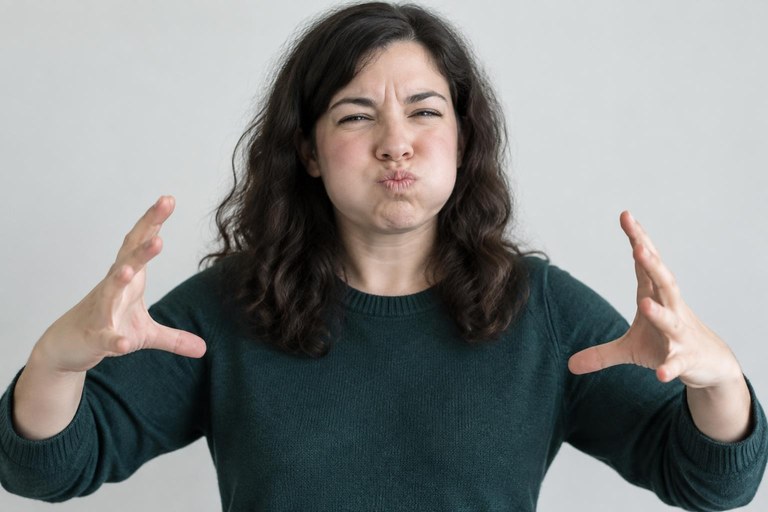
- Puffed cheeks. Fill both cheeks with air, lips closed, eyes slightly squinted. Meaning: very large, a lot, a long time, crowded. Attach it to BIG and you get huge. Attach it to BUSY and you get swamped. Attach it to PEOPLE and you get a big crowd.
- Tight lips, sometimes called the pressed mouth. Press your lips into a thin line and pull them slightly to one side, eyes narrowed. Meaning: small, thin, careful, exact, barely. Attach it to SMALL and you get tiny. Attach it to WRITE and you get wrote it out neatly.
- The "cha" mouth. Open your mouth, tongue behind the teeth, and release a silent cha as the sign moves. Meaning: enormous, way more than expected. Attach it to TALL and the person is towering. Attach it to EXPENSIVE and the price was shocking.
These postures are not mime and they are not optional flavour. Signing BIG with a flat face means big. Signing BIG with puffed cheeks means huge. Two different messages, one difference on the face.
Movement Shows Degree
The second way to say very is to change the movement itself, using the movement parameter from Chapter 2. Three adjustments do most of the work.
- Listen to the audio with the screen off.
- Earn a certificate upon completion.
- Over 5000 courses for you to explore!

Download the app
- Bigger path. Make the sign travel farther. BIG with hands pulling far apart says a great deal more than BIG with a small pull.
- Sharper start. Hold still for a beat, then release the sign fast and stop hard. On HAPPY, that quick sharp version reads as thrilled. On HUNGRY it reads as starving.
- Slower and repeated. Drag the sign out and repeat it. On WORK, slow heavy repetition says worked and worked. On WAIT, slow repetition says waited forever.
Keep this inside your normal signing space, roughly from the top of your head to your waist and no wider than your shoulders plus a little. Intensity comes from sharpness and from the face, not from flailing.
Body Shift: Reporting Two People at Once
Body shift, also called role shift, lets you replay a conversation without repeating she said and I said. You become each person in turn. It is built from three moves you already know how to make.
- Name the people and place them. Sign or fingerspell each person, then assign each one a spot in your signing space, exactly as you learned with indexing and referents in Chapter 7. Put one slightly to your right, the other slightly to your left.
- Turn your shoulders toward one spot and become that person. Rotate your upper body a few degrees, no more than a quarter turn. Your eye gaze moves to where the other person would be standing.
- Sign their words in first person. While you are turned, I means them, not you. Then turn the other way for the reply.
Two habits make body shift readable. Add a small pause at each turn so your viewer knows you swapped. And put each character's own facial expression on while you are them: if the boss was annoyed, wear the annoyed face during the boss's lines.
Here is a short example in gloss. MY BOSS ASK-ME, then shift right, TOMORROW YOU WORK? then shift left, ME CAN'T, ME DOCTOR APPOINTMENT. In English: my boss asked me if I could work tomorrow, and I said I couldn't because I have a doctor's appointment. Notice that ASK-ME is a directional verb from Chapter 15, so it already shows who asked whom.
Signs That Keep a Conversation Going
These are the short reactions and traffic signals of conversation. Each description follows the book's format: handshape, palm orientation, location, movement, then face.
- WAIT. Both hands claw 5, palms up, in neutral space slightly to your non-dominant side, with the dominant hand a little behind the other, fingers wiggling. Face slightly urgent.
- HOLD-ON. One flat B hand, palm out, held up at shoulder height, still. A polite freeze frame that means one moment.
- OH-I-SEE. Y hand, palm in, at chest height, shaken slightly twice. A small nod and a relaxed oh mouth.
- REALLY? One 1 hand, palm facing your non-dominant side, index finger touching the lips, moving forward and out in a short arc. Brows raised, head forward, and hold the end.
- WOW. Open 5 hand, palm in, shaken loosely from the wrist near the dominant shoulder. Wide eyes, open mouth.
- TRUE. One 1 hand, palm to the side, index at the lips, moving straight forward and out. Firm, serious face.
- RIGHT. Both hands in the 1 handshape, palms to the side, dominant hand tapping down onto the non-dominant hand once, both index fingers pointing forward. A single nod.
- WRONG. Y hand, palm in, the thumb tip touching the chin while the pinky stays extended and points forward, one short contact. Brows slightly furrowed.
- ME-TOO. Y hand, palm down, in neutral space, rocking side to side between yourself and the other person. Friendly face.
- WHAT'S UP. Both hands, middle finger bent in toward the palm, palms in at chest height, flicking the middle fingers up and out. Brows raised as a casual question.
- FINISH? Both hands 5, palms in at chest height, twisting quickly so palms face out. With raised brows it asks are you done?
Turn-taking works differently from spoken conversation. To take the floor, raise your hand slightly, lift your index finger, or lean forward a little and catch the signer's eyes. To keep the floor, hold your hands up and keep signing. To hand the floor over, drop your hands and look at the person you want to hear from. Eye gaze is the microphone.
Dialogue One: Meeting Someone at a Deaf Event
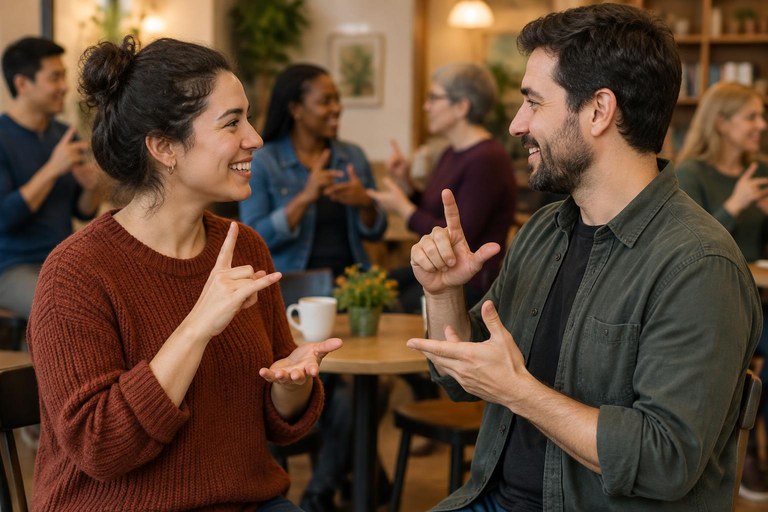
Two people meet at a Deaf coffee night. Gloss first, then English.
A: HELLO! WHAT'S UP. YOUR NAME WHAT?
B: MY NAME B-E-N. YOU?
A: M-A-Y-A. NICE MEET YOU. YOU DEAF?
B: YES, ME DEAF. YOU?
A: ME HEARING, ME LEARN SIGN. PLEASE SLOW.
B: FINE, NO PROBLEM. YOU LEARN WHERE?
A: LIBRARY, EVERY-WEEK TUESDAY NIGHT.
B: OH-I-SEE. GOOD!
In English: Hello, how's it going, what's your name? My name is Ben, and you? Maya. Nice to meet you. Are you Deaf? Yes, I'm Deaf, and you? I'm hearing, I'm learning to sign, so please go slowly. That's fine, no problem. Where are you learning? At the library, every Tuesday evening. Oh, I see. Great.
Watch three things. YOUR NAME WHAT takes the WH face, brows down, held to the end. YOU DEAF takes the yes/no face, brows up, last sign held. And EVERY-WEEK TUESDAY NIGHT sits at the end here only because the line is a short answer that leads with the place; in a full sentence the time phrase comes first, as in EVERY-WEEK TUESDAY NIGHT ME LEARN LIBRARY.
Dialogue Two: A Customer-Service Exchange
CUSTOMER: EXCUSE-ME. ME DEAF. YOU HAVE PEN PAPER?
WORKER: YES, HOLD-ON. ... HERE. ME LEARN SIGN LITTLE-BIT. YOU NEED WHAT?
CUSTOMER: ME WANT COFFEE, MILK NONE. HOW-MUCH?
WORKER: THREE DOLLAR.
CUSTOMER: OK. ME PAY CARD.
WORKER: FINE. WAIT ONE MINUTE, COFFEE FINISH SOON. THANK-YOU!
In English: Excuse me, I'm Deaf. Do you have a pen and paper? Yes, one moment. Here you go. I'm learning a little sign. What do you need? I'd like a coffee, no milk. How much? Three dollars. Fine, I'll pay by card. All right. Wait one minute, the coffee will be ready soon. Thank you.
Two details matter here. MILK NONE uses the negation headshake spread across both signs. And THREE DOLLAR uses the dollar twist from the food chapter, not a separate sign for dollars after the number; keep in mind that this number incorporation works only for about one through nine, so ten dollars and up are signed as the number followed by DOLLAR.
Dialogue Three: A Parent-Teacher Chat
TEACHER: HELLO! YOU E-M-M-A MOTHER?
PARENT: YES. YOUR CLASS, SHE HAPPY.
TEACHER: GOOD. SHE READ GOOD, BUT MATH, SHE FRUSTRATED.
PARENT: REALLY? HOME SHE HOMEWORK FINISH, BUT SLOW.
TEACHER: OH-I-SEE. EVERY-DAY AFTERNOON ME HELP-HER TWENTY MINUTE. OK?
PARENT: YES, THANK-YOU! NEXT-MONTH WE MEET AGAIN?
TEACHER: RIGHT. ME EMAIL YOU.
In English: Hello, are you Emma's mother? Yes. She's happy in your class. Good. She reads well, but math frustrates her. Really? At home she finishes her homework, but slowly. Oh, I see. Every afternoon I'll work with her for twenty minutes. Does that sound all right? Yes, thank you. Shall we meet again next month? Right, I'll email you.
Notice YOUR CLASS as a topic with raised brows and a pause, HELP-HER aimed toward the spot where Emma has been placed in space, and the tight-lipped face on SLOW to mean slowly and with effort.
Self-Recording Tasks
Film each dialogue playing both parts, then watch with the sound off and check honestly.
- Eyebrows. Pause on every question. Are your brows up for yes/no and down for WH? If your face never moves, you are signing vocabulary, not language.
- Pauses. Can you see the break after each topic and at each body shift? If the whole clip is one smooth stream, add pauses.
- Eye gaze. Count how often you look at your own hands. Aim for zero. Look at the camera as if it were a person.
- Facial adverbs. Record BIG, then BIG with puffed cheeks, then BIG with the cha mouth. Watch back. If all three look the same, exaggerate more.
- Body shift. Record the boss example. Can a viewer tell who is speaking from your shoulders and gaze alone?
Then take one dialogue to a real conversation, ideally at a Deaf-led event or class. Recording builds accuracy. Only people build fluency.
Recap and Review Checklist
Facial adverbs turn ordinary signs into intense ones: puffed cheeks for very large, tight lips for small or careful, and the cha mouth for enormous. Movement size, sharpness and repetition add degree. Body shift reports a two-person exchange by turning your shoulders and moving your eye gaze. And a handful of short reaction signs keep a conversation flowing instead of stalling.
- I can produce puffed cheeks, tight lips and the cha mouth on command.
- I can sign BIG three ways to mean big, huge and enormous.
- I can show degree by changing movement size, sharpness and repetition.
- I can place two people in space and body shift between them with a pause at each turn.
- I can sign WAIT, HOLD-ON, OH-I-SEE, REALLY, WOW, TRUE, RIGHT, WRONG, ME-TOO, WHAT'S UP and FINISH with the right face.
- I can take, keep and hand over a turn using a raised hand and eye gaze.
- I have filmed all three dialogues and checked eyebrows, pauses and eye gaze.