By the end of this chapter you will be able to describe your home room by room, name eleven colors, use fourteen everyday adjectives, and put them together in ASL order to describe a car, a cat, or a person. You already know topic-comment order from the sentence chapter and the question faces from the question chapter, so everything here is new vocabulary poured into sentence patterns you have already practiced.
Home and the Things In It
Each description follows the book's fixed order: handshape, palm orientation, location, movement, then face if the face matters. Unless a sign says otherwise, it happens in neutral space in front of your chest.
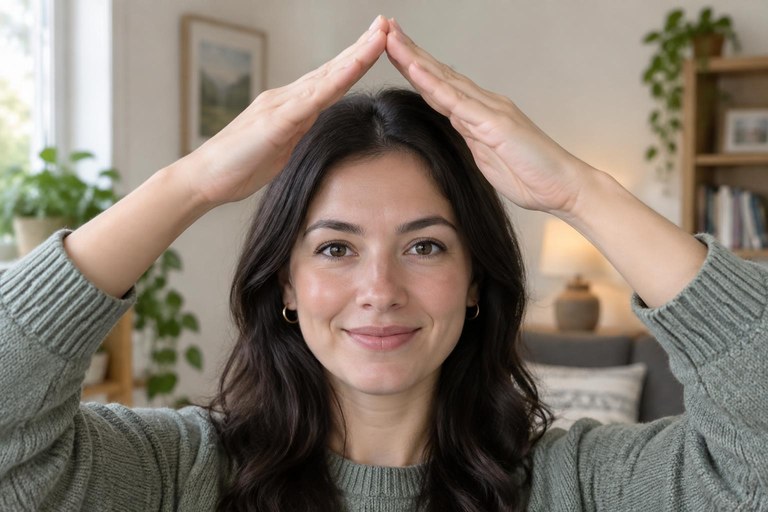
- HOUSE — Two flat B hands, palms angled toward each other, fingertips touching at forehead height to make a roof, then slide apart and straight down to trace two walls.
- HOME — Flat O hand, palm in, taps twice on the cheek: once near the corner of the mouth, once higher on the cheek.
- ROOM — Two flat B hands, palms facing each other at either side of your chest; then shift them so the dominant hand moves back toward your chest and the non-dominant hand moves forward, both palms now facing you, tracing the other two walls of a box.
- BED — Flat B hand, palm in, held against your cheek as you tilt your head onto it.
- BEDROOM — A compound sign: sign BED, then ROOM, one right after the other with no pause.
- BATHROOM — T hand, palm out, shaken side to side in neutral space.
- TABLE — Both forearms flat and level, palms down, dominant forearm taps twice on top of the non-dominant forearm.
- CHAIR — Dominant bent V hand, palm down, taps twice on top of the non-dominant bent V fingers, like legs sitting on a seat.
- DOOR — Both flat B hands, palms out, index fingers touching side by side; the dominant hand swings back toward you twice, hinging at the wrist.
- WINDOW — Both flat B hands, palms in, dominant hand resting on the non-dominant hand; lift the dominant hand a few inches and tap it down twice.
- KITCHEN (review from the food chapter) — Flat B hand on the upturned non-dominant palm, flip it over and back.
- TV — Fingerspell T then V, palm out, in neutral space at shoulder height.
- PHONE — Y hand, thumb at the ear and pinky at the mouth.
- COMPUTER — C hand, palm to the side, arcs in a small hop across the forehead. A common variant taps the C hand on the back of the non-dominant forearm.
- CAR — Two S hands, palms in, held as if on a steering wheel, moving alternately up and down.
- KEY — X hand, palm down, the crooked index finger twists against the upturned non-dominant palm.
- CLEAN — Dominant flat B hand, palm down, brushes forward along the upturned non-dominant palm.
- DIRTY — 5 hand under the chin, palm down, back of the hand touching the chin, fingers wiggling. Add a slightly disgusted face.
- OPEN — Both flat B hands, palms out and touching at the index fingers, swing apart so the palms turn to face each other.
- CLOSE — The same sign in reverse: hands apart, palms facing each other, swing together until the index fingers meet, palms out.
- SLEEP — 5 hand in front of the face, palm in, draws down toward the chin while closing to a flat O. Let your eyes close.
- WAKE-UP — Both hands pinched shut at the corners of the eyes, then flick open into L shapes as your eyes widen.
- SHOWER — S hand above the head, palm down, opens and closes twice like water spraying.
Eleven Colors, Plus the Sign COLOR
Notice a pattern that makes these easy to remember: several colors are made at the mouth or chin, and several are simply the first letter of the English word shaken in neutral space.
- COLOR — 5 hand, palm in, fingertips at the chin, fingers wiggling.
- RED — 1 hand, palm in, index fingertip brushes down across the lips.
- BLUE — B hand, palm to the side, shakes with a small twist of the wrist.
- GREEN — G hand, palm to the side, same wrist shake.
- YELLOW — Y hand, palm to the side, same wrist shake.
- PURPLE — P hand, palm to the side, same wrist shake.
- ORANGE — S hand at the mouth, palm in, squeezing open and closed twice.
- PINK — P hand, palm in, the middle finger brushes down across the lips.
- BROWN — B hand, palm to the side, slides down the cheek.
- BLACK — 1 hand, palm down, index finger drags sideways across the forehead along the eyebrow.
- WHITE — 5 hand on the chest, palm in, pulls straight out while closing to a flat O.
- GRAY — Both 5 hands, palms facing each other, fingers passing back and forth between each other.
Fourteen Everyday Adjectives
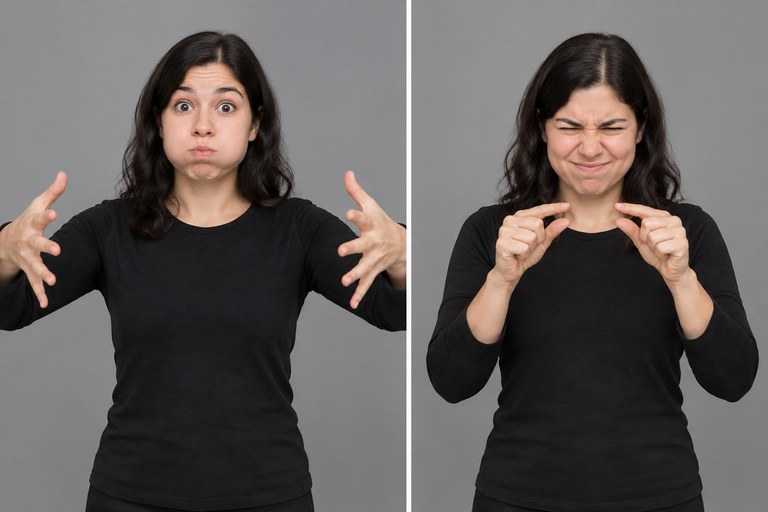
- BIG — Both L hands with slightly bent index fingers, palms facing each other, pull apart. Puff your cheeks for very big.
- SMALL — Both flat B hands, palms facing each other, move toward each other. Squint and tighten the lips.
- TALL — 1 hand, palm to the side, slides upward along the upright non-dominant palm.
- SHORT (in height) — Bent B hand, palm down, held out at the height you mean and pressed down slightly.
- OLD — C hand at the chin, palm to the side, moves down while closing to an S, like stroking a beard.
- NEW — Both hands slightly curved, palms up; the back of the dominant hand brushes across the non-dominant palm and scoops up.
- HOT — Claw 5 hand at the mouth, palm in, twists sharply out and down.
- COLD — Two S hands, palms facing each other, shaking, shoulders hunched.
- BEAUTIFUL — 5 hand circling in front of the face, closing to a flat O at the chin.
- UGLY — 1 hand crossing under the nose, palm down, bending into an X as it goes. Remember the minimal pair from the parameters chapter.
- EXPENSIVE — Flat O hand resting on the upturned non-dominant palm, lifts up and flings open downward.
- CHEAP — Dominant flat B hand brushes downward off the side of the upright non-dominant palm.
- FAST — Both 1 hands, palms down, snap the index fingers back into fists quickly.
- SLOW (review) — Dominant flat B hand slides slowly up the back of the non-dominant hand.
Noun First, Description Second
In English you say a red car. In ASL the normal order is the opposite: CAR RED. This is called noun-adjective order, and it fits the logic you already know from topic-comment structure. You name the thing, then you comment on it. Two or three descriptions can stack after the noun, usually from most obvious to least: HOUSE OLD SMALL WHITE means an old, small, white house.
To describe a person, name them first with raised eyebrows as your topic, then comment from the top of the body down. For example, MY FRIEND, WOMAN TALL, HAIR BROWN means my friend is a tall woman with brown hair. To describe a room, name the room as your topic and then list what is in it: MY BEDROOM, BED BIG, TABLE SMALL, WINDOW TWO.
- Listen to the audio with the screen off.
- Earn a certificate upon completion.
- Over 5000 courses for you to explore!

Download the app
Two small cautions. First, many descriptive signs come before the noun in everyday signing, as in BIG HOUSE, NEW CAR, or RED SHIRT, so do not be startled when a Deaf signer puts the description first. Both orders are correct ASL; noun-first is simply a convenient starting pattern for a beginner, not a rule that fluent signers always follow. Second, numbers are flexible too: they can come before or after the noun, so both THREE ROOM and ROOM THREE are good ASL, which is why Rosa signs WINDOW TWO in the dialogue below.
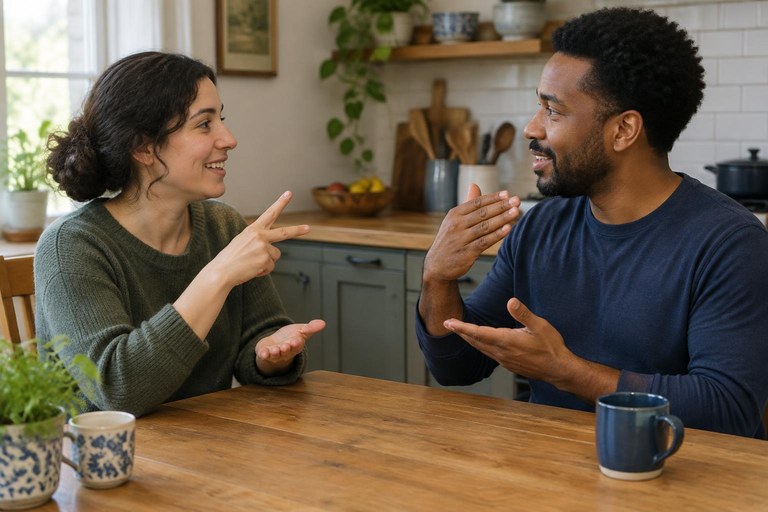
Dialogue: Where Do You Live?
Jamal and Rosa are chatting after class. The gloss comes first, then the English.
Jamal: YOU LIVE WHERE? — Where do you live? Furrowed brows held across the sentence.
Rosa: I LIVE HOUSE OLD, SMALL. — I live in a small old house. Squint slightly on SMALL.
Jamal: HOUSE, HOW-MANY ROOM? — How many rooms does the house have? Raised brows on the topic HOUSE, then the WH face.
Rosa: THREE. KITCHEN BIG, I LIKE. BATHROOM SMALL. — Three. The kitchen is big, and I like that. The bathroom is small.
Jamal: YOU HAVE PET? — Do you have a pet? Raised brows, head forward, last sign held.
Rosa: YES, CAT BLACK. NAME M-I-M-I. YOUR HOUSE? — Yes, a black cat named Mimi. What about your place?
Jamal: MY ROOM SMALL, EXPENSIVE. — My place is small and expensive. Frustrated face.
Rosa: YOUR CAR, COLOR WHAT? — What color is your car? WH face.
Jamal: CAR RED, OLD, SLOW. — A red car, old and slow. Smile on SLOW.
Practice Drills
- Room tour. Walk through your home and sign the name of every object you pass that appeared in this chapter, then add one color and one adjective after it.
- Color flash. Point at five objects around you and sign only the color. Aim for one second per sign with no bouncing.
- Order flip. Say ten English phrases such as a big white door, then sign each in noun-adjective order. Check yourself: did the noun really come first?
- Opposites pair drill. Alternate CLEAN and DIRTY, OPEN and CLOSE, BIG and SMALL, HOT and COLD, FAST and SLOW, EXPENSIVE and CHEAP, ten times each, letting your face match the meaning.
- Self-recording. Film yourself describing your bedroom in four sentences using topic-comment order. Watch it back and check that your eyebrows rise on each topic and your hands stay inside a comfortable space in front of your chest.
Review Checklist
- I can sign the twenty-three home signs, including the compound BEDROOM.
- I can produce all eleven colors, plus the general sign COLOR, and I know which ones are made at the lips, the chin, the cheek, or in neutral space.
- I can sign fourteen adjectives and match my face to each one.
- I put the adjective after the noun, as in CAR RED, and I know that numbers can come either before or after the noun.
- I can describe a person from the top down and a room item by item using topic-comment order.
- I can ask where someone lives with the WH face and whether they have a pet with the yes/no face.
To recap: this chapter gave you the vocabulary of a home, a full palette of colors, and the most useful describing words, plus the single most important rule for using them, which is that in ASL the thing comes first and the description follows.