By the end of this chapter you will be able to count from one to one hundred on one hand, tell someone your age, give your phone number in the natural ASL rhythm, and count objects out loud with your hands. You already know the manual alphabet and the book's five-part description format from earlier chapters, so every number here is described the same way: handshape, palm orientation, location, movement, and face.
The palm rule that trips up every beginner
ASL numbers are made with the dominant hand only, held comfortably in neutral space in front of your chest or slightly to the side. Keep the hand still and let the fingers do the work. There is no bouncing, just as in fingerspelling.
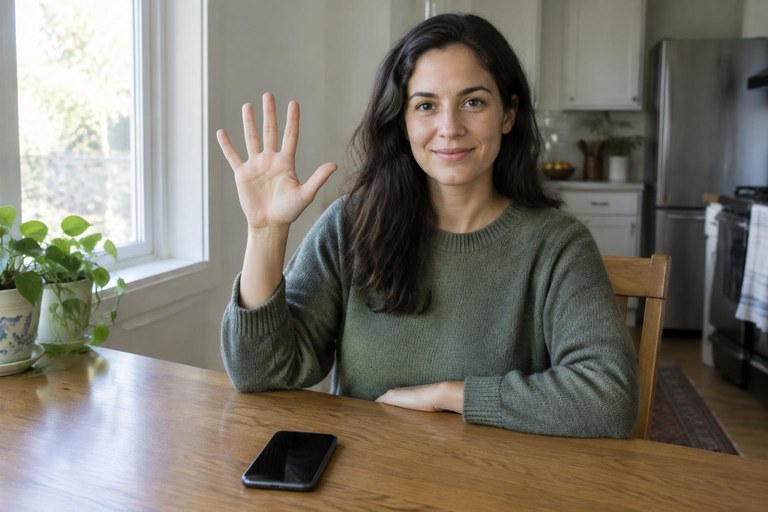
Here is the rule to memorise before anything else. When you are telling someone how many of something there are, the numbers one through five face in, toward yourself, and the numbers six through nine face out, toward the person you are talking to. That single switch of palm orientation is grammar, not decoration. You will still meet Deaf signers who sign one through five palm out in everyday chat, so treat the rule as the classroom standard rather than an absolute. A one through five signed palm out looks like you are counting for an audience on a stage, or like you are giving a digit in a phone number, which is a different job entirely.
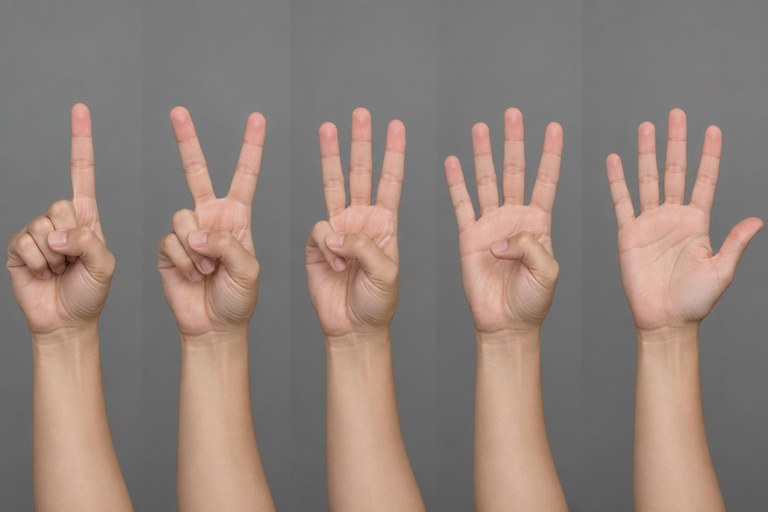
One through five
- One: index finger straight up, all other fingers and the thumb closed. Palm faces in. Held still.
- Two: index and middle fingers up in a V, thumb holding the other two fingers down. Palm faces in.
- Three: thumb, index and middle finger extended, ring and pinky folded down. Palm faces in. Note that there is no letter three in the manual alphabet, and the ASL three is thumb plus index and middle finger, not three fingers held up. The three-fingers-up gesture many hearing people use is the letter W, which is also the ASL six.
- Four: four fingers straight up and spread slightly, thumb folded across the palm. Palm faces in.
- Five: all five fingers spread open, the 5 hand you already know. Palm faces in.
Six through nine: thumb walks down the fingers
These four are beautifully simple once you see the pattern. The thumb touches one fingertip and the remaining three fingers stay up. The palm faces out.
- Six: thumb touches the tip of the pinky. Index, middle and ring fingers stay up. Palm out. This is the same shape as the letter W, so the context tells the viewer which one you mean.
- Seven: thumb touches the tip of the ring finger. Palm out.
- Eight: thumb touches the tip of the middle finger. Palm out.
- Nine: thumb touches the tip of the index finger. Palm out. This is the same shape as the letter F.
Say the pattern to yourself as you practise: pinky, ring, middle, index. Six, seven, eight, nine.
- Listen to the audio with the screen off.
- Earn a certificate upon completion.
- Over 5000 courses for you to explore!

Download the app
Ten, and the teens
- Ten: the A hand with the thumb pointing up, palm facing to the side, shaken quickly a few times with a small twist of the wrist.
- Eleven: closed fist, palm facing in, index finger flicks up and open twice from the fist.
- Twelve: closed fist, palm facing in, index and middle fingers flick up together twice.
- Thirteen: the 3 handshape, palm facing in, index and middle fingers bend down toward the palm twice while the thumb stays out.
- Fourteen: the 4 handshape, palm facing in, all four fingers bend forward from the knuckles twice.
- Fifteen: the 5 handshape, palm facing in, all four fingers bend forward from the knuckles twice while the thumb stays extended.
Notice that eleven and twelve flick open, while thirteen, fourteen and fifteen bend closed. That contrast is the easiest way to keep them apart.
Sixteen through nineteen: the twisting six
These four are formed from the six, seven, eight and nine handshapes with one extra ingredient: a twist of the wrist. Start with the handshape and the palm facing in toward you, then twist outward so the palm ends up facing the viewer. Sixteen is the twisting six, seventeen the twisting seven, eighteen the twisting eight, nineteen the twisting nine. Think of the twist as standing in for the ten. You will also see signers produce these as a quick ten followed by the second digit, and both versions are perfectly normal.
The twenties, including the odd ones
The twenties have three special forms worth memorising outright.
- Twenty: thumb and index finger extended like the letter L, palm facing out, then the thumb and index pinch closed and open twice, like a small beak.
- Twenty-one: the L handshape, palm out with the index finger pointing up, thumb bends up and down twice while the index finger stays still.
- Twenty-two: the 2 handshape, palm facing down, tapped forward twice with a small sideways shift, as though the number hops once to the side.
- Twenty-three: the 3 handshape, palm facing out, middle finger wiggles down and up twice.
- Twenty-five: the 5 handshape, palm facing out, middle finger wiggles down and up twice.
- Twenty-four, twenty-six, twenty-seven, twenty-eight and twenty-nine: simply the number two followed by the second digit, palm facing out, with a tiny sideways drift to the side. For twenty-six through twenty-nine the thumb-and-fingertip shapes already face out, so nothing changes.
Thirty through ninety-nine
From thirty up, life gets easy. Sign the tens digit, then the ones digit, palm facing out, with a small drift to the side so the two digits do not look like one blurred shape. Thirty is three then zero, which is the O handshape: fingers and thumb curved into a closed circle, palm out. Forty-seven is four then seven. Eighty-two is eight then two.
When both digits are the same, do not sign the handshape twice in the same spot. Slide it a short distance sideways instead, exactly like the double letter slide you learned for fingerspelling. Thirty-three is one 3 hand sliding to the side. Sixty-six, seventy-seven and eighty-eight all work the same way.
One hundred is the number one followed immediately by the letter C, palm facing out. The C comes from the Roman numeral for one hundred.
Telling your age
There are two everyday ways to give an age. The first is the sign AGE: a claw 5 hand at the chin, palm facing to the side, closing into an S fist as it moves down a couple of inches, as if gently gripping a beard. Then sign the number in neutral space. The second and very common shortcut is to form the number itself at the chin and move it forward a short distance. Signing eight at the chin and moving it out means eight years old. Your eyebrows stay relaxed for a statement, and warm and friendly, as always.
Phone numbers, addresses, and counting things
Digit strings behave differently from quantities. In a phone number, every digit faces out, including one through five, because these are symbols being read off rather than amounts being counted. Keep the hand parked in one place, sign the digits in the groups a speaker would say them, and pause slightly between groups. In the United States and Canada that means a three-digit area code, a pause, three digits, a pause, then the last four; elsewhere, group the digits the way phone numbers are normally spoken where you live. Repeated digits inside a group get the small sideways slide rather than a bounce in place.
For addresses, group the number the way you would say it aloud. A house number like fourteen fifty is signed as fourteen, then fifty. Street names are fingerspelled, and a numbered street is signed as a number.
To count objects, sign the number and then the thing, with the palm turned in for one through five. Three books is three, then the sign for book. You will meet the question sign for how many in the questions chapter, and numbers built into pronouns, like two of us, in the pronouns chapter.
Listening drill: form the number I describe
Do this without looking at the lists. Form each number as you hear or read the description, then check yourself.
- Thumb touches the tip of the ring finger, three fingers up, palm out.
- Closed fist, palm in, index and middle fingers flick open twice.
- The L hand, palm out, thumb and index pinch closed and open twice.
- The 5 hand, palm in, all four fingers bend forward twice.
- The 3 handshape, palm out, middle finger wiggles twice.
- A 3 hand sliding a short distance sideways, palm out.
- The number one followed by the letter C, palm out.
The answers are seven, twelve, twenty, fifteen, twenty-three, thirty-three, and one hundred.
Then do the reverse. Say a number out loud, form it, and describe your own hand in the book's format before you look anything up. Five minutes a day for a week will make the whole range automatic. Record yourself signing your phone number three times and watch it back at normal speed, checking that your hand stays parked and that your groups have clear pauses.
Review checklist
- I can sign one through five with the palm facing in, and six through nine with the palm facing out.
- I can recite the six to nine pattern: pinky, ring, middle, index.
- I can sign ten as a shaking A hand with the thumb up.
- I can flick eleven and twelve open, and bend thirteen, fourteen and fifteen closed.
- I can twist sixteen through nineteen from palm in to palm out.
- I know the special forms for twenty, twenty-one, twenty-two, twenty-three and twenty-five.
- I can sign any two-digit number from thirty to ninety-nine as two digits with a small sideways drift, and slide repeated digits.
- I can sign one hundred as one plus C.
- I can give my age, either with AGE at the chin or with the number starting at the chin.
- I can sign my phone number palm out, in groups, with clear pauses.
- I can count objects by signing the number before the noun.
To recap: palm in for quantities one through five, palm out for six through nine and for all digit strings; the thumb walks down the fingers for six through nine; eleven and twelve flick open while thirteen, fourteen and fifteen bend closed; the teens from sixteen up twist outward; twenty, twenty-one, twenty-two, twenty-three and twenty-five have their own forms; everything from thirty to ninety-nine is just two digits in a row; and one hundred is one plus C.