In the last chapter you learned to make all twenty-six letters of the manual alphabet. That is the expressive half of fingerspelling, the producing half. This chapter teaches the other half: reading fingerspelling that somebody else produces at normal, unhelpful, real-world speed. By the end you will know how to read a spelled word by its overall shape and rhythm instead of chasing one letter at a time, how to handle double letters, how to mouth a word naturally while you spell it, when ASL actually uses fingerspelling at all, and how to ask a signer to repeat without embarrassment.
Reading is a different skill from spelling
Almost every beginner is shocked the first time a Deaf person spells a name at conversational speed. You knew every letter yesterday, and today they blur into a fluttering shape. Nothing is wrong with you. Producing letters is a motor skill, and reading them is a pattern-recognition skill, and the two are learned separately. Fluent readers do not decode letters. They see a whole shape unfold in the air, the way you read the printed word through without sounding out its seven letters one at a time.
So change your goal right now. Stop trying to catch every letter. Start trying to catch the word shape, which means the overall silhouette and rhythm of a spelled word: how long it is, where it seems to pause, whether it starts wide or closed, whether there is a twist or a bounce in the middle. Your brain is very good at matching shapes to words once it has a stock of shapes to match against.
First letter, last letter, context
Here is the practical technique that carries beginners through their first year. Catch the first letter. Catch the last letter. Count roughly how many letters were in between. Then let context fill the rest.
If a signer has been talking about their weekend, points to themself, and spells something with a hard S at the start, about five letters long, ending in H, you do not need the middle. It was Sarah. If someone asks where you work and spells a six-letter word beginning with T and ending in T, in a conversation about shops, it was Target. Context does most of the work in every language. You already do this when a stranger mumbles on the phone.
- Listen to the audio with the screen off.
- Earn a certificate upon completion.
- Over 5000 courses for you to explore!

Download the app
Train the habit deliberately. When you watch a video of fingerspelling, pause after each word and say out loud only what you actually caught: "Starts with M, ends with a Y, about six letters." Then guess. Then check. Guessing is not cheating; guessing from partial information is exactly what fluent reading is.
Rhythm: one word, one smooth burst
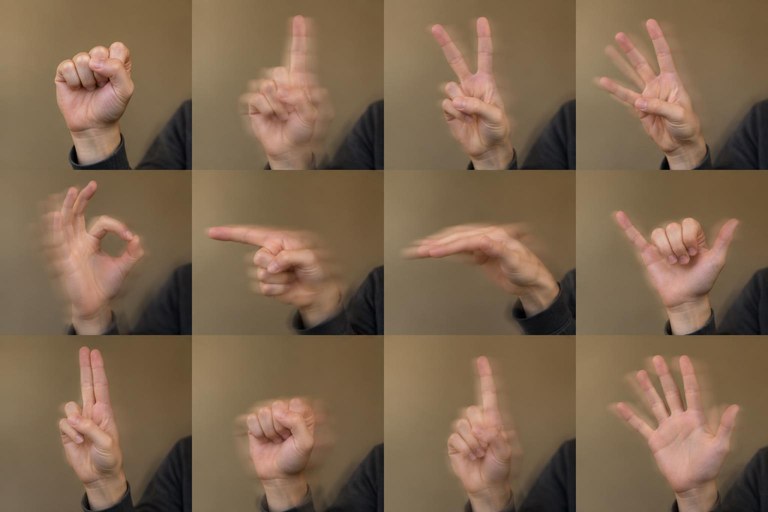
A fingerspelled word in ASL is produced as a single package, not as a list. The hand stays in the parked position you learned in the last chapter, at shoulder height and slightly to the side, palm toward the viewer, and the letters flow through that one spot. The rhythm within a word is even. The pause comes between words, not inside them.
This matters for reading, because the pauses tell you where words begin and end. If you see a short hold, a fresh word has started. A first and last name are spelled as two packages with a small pause between them, which is why you practised your own name that way.
It also matters for your own production. Steady and slightly slow reads far better than fast and uneven. Speed is not a goal. Clarity and consistent rhythm are the goal, and speed arrives on its own after a few months.
Double letters
English is full of doubled letters, and ASL handles them in one of two ways. For most letters, you make the handshape and give it a small bounce or slide to the side: the hand shifts a couple of inches sideways while holding the shape, so the viewer sees one shape appearing twice in two places. In the name Anna, the two N handshapes appear side by side rather than in the same spot. In the word coffee, the double F slides.
For letters whose fingers can simply open and close, such as the doubled L in Bill or the doubled T in butter, many signers instead re-form the handshape quickly in place, a small reopening rather than a sideways move. Both are correct and both are common. What you must not do is stop, reset, and make the letter twice as if they were two separate words. That destroys the rhythm and makes the word much harder to read.
Mouthing the word, not the letters
While you spell, your mouth should quietly form the whole English word, once, stretched gently across the spelling. Spell the name Maria and your lips shape "Maria" as one word. Do not mouth the letter names. Saying "em, ay, are, eye, ay" under your breath looks strange and is a clear beginner tell.
Mouthing helps your reader enormously, because lip shape is a second channel of information. When you are reading someone else, watch their face, not their hand. This feels wrong at first, but the hand is perfectly visible in your peripheral vision, and the mouth often hands you the answer for free. Watching the face also keeps the eye contact that chapter one insisted on.
When ASL actually fingerspells
Fingerspelling is not a substitute for signing. It is a tool with specific jobs:
- Proper names of people, unless the person has a name sign given to them by a Deaf person.
- Place names, such as cities, streets, schools, and shops, though large cities often have their own signs.
- Brands and titles, such as Toyota, Netflix, or the name of a medication.
- Specific or technical words with no common sign, such as a diagnosis or a job title.
- Clarifying a sign the other person did not recognise.
If you find yourself spelling most of a sentence, you are speaking English on your hands, not signing ASL. Spell what needs spelling and sign the rest.
Lexicalized fingerspelling
Lexicalized fingerspelling means a fingerspelled word that has worn down over time into something that behaves like a single sign. Letters get dropped, movement gets added, and the whole thing becomes a shape you recognise as a unit. Written in gloss, these are marked with a number sign in front, so #BUS, #JOB, #OK.
You do not need to analyse these letter by letter. Recognise them as shapes. In #BUS, the B slides smoothly into a twisting S with almost no U visible. In #JOB, the J and the B merge into one quick flick. In #OK, the O snaps open into a K with a small forward push. Others you will meet often include #BACK, #DO, #ALL, and #NO. When you see a spelled item that looks too fast and too fluid to be ordinary spelling, it is probably lexicalized, and the meaning is usually one of these everyday words.
Asking for a repeat, politely
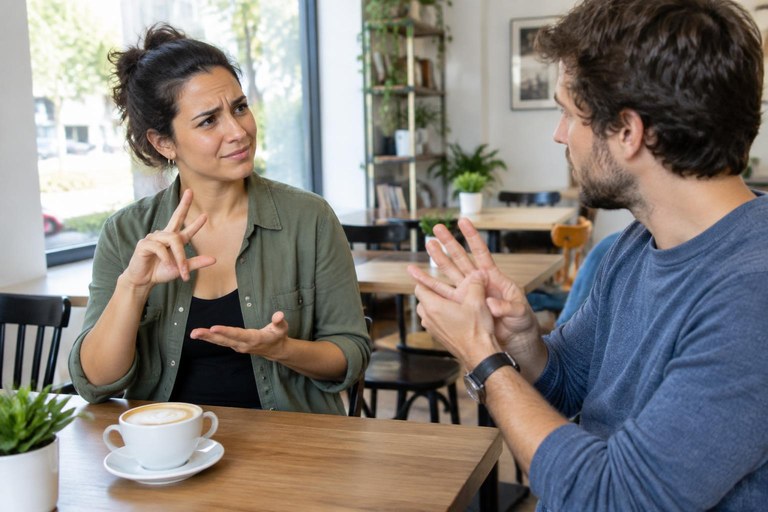
Nobody expects a new signer to read fast fingerspelling. Deaf people ask each other to repeat constantly; it is entirely normal. What is rude is pretending you understood and nodding along, because the conversation then builds on a misunderstanding.
Until you learn the specific signs for again, slow, and please in the greetings chapter, you can do three things that work immediately. Hold eye contact and let your eyebrows knit together in genuine confusion; that face alone reads as "I did not catch that." Second, repeat back the part you did get, spelling the first two or three letters yourself with a questioning expression, and the signer will take it from there. Third, hold up an open hand briefly, a small "hold on" gesture, so they wait rather than continuing. If a name is important, such as at a clinic desk, offer a pen and paper or a phone screen. Bear in mind, though, that in medical, legal, and other high-stakes settings in the United States, the Americans with Disabilities Act generally requires the provider to supply a qualified interpreter on request, so written notes are a courtesy between two people and never a replacement for that right. That is a normal, respectful solution, not a failure.
Drills for this week
- The ten-word recording. Choose ten words you would really spell: your street, your employer, two friends' names, a coffee order, a pharmacy, a pet's name. Film yourself spelling all ten at a comfortable, steady pace, with a clear pause between words. Watch it back the next day, when you have half forgotten the list, and see which ones you can read. Check three things: did your hand stay parked in one spot, did you avoid bouncing on every letter, and did you mouth whole words rather than letter names?
- Speed-up review. Watch the same recording at faster playback if your player allows it. This is the cheapest way to build tolerance for fast spelling, because the shapes are ones you already know.
- Double-letter set. Spell ten words with doubles: coffee, Anna, pizza, butter, address, Jeff, Molly, dinner, soccer, Mississippi. Film them and confirm each double slides or reopens without a full stop.
- Shape-only practice. Watch a Deaf-run video dictionary or vlog and, without trying to understand, count how many words are fingerspelled and note only their first letters. Two minutes a day, and pattern recognition builds quietly in the background.
- Partner swap. If you have a study partner, spell five words each from a list you both wrote separately. Reading real hands, not video, is the skill that transfers.
Recap
Reading fingerspelling is a shape skill, not a letter skill. Watch the face, catch the first and last letters, use context, and guess out loud. Spell your own words as one smooth package at an even pace, with the hand parked in a single spot, doubles marked by a small slide or reopening, and the whole word mouthed once. Save spelling for names, places, brands, and words with no common sign, and learn to recognise lexicalized items such as #BUS, #JOB, and #OK as single shapes. Above all, ask for repeats freely; every fluent signer does.
Review checklist
- I aim to catch the first and last letters and the word length, not every letter.
- I watch the signer's face while reading, not their hand.
- I use context and guess out loud rather than freezing.
- I keep my hand parked in one spot with an even rhythm and no bouncing.
- I pause between words, not inside them.
- I produce double letters with a small sideways slide or a quick reopening.
- I mouth the whole word once, never the letter names.
- I can name the situations that call for fingerspelling, and I do not spell whole sentences.
- I recognise #BUS, #JOB, and #OK as lexicalized shapes.
- I have filmed myself spelling ten real-life words and watched the recording back.
- I ask for a repeat without apology and offer pen and paper when accuracy matters.