By the end of this chapter you will be able to ask any question in American Sign Language two different ways: yes or no questions, and the WH-questions that start with words like who, what, where, when and why. You already know how to build statements with topic-comment order and time-first order from the last chapter. Questions in ASL use those same word patterns. What changes is your face. That is the whole secret, and it is why this chapter matters more than almost any other.
Your face is the question mark
English marks a question with word order and a little printed symbol. ASL marks a question with non-manual markers, the eyebrow, head and mouth signals you met in chapter two. If your hands sign a perfect yes or no question and your face stays flat, a Deaf signer sees a statement; a WH-question with a flat face is usually still understood, but it reads as blunt, unclear or unfinished. This is not decoration. It is grammar.
There are exactly two faces to learn, and they are opposites.
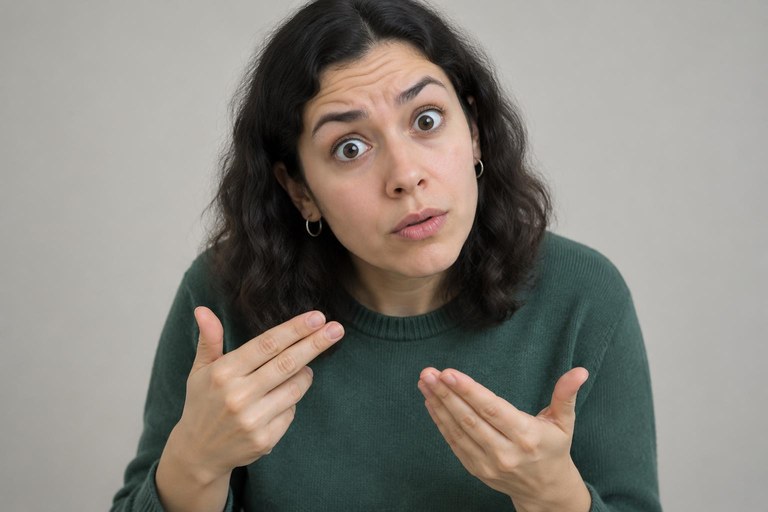
The yes or no face. Raise your eyebrows high. Tilt your head slightly forward, as though leaning in for the answer. Widen your eyes a little. Hold the last sign of the sentence in the air for a beat instead of dropping your hands, and keep looking at the person. A small shoulder lift forward helps. Take the statement YOU DEAF and add that face, and it becomes are you Deaf? Nothing on the hands changed at all.
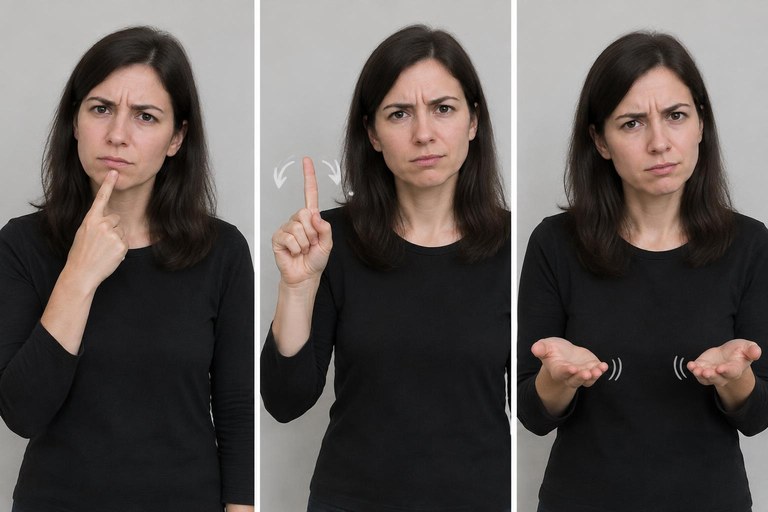
The WH face. Squeeze your eyebrows down and together. Tilt your head slightly to one side or forward. Narrow your eyes a bit, and let your mouth take a slightly open, questioning shape. Use this face for the whole question, not just on the WH-sign. Beginners often furrow only for a split second at the end; the furrow should start with the first sign and stay until you stop.
- Listen to the audio with the screen off.
- Earn a certificate upon completion.
- Over 5000 courses for you to explore!

Download the app
Where the eyebrows go wrong
Remember the topic marker from chapter eight: raised eyebrows with a small pause. Raised eyebrows are therefore doing double duty. That is fine, because the two uses do not collide. A topic sits at the start of a sentence and is followed by a comment with a neutral face. A yes or no question carries raised brows across the whole sentence and finishes with a held sign and expectant eye contact. Think of a topic as a raised eyebrow that lands, and a question as a raised eyebrow that hangs.
The eight WH-signs
Each description follows the book's standard order: handshape, palm orientation, location, movement, then face. Every one of these is signed with the WH face. Several of these signs have more than one accepted form, and regional, generational and individual variation is completely normal in ASL, so if the Deaf people around you sign one of them differently, follow their version.
- WHO — 1 hand, palm facing in, index fingertip resting just below the mouth on the chin, bend the index finger open and closed a couple of times.
- WHAT — both hands in 5 handshapes, palms up, in neutral space in front of the chest, shake them slightly from side to side. A quicker everyday version drags the dominant index finger down across the open non-dominant palm.
- WHERE — 1 hand, palm facing out, index finger pointing up at about shoulder height, shake it quickly side to side.
- WHEN — non-dominant 1 hand, palm facing in, index pointing up; dominant 1 hand circles once around it and lands fingertip to fingertip on top.
- WHY — open 5 hand, palm facing in, fingertips touching the temple, then draw the hand down and forward as it changes into a Y handshape, palm still facing in.
- WHICH — both hands in A handshapes with thumbs up, palms facing each other, in neutral space, alternate them up and down like two pistons.
- HOW — both hands in bent B handshapes with the backs of the fingers touching, palms turned down and in, then roll both hands forward and up until the palms face up.
- HOW-MANY — both hands in flat O handshapes, palms up, in neutral space, flick all the fingers open into claw 5 hands.
Where the WH-sign goes in the sentence
In ASL the WH-sign most often comes at the end of the question. This surprises English speakers, but it feels natural quickly, because the end of an ASL sentence is where emphasis lives. You may also sign it at both the start and the end for weight, which is very common in conversation. Putting it only at the front is also fully grammatical, and plenty of native signers do exactly that, so treat the final position as the pattern to drill first rather than the only correct one. What actually makes any of these read as a question is the WH face held all the way through.
- YOUR NAME WHAT — what is your name?
- YOU LIVE WHERE — where do you live?
- YOUR TEACHER WHO — who is your teacher?
- YOU HAVE HOW-MANY — how many do you have?
- WHY YOU LEARN SIGN WHY — why are you learning to sign?
- TOMORROW YOU GO WHERE — where are you going tomorrow? Notice the time sign still comes first, exactly as in chapter eight.
One more tool: the question-mark wiggle. Hold up a 1 hand, palm facing out, and hook the index finger down and straight again once or twice, tracing a question mark in the air. It is an optional emphasis marker. Use it sparingly at the end of a yes or no question when you want to be unmistakable, for example in a noisy room or when checking that someone understood. It never replaces the face.
Answering: yes, no, maybe, I don't know
- YES — S hand, palm facing out, held in neutral space, nod the whole fist up and down at the wrist like a nodding head. Nod your own head with it.
- NO — index and middle fingers extended together with the thumb, palm facing out, snap the two fingers down onto the thumb once, with a small headshake.
- MAYBE — both flat B hands, palms up, in neutral space, alternate them up and down like a balance scale that cannot settle. Let your mouth and eyebrows look uncertain.
- I DON'T KNOW — start with KNOW, the bent B fingertips tapping the forehead, then flip the hand forward and away so the palm faces up and open, with raised brows, a shrug of both shoulders and a small headshake.
Deaf signers answer generously. A nod plus the sign, or a head shake plus the sign, reads as warmer and clearer than a bare handshape.
Rhetorical questions: asking yourself out loud
ASL uses questions to connect ideas, the way English uses because. You ask, then immediately answer yourself. Here is the classic example:
I LATE WHY? BUS.
I was late because of the bus.
The crucial detail is the face. A rhetorical question takes raised eyebrows, not the furrowed WH face, because you are not really asking. Furrowed brows tell your partner to answer; raised brows tell them to wait for your explanation. Two more examples:
- I LIKE COFFEE WHY? TASTE GOOD.
- MY FRIEND DEAF, HOW I KNOW? WE WORK SAME PLACE.
Do not overuse this at first. One rhetorical question in a conversation sounds fluent. Five sounds like a lecture.
Drill: turn your statements into questions
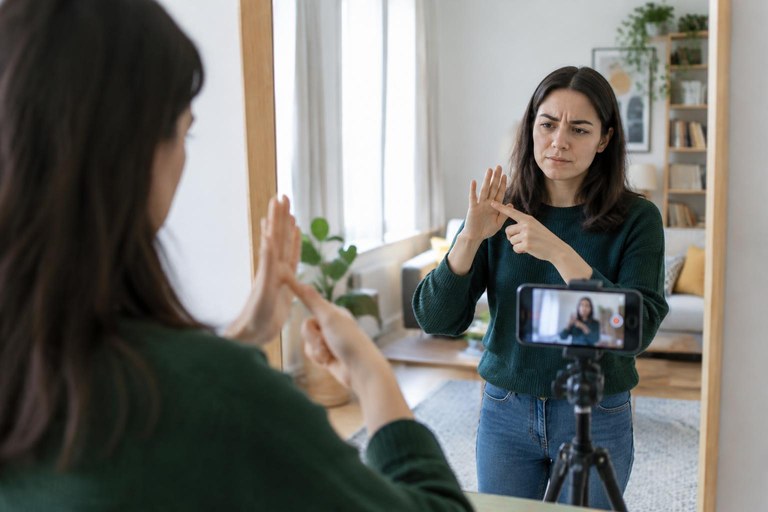
Take these statements from the last chapter and run each one through three versions. Do it in front of a mirror, then record yourself and watch it back with the sound off.
- YOU DEAF. Yes or no version: raise brows, lean in, hold DEAF. WH version: YOU DEAF HOW-LONG, with furrowed brows.
- MY FRIEND WORK. Yes or no: YOUR FRIEND WORK? WH: YOUR FRIEND WORK WHERE.
- TOMORROW I GO STORE. Yes or no: TOMORROW YOU GO STORE? WH: TOMORROW YOU GO WHERE.
- I HAVE TWO. Yes or no: YOU HAVE TWO? WH: YOU HAVE HOW-MANY.
- SHE TEACHER. Yes or no: SHE TEACHER? WH: SHE WHO. Keep pointing to the same spot in space you assigned her, as you learned in chapter seven.
When you watch the recording, check three things only: did the eyebrows move, did they move in the right direction, and did you hold the final sign or drop your hands too soon. If you cannot see the eyebrow change on video, your partner cannot see it in person. Exaggerate until it shows, then relax back slightly.
Review checklist
- I can make the yes or no face: brows up, head forward, last sign held, eye contact kept.
- I can make the WH face: brows squeezed down, head tilted, held across the whole question.
- I can sign WHO, WHAT, WHERE, WHEN, WHY, WHICH, HOW and HOW-MANY from memory.
- I place the WH-sign at the end of the sentence, or at both ends, and still put time signs first.
- I can add the question-mark wiggle for emphasis without relying on it.
- I can answer with YES, NO, MAYBE and I DON'T KNOW, with matching head movement.
- I know a rhetorical question takes raised brows, and I can sign I LATE WHY? BUS.
- I have recorded five statements turned into both question types and checked my eyebrows on video.
To recap: ASL questions are built on the statements you already know, and the grammar lives on your face. Brows up and leaning in asks for a yes or a no. Brows down and squeezed asks for information, with the WH-sign usually at the end. Brows up on a WH-sign means you are about to answer it yourself. Practise the two faces until they feel automatic, and your questions will land the first time.