By the end of this chapter you will be able to say how you feel, ask someone else how they feel and why, and say no in ASL the way Deaf people actually say it. You already know how to point, how to set up a topic, and how to put question brows on your face. Now you add the emotional layer that makes all of that sound human.
Your face is not decoration
In Chapter 2 you learned that non-manual markers are one of the five parameters of a sign. Nowhere is that more obvious than with feelings. If your hands sign SAD while your face stays cheerful, you have not signed a sentence with a mismatched mood. You have signed something confusing and slightly wrong, the way an English speaker would sound if they said the words "I am devastated" in a bright singsong voice.
So for every sign in this chapter, the face is part of the instruction. Brows down and mouth corners down for SAD. Brows tight and jaw set for ANGRY. Eyes wide and brows high for SURPRISED. Practise the face first in a mirror, then add the hands. Beginners who feel shy about this look flat and hard to read, and that is one of the most common beginner problems in the whole book.
The feeling verb itself
- FEEL: open 5 hand with the middle finger bent forward, palm in, middle fingertip on the center of the chest, brush upward once or twice. Neutral face, or already showing the feeling you are about to name.
FEEL is your all-purpose opener. YOU FEEL HOW with WH brows means "how are you feeling?"
Ten core emotions
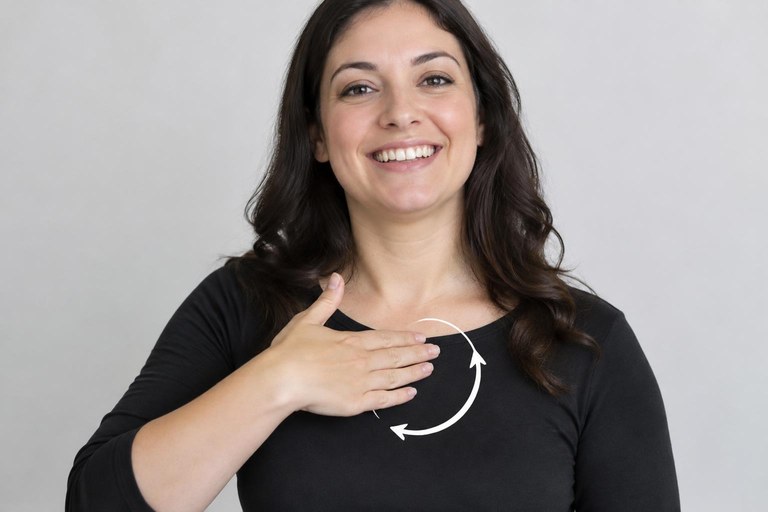
- HAPPY: flat B hand, palm in, on the chest, brush upward in repeated small circles. Smile.
- SAD: both 5 hands, palms in, in front of the face, fingers spread, drift slowly downward. Head tilts down, mouth corners down.
- ANGRY: claw 5 hand, palm in, in front of the chest or stomach, pull sharply out and up. Brows down hard, teeth clenched.
- TIRED: both bent B hands, palms in, fingertips on the upper chest, let the wrists drop so the hands rotate downward. Eyes half closed, shoulders sag.
- EXCITED: both 5 hands with the middle fingers bent forward, palms in, alternate quick upward circles brushing the chest. Eyes bright, mouth open.
- SCARED: both S hands, palms down, held apart in neutral space, flick open into 5 hands as they move toward the center of the chest. Eyes wide, shoulders pulled in.
- NERVOUS: both 5 hands, palms down, in neutral space, tremble and shake. Tense mouth, slight grimace.
- BORED: 1 hand, palm down, index fingertip touching the side of the nose, twist the hand once. Flat, droopy face, eyes unimpressed.
- SURPRISED: both S hands, palms facing each other, at the outside corners of the eyes, flick open into L shapes. Eyes wide, brows high, quick intake of breath.
- CONFUSED: 1 hand, index fingertip touching the forehead, then both claw 5 hands, palms up, circle in opposite directions in neutral space. Brows furrowed, head tilted.
Four more, plus a first look at SICK
- FRUSTRATED: flat B hand, palm facing out away from you, fingers pointing up, bring the back of the hand sharply back against the chin or mouth. Sharp exhale, brows down.
- PROUD: A hand with the thumb pointing up, palm down, drag the thumb up the center of the torso from the stomach to the chest. Chin up, satisfied smile.
- LONELY: 1 hand, palm facing to the side, index finger upright, brush the finger slowly down across the lips once. Quiet, sober face.
- SICK: 5 hand with the middle finger bent, middle fingertip touching the forehead, often with the other hand touching the stomach at the same time. Weak, unwell face. The full health chapter comes later.
- LOVE: both hands in loose fists, arms crossed over the chest, press in like a hug. Warm face.
- HATE: both hands with the thumb holding the middle finger, palms out, flick the middle fingers out sharply away from the body. Disgusted face, nose slightly wrinkled.
- ENJOY: flat B hand, palm in, circle on the chest smoothly. Contented smile. Made with one hand, this same movement is the sign PLEASE; APPRECIATE is a separate sign that uses a bent middle finger circling on the chest.
Likes, wants, and needs
You already have LIKE and WANT from the sentence-order chapter. Here they are again in one line each, plus NEED.
- Listen to the audio with the screen off.
- Earn a certificate upon completion.
- Over 5000 courses for you to explore!

Download the app
- LIKE: thumb and middle finger touching the chest, palm in, pull out from the body while the thumb and middle finger close together.
- WANT: both claw 5 hands, palms up, in neutral space, pull them back toward the body.
- NEED: X hand, palm down, in neutral space, bend the wrist sharply downward once or twice. Firm, serious face.
Saying no: the headshake does the work
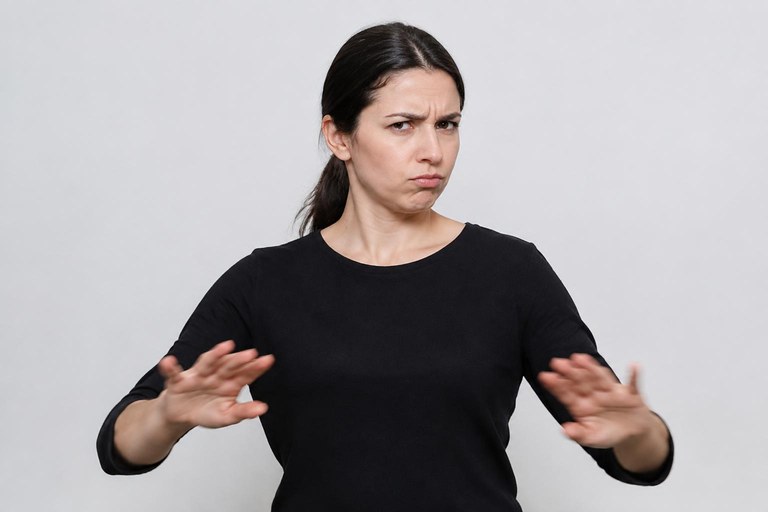
This is the most important grammar point in the chapter. In ASL, negation lives on your face and head, not only in a separate sign. You shake your head across the entire part of the sentence you are negating, and you usually pull your brows down and press your lips together.
That means you can negate with no negative sign at all. Sign I LIKE COFFEE while shaking your head throughout, and you have said "I don't like coffee." Add the headshake to UNDERSTAND from the greetings chapter and you have "I don't understand." If your hands say one thing and your head says no, the head wins.
The negation signs
- NOT: A hand, palm facing to the side, thumb tucked under the chin, move the hand forward and away. Headshake.
- NONE, also glossed NOTHING: both flat O hands, palms facing out, in neutral space, move them apart to the sides. Headshake, lips pressed.
- NEVER: flat B hand, palm facing in and then to the side, trace a wavy downward path in front of the body, like drawing a question mark without the dot. Headshake.
- NOT-YET: flat B hand, palm facing back, held low at the side of the waist with the fingers pointing down, brush backward repeatedly. Head shakes and the tongue relaxes slightly out over the lower lip, the "th" mouth morpheme. Remember this is a minimal pair with LATE, which has no headshake and no tongue.
- DON'T-KNOW: fingertips of a flat B hand touch the forehead, then the hand pulls away and twists so the palm faces out. Headshake, shoulders shrug.
- CAN'T: both 1 hands, palms down, the dominant index finger strikes down across the non-dominant index finger. Firm face, headshake.
Palm-flip negatives
Two very common negatives are made by taking a positive sign and throwing it away.
- DON'T-LIKE: start exactly like LIKE at the chest, then as the hand comes away, turn the palm out and flick the fingers open, as if dropping something distasteful. Headshake, wrinkled nose.
- DON'T-WANT: start like WANT with both claw 5 hands palms up, then flip both palms down and toss the hands outward. Headshake.
These flips feel dramatic at first. That is correct. In ASL they are ordinary.
Dialogue: how are you feeling?
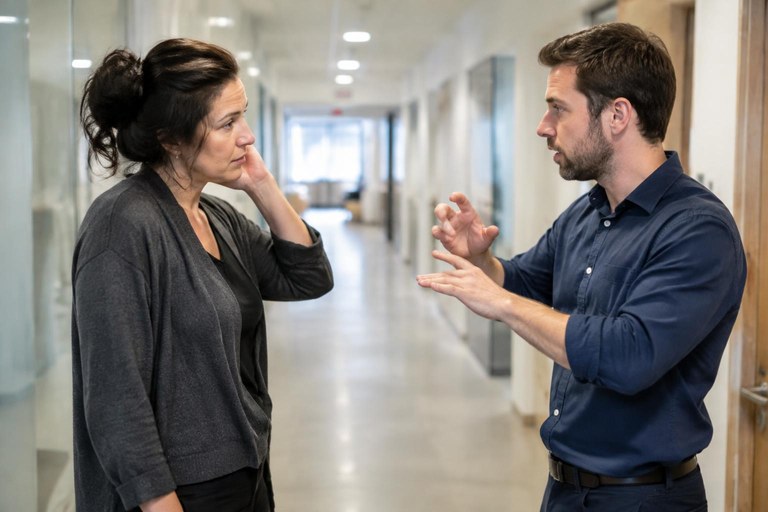
Ana and Ben meet in a hallway. The gloss is first, then the English.
ANA: HELLO. YOU FEEL HOW with WH brows.
BEN: ME TIRED. TODAY ME WORK, MEETING MANY.
ANA: OH-NO. YOU WANT COFFEE with yes/no brows.
BEN: NO, ME DON'T-LIKE COFFEE with headshake. WATER FINE.
ANA: MY SISTER SAME, COFFEE DON'T-LIKE.
BEN: YOU FEEL HOW with WH brows.
ANA: ME EXCITED. TOMORROW MY FAMILY COME.
BEN: NICE. ME NEVER MEET YOUR FAMILY with headshake.
ANA: TOMORROW YOU COME, MEET THEM with yes/no brows.
BEN: MAYBE. ME KNOW NOT-YET.
In English: "Hi, how are you feeling?" "I'm tired. I worked today and had a lot of meetings." "Oh no. Do you want coffee?" "No, I don't like coffee. Water is fine." "My sister is the same, she doesn't like coffee." "How are you feeling?" "I'm excited. My family is coming tomorrow." "Nice. I've never met your family." "Come tomorrow and meet them?" "Maybe. I don't know yet."
Notice that Ben's headshake runs across DON'T-LIKE COFFEE and across NEVER MEET YOUR FAMILY, not just on one sign. Notice too that TODAY and TOMORROW stay at the front, exactly as the sentence-order chapter taught.
Practice drills
- Face first. In a mirror, make only the face for happy, sad, angry, scared, bored and confused. Hold each for three seconds. Then add the hands.
- Emotion and reason. Build five sentences on the pattern feeling plus WHY plus reason. For example ME FRUSTRATED, WHY? MY COMPUTER. Use the rhetorical question brows from Chapter 9, which are raised, not furrowed.
- Negation sweep. Take five positive sentences you already know, such as I LIKE DOG, and sign each one twice, once plain and once with a full headshake. Watch the recording with the sound off and check that the headshake covers the whole phrase.
- Mismatch test. Record yourself signing SAD with a smile and then SAD with a sad face. Watch both. The difference will teach you more than any explanation.
- Six negatives. Sign NOT, NONE, NEVER, NOT-YET, DON'T-KNOW and CAN'T in a row, each with its headshake, and check that NOT-YET does not drift into LATE.
Review checklist
- I can sign FEEL and ask YOU FEEL HOW with WH brows.
- I can produce HAPPY, SAD, ANGRY, TIRED, EXCITED, SCARED, NERVOUS, BORED, SURPRISED and CONFUSED with a matching face.
- I can produce FRUSTRATED, PROUD, LONELY, SICK, LOVE, HATE and ENJOY.
- I can use LIKE, WANT and NEED in short sentences.
- I can negate a whole phrase with a headshake and no negative sign.
- I can produce NOT, NONE, NEVER, NOT-YET, DON'T-KNOW and CAN'T, each with the headshake.
- I can flip LIKE and WANT into DON'T-LIKE and DON'T-WANT.
- I keep NOT-YET distinct from LATE by adding the headshake and tongue.
- I understand that a mismatched face makes an emotion sign wrong, not just bland.
To recap: feelings in ASL are made with the hands and the face together, and the face is grammar rather than garnish. Negation is carried by a headshake that stretches across everything you are denying, supported by a small set of negative signs and by palm-flip forms of LIKE and WANT. With these plus your questions and pointing, you can now ask a real person how they are and understand the answer.