By the end of this chapter you will be able to say when something happened or will happen: name the days of the week, the parts of the day, the months, and the clock time, and place all of it at the front of your sentence the way ASL wants it. You already know the four basic time signs NOW, TODAY, YESTERDAY and TOMORROW from the sentence-order chapter, and you already know your numbers. This chapter fills in the rest of the calendar.
The timeline runs through your shoulder
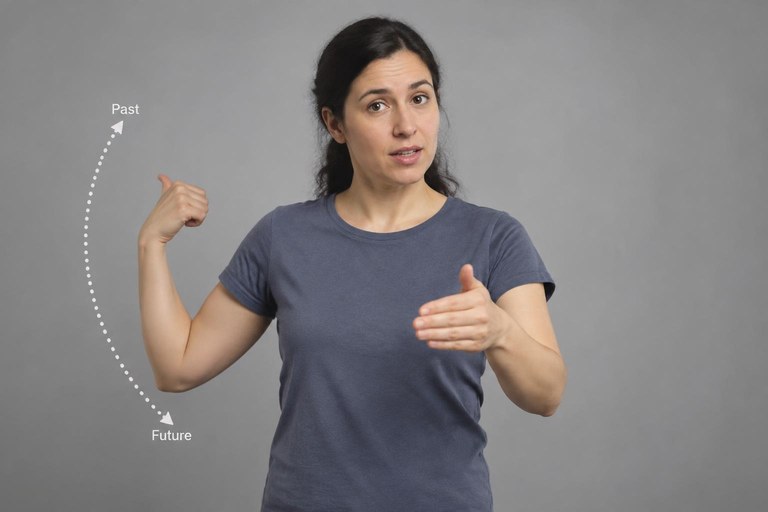
Imagine a line running past the side of your body from back to front. The space behind your shoulder is the past. The space right at your body is now. The space in front of your chest is the future. Signers use that line constantly. When a sign moves back over the shoulder, it means earlier. When a sign moves forward away from the body, it means later. That is the whole logic behind LAST-WEEK and NEXT-WEEK, and once you feel it, dozens of time signs stop being separate items to memorise.
Distance on the line also carries meaning. A small movement forward means soon. A long, slow push forward means far in the future. You will use that again in the conversation chapter when facial expression adds degree.
The basic units: DAY, WEEK, MONTH, YEAR
- DAY. Non-dominant arm lies across the body, palm down. Dominant 1 hand, index finger pointing up, palm facing in, elbow resting on the back of the non-dominant hand. The dominant arm arcs down until it lies along the non-dominant arm. Neutral face.
- WEEK. Non-dominant flat B hand, palm up, held in neutral space. Dominant 1 hand, palm down, slides forward across that palm from the heel to the fingertips. Neutral face.
- MONTH. Non-dominant 1 hand held upright, palm facing in. Dominant 1 hand, palm down, slides downward along the back of that upright finger, from the tip to the knuckle. Neutral face.
- YEAR. Both hands in S handshapes, dominant resting on top of the non-dominant. The dominant hand circles forward all the way around the non-dominant hand and lands back on top. Neutral face.
Moving those units along the timeline
- LAST-WEEK. Sign WEEK, then let the dominant 1 hand keep going past the fingertips, curve upward and flick back over your dominant shoulder.
- NEXT-WEEK. Sign WEEK, then let the dominant hand arc up and forward, away from your body.
- LAST-YEAR. From the two S hands of YEAR, raise the dominant hand near the shoulder, flick the index finger out and move it backward over the shoulder.
- NEXT-YEAR. From the same two S hands, flick the dominant index finger forward and push it ahead of the body.
Parts of the day
These four all use the non-dominant forearm as the horizon line. You already met MORNING, AFTERNOON and NIGHT in the greetings chapter, so treat those as review.
- MORNING. Non-dominant arm across the waist, palm in. Dominant flat B hand, palm up, rises from underneath that arm like a sun coming up.
- NOON. Non-dominant arm across the body, palm down. Dominant flat B hand, palm facing to the side, forearm straight up with the elbow resting on the back of the non-dominant hand. No movement.
- AFTERNOON. Same base. The dominant forearm tips forward to a diagonal, palm down, like the sun past its peak.
- EVENING. Same base. The dominant hand droops so the fingers point slightly downward past the horizon.
- NIGHT. Same base. The dominant hand bends sharply down over the edge of the non-dominant hand, fingers pointing at the floor.
The seven days of the week
Six of the seven use an initialized handshape drawn from the English word, held in neutral space in front of the chest, moving in a small circle. Palm orientation varies from region to region for all of them: some signers keep the palm facing in toward themselves, others turn it out, and both are accepted, so match the signers around you.
- Listen to the audio with the screen off.
- Earn a certificate upon completion.
- Over 5000 courses for you to explore!

Download the app
- SUNDAY. Both open flat hands, palms facing out at about shoulder height, each making a small outward circle.
- MONDAY. M handshape, palm in, small circle.
- TUESDAY. T handshape, palm in, small circle.
- WEDNESDAY. W handshape, small circle, palm in or palm out to match the rest of your set.
- THURSDAY. Several accepted variants. The most common is a quick T that opens into an H while making a small circle. Others sign a plain H with a small shake, and some fingerspell T then H. Pick one and stay consistent.
- FRIDAY. F handshape, palm in, small circle.
- SATURDAY. S handshape, palm in, small circle or a small shake.
Keep these circles small and keep them in one place. Beginners tend to swing the whole arm, which makes MONDAY and TUESDAY look identical from a distance.
The months are fingerspelled
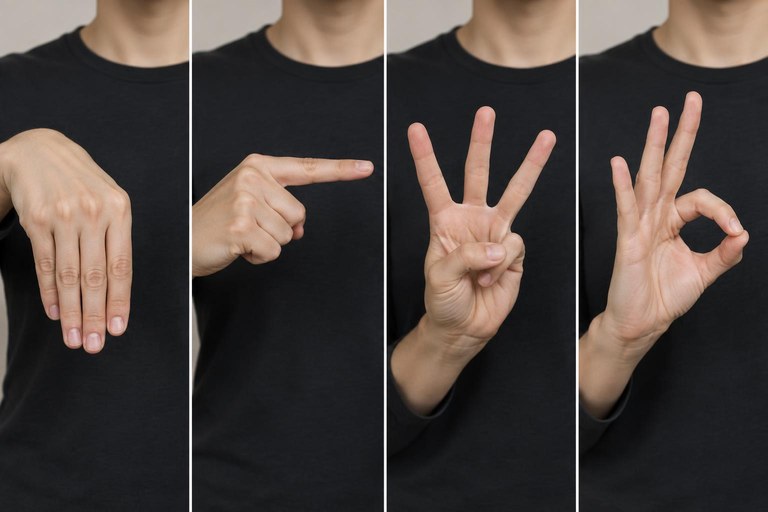
ASL does not have separate signs for the months. Signers fingerspell an abbreviation, using the smooth parked-hand rhythm from the fingerspelling chapters. The usual abbreviations are J-A-N, F-E-B, M-A-R, A-P-R, A-U-G, S-E-P-T, O-C-T, N-O-V and D-E-C. May, June and July are short enough to spell in full, and spelling June and July in full keeps them from being confused with each other.
A date is simply the month followed by the number. The fourteenth of October is O-C-T then fourteen. Your listener does not need an ordinal ending, because ASL does not tack the English -th onto a date; the plain number is enough. ASL does have grammatical inflection, but it is carried by changes in movement rather than by endings.
Clock time
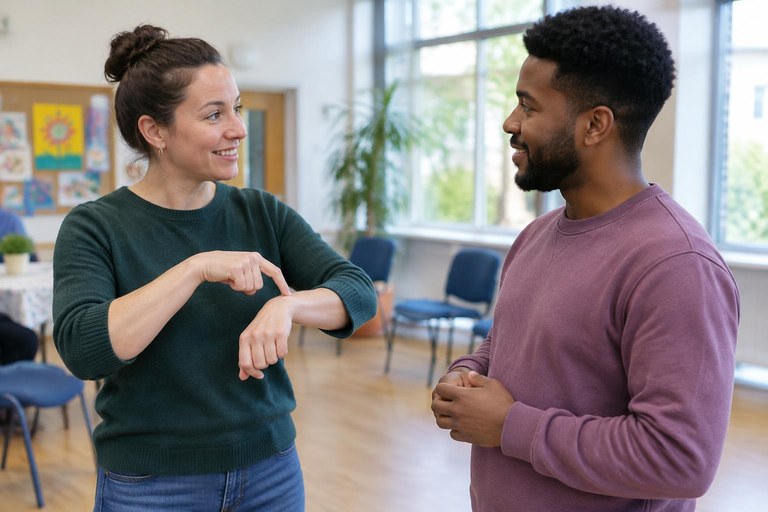
- TIME. Dominant X hand, that is a bent index finger, taps the back of the non-dominant wrist twice, right where a watch sits.
- WHAT TIME. Tap the wrist, then sign WHAT with furrowed brows and the WH face held across the whole question.
To give the hour, tap the wrist and then form the number. For one through nine the palm faces out, while ten, eleven and twelve keep their usual handshapes and orientation. An even faster and very common option is to form the number directly at the wrist, with no tap first. For minutes, sign the hour number and then the minute number in sequence. Nine thirty is nine, then thirty. Seven forty-five is seven, then forty-five. Add MORNING, AFTERNOON, EVENING or NIGHT after the time if the context is not obvious.
How often, and how punctual
- EVERY-DAY. A handshape, palm facing in, at the cheek near the jaw, brushing forward along the jawline two or three times.
- SOMETIMES. Non-dominant flat B hand, palm up. Dominant 1 hand touches that palm and arcs up and away, repeated slowly.
- ALWAYS. Dominant 1 hand, palm up, index finger circling steadily in neutral space.
- NEVER. Review from the feelings chapter. Flat B hand, palm out, tracing a wavy line downward, with a headshake.
- EARLY. Non-dominant flat B hand, palm down. Dominant hand in a 5 shape with the middle finger bent down, brushing forward over the back of the non-dominant hand.
- LATE. Flat B hand, palm facing backward, beside the hip, swinging back and down a couple of times. Remember the minimal pair from the parameters chapter: the same hand with the tongue showing and a headshake means NOT-YET.
- BIRTHDAY. There are regional variants. A widely used one is BIRTH plus DAY: both flat hands palm up, the dominant hand starting at the stomach and moving forward to land on the non-dominant palm, then the sign DAY. Another common version touches the bent middle finger of an open hand to the chin and then to the chest.
Time goes first
Everything above belongs at the front of the sentence. The time sign sets the tense, and it stays set until you change it. You never add a past or future ending to the verb.
- TOMORROW MORNING NINE, I WORK. Tomorrow morning at nine, I work.
- EVERY-DAY I PRACTICE SIGN. I practice signing every day.
- LAST-WEEK MY SISTER SICK. My sister was sick last week.
- NEXT-YEAR MY DAUGHTER AGE TEN. My daughter turns ten next year.
- SATURDAY AFTERNOON TWO, WE-TWO MEET. We two are meeting Saturday afternoon at two.
Notice the order inside the time phrase: the larger unit comes first, then the smaller. Day, then part of day, then clock number.
Dialogue: making plans
Ana and Ben are arranging to meet. The gloss comes first, then the English.
ANA: SATURDAY YOU WORK? Raised brows, head forward, last sign held. Are you working Saturday?
BEN: SATURDAY MORNING I WORK. AFTERNOON NOTHING. Headshake across NOTHING. I work Saturday morning. I am free in the afternoon.
ANA: GOOD. WE-TWO MEET, WANT? Raised brows on the question. Good. Do you want to meet up?
BEN: YES. TIME WHAT? Furrowed brows on WHAT. Yes. What time?
ANA: TWO. TOO EARLY? Raised brows. Two o'clock. Too early?
BEN: NO, FINE. MY BIRTHDAY SUNDAY, SO I HAPPY. No, that is fine. My birthday is Sunday, so I am glad.
ANA: OH, HAPPY BIRTHDAY. SATURDAY TWO, MEET. GOODBYE. Oh, happy birthday. Saturday at two, then. Bye.
Practice
- Sign the seven days in order, three times through, keeping the circles small and in one spot.
- Fingerspell all twelve month abbreviations, then fingerspell the month and number of your own birthday.
- Record yourself giving five clock times: seven fifteen in the morning, noon, two thirty, six forty-five in the evening, and eleven at night. Watch it back and check that your number palms are correct.
- Sign your real schedule for tomorrow in three sentences, each starting with a time phrase.
- Take five sentences from earlier chapters and add a time sign to the front of each. Say the English aloud afterwards to check that the tense matches.
Recap
The timeline runs from behind your shoulder, through your body, to the space in front of you, and it powers LAST-WEEK, NEXT-WEEK, LAST-YEAR and NEXT-YEAR. The four unit signs are DAY, WEEK, MONTH and YEAR. Six weekdays use an initialized handshape in a small circle, Sunday uses two open hands circling outward, and Thursday has several accepted variants. The parts of the day all use the non-dominant forearm as a horizon. Months are fingerspelled abbreviations, dates are month plus number, and clock time is a tap at the wrist followed by the number, or the number formed right at the wrist. Frequency signs are EVERY-DAY, SOMETIMES, ALWAYS and NEVER, and punctuality is EARLY and LATE.
Review checklist
- I can explain where the past, the present and the future sit on the ASL timeline.
- I can sign DAY, WEEK, MONTH and YEAR, and move WEEK and YEAR backward and forward.
- I can sign all seven days of the week with small, steady circles.
- I can sign MORNING, NOON, AFTERNOON, EVENING and NIGHT on the forearm horizon.
- I can fingerspell all twelve month abbreviations and give a date as month plus number.
- I can ask WHAT TIME with the WH face, and give an hour and minutes.
- I can sign EVERY-DAY, SOMETIMES, ALWAYS, NEVER, EARLY, LATE and BIRTHDAY.
- I put the time phrase at the front of the sentence, largest unit first, and I never add a tense ending to the verb.
- I can run the plan-making dialogue with a partner, a mirror or a camera.