In the last chapter you learned to greet someone and introduce yourself. Now you will learn how to talk about other people: how to say I, you, he, she, we and they with nothing more than a pointing finger, how to give a person who is not in the room a spot in the air and keep coming back to it, and how to sign about fifteen kinds of people, from BABY to BOSS. By the end you will be able to introduce a friend to a Deaf person and keep everyone straight.
Indexing: pointing is grammar, not rudeness
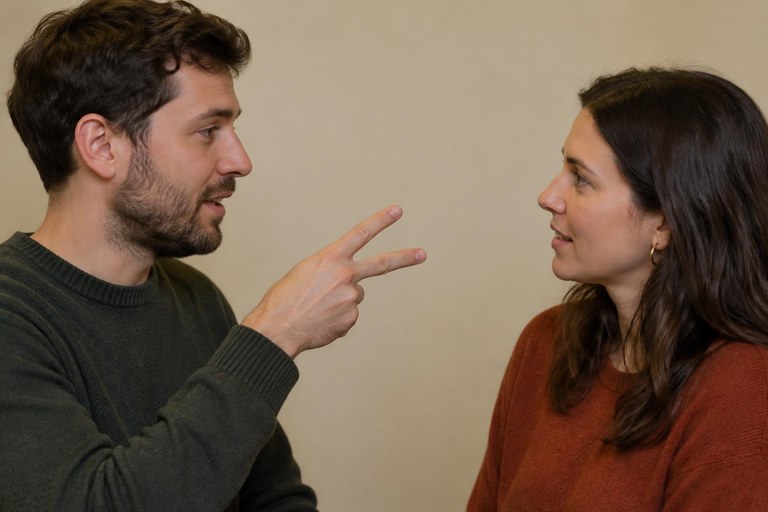
In English, pointing at people can be impolite. In American Sign Language, pointing at people is the pronoun system. The technical word for it is indexing, and it is completely neutral and expected. One handshape does almost all the work: the 1 hand, index finger extended, other fingers closed.
- I or ME — 1 hand, palm facing to the side, index finger touches the center of your chest. One contact, no tapping.
- YOU — 1 hand, palm down, in neutral space, point directly at the person you are talking to, at about their chest height. Look at them while you do it.
- HE, SHE, IT or THAT-PERSON — 1 hand, palm down, point to the person if they are present, or to an empty spot off to your side if they are not.
Notice that ASL does not mark gender in its pronouns. The same point means he, she or they. If it matters who you mean, you say the person's name or sign first, then point.
Setting a person in space
Here is the move that makes ASL feel spatial rather than spoken. When you talk about someone who is not present, you give them a location and then reuse it. The person you are talking about is the referent, and the spot in space you assign to them is called a locus.
- Name the person. Fingerspell the name, or sign a role such as FRIEND or DOCTOR.
- Point to an empty spot in the signing space, usually to your right or left at about chest height.
- Keep using that spot. Every time you mean that person again, point back to the same place.
So if you set your friend Maya on your right and your boss on your left, you can then point right, point left, and a Deaf viewer knows exactly who you mean without you repeating a single name. The one rule that matters: do not move people around. Beginners often place someone on the right and then absent-mindedly point left ten seconds later. That is the ASL equivalent of swapping names mid-story.
- Listen to the audio with the screen off.
- Earn a certificate upon completion.
- Over 5000 courses for you to explore!

Download the app

Possessives: swap the finger for a flat hand
You already know MY and YOUR from the greetings chapter. The pattern behind them is simple: a pointing finger gives you a pronoun, and a flat B hand in the same direction gives you a possessive.
- MY — flat B hand, palm in, pressed flat against the center of your chest.
- YOUR — flat B hand, palm out, pushed slightly toward the person.
- HIS or HER — flat B hand, palm out, pushed toward that person or toward their established spot in space.
- OUR — flat B hand, palm in, touch the chest near your dominant shoulder, then arc across and touch the chest on the other side, the palm turning as it goes.
- THEIR — flat B hand, palm out, sweep in a short horizontal arc across the group or their spot.
Plural pronouns and number incorporation
- WE or US — 1 hand, palm in, index finger touches your chest near the dominant shoulder, then arcs forward and around to touch your chest on the other side.
- THEY or THEM — 1 hand, palm down, point out to the side and sweep a short horizontal arc.
- YOU-ALL — 1 hand, palm down, point out and sweep across the people you mean.
ASL can also fold a number straight into a pronoun. This is called number incorporation, and it uses the number handshapes from chapter five instead of the index finger.
- TWO-OF-US — V hand held sideways, palm in, fingers pointing toward the other person, rocking at the wrist so the fingers swing between you and them.
- THREE-OF-THEM — 3 hand, palm in, off to the side where that group is set, moved in a small horizontal circle.
The same trick gives you TWO-OF-THEM, THREE-OF-US, FOUR-OF-US and so on, up to about five. Above that, signers use THEY or the group sign instead.
People vocabulary
Many of these signs use the gender pattern you met in chapter two: signs about males sit high on the forehead, signs about females sit low near the chin.
- MAN — open 5 hand, palm to the side, thumb touches the forehead, then the hand drops and the thumb touches the center of the chest.
- WOMAN — open 5 hand, palm to the side, thumb touches the chin, then drops and touches the center of the chest.
- BOY — flat O hand at the forehead, palm down, fingers and thumb open and close twice, as if grasping a cap brim.
- GIRL — A hand, palm in, thumb brushes down along the jawline from the cheek to the chin, twice.
- BABY — both forearms crossed horizontally in front of the body, palms up as if cradling, rocking gently side to side.
- CHILD — flat B hand, palm down, pats downward once or twice at about hip height.
- ADULT — A hand, palm out, touches the side of the forehead, then drops to touch near the jaw.
- PERSON — both flat B hands, palms facing each other at the sides of the chest, move straight down together.
- PEOPLE — both P hands, palms down in neutral space, circling forward alternately.
- FRIEND — both X hands, hook the index fingers together, then release and hook them the other way around.
- BOSS — claw 5 hand, palm down, taps the shoulder on your dominant side twice.
- DOCTOR — D hand, palm to the side, taps the wrist of the flat non-dominant hand twice.
- NURSE — N hand, palm down, taps the same wrist twice.
- TEACHER — both flat O hands at the temples, palms facing forward, push forward twice, then add the person marker described next.
- STUDENT — the sign LEARN, scooping from the flat non-dominant palm up to the forehead, then the person marker.
- NEIGHBOR — dominant flat B hand, palm in, placed just behind the non-dominant flat B hand and moved forward alongside it, then the person marker.
The person marker
That ending you just added twice is the person marker, sometimes called the agent marker. It is identical to the sign PERSON: both flat B hands, palms facing each other at the sides of the chest, sliding straight down. Attach it to a verb and you get the human who does it. TEACH plus person marker is teacher. LEARN plus person marker is student. SIGN plus person marker is signer. It is one of the most productive patterns in the language, so once you know it, dozens of job words come free. It does not fit every job, though: DOCTOR, NURSE and BOSS are their own signs, and tacking the person marker onto them is not how Deaf signers say those words, so look a job word up before you build it yourself.

Dialogue: introducing a friend
You are at a Deaf coffee meetup with your friend Maya. Ravi, who is Deaf, comes over. Read the gloss, then the English.
You: HELLO! NICE MEET-AGAIN. MY FRIEND, NAME M-A-Y-A. (point to Maya)
Ravi: HELLO M-A-Y-A. NICE MEET YOU. TWO-OF-YOU FRIEND?
Maya: YES. TWO-OF-US TEACHER. I HEARING, I LEARN SIGN. SLOW PLEASE.
Ravi: FINE. MY NEIGHBOR (point left) TEACHER TOO. WOMAN, DEAF.
You: OH! (point to that same spot, which is on your right) YOUR NEIGHBOR, I MEET?
Ravi: YES, LATER. (point left) COME.
In English: "Hi, good to see you again. This is my friend Maya. " "Hi Maya, nice to meet you. Are you two friends?" "Yes, we're both teachers. I'm hearing and I'm learning to sign. Please go slowly." "Sure. My neighbor is a teacher too, a Deaf woman." "Oh! Could I meet your neighbor?" "Yes, later. She's coming."
Watch what Ravi's hands do with space. He sets his neighbor on his left and never moves her. When you reply, you reach toward that same spot in the space between you, because you are now sharing his map of the conversation. Since you are facing him, his left side is your right side, so point there. Do not copy the word "left" onto your own body; point where the referent already lives.
Practice
- Point and name: I, YOU, HE-SHE, WE, THEY, YOU-ALL, then the possessives MY, YOUR, HIS-HER, OUR, THEIR. Say each gloss aloud as you sign it.
- Set two imaginary people in space, one right and one left. Record thirty seconds of yourself alternating pointing. Watch it back and check that neither person drifted.
- Take three verbs you know, TEACH, LEARN and SIGN, and add the person marker to each.
- Film the dialogue above, playing all three parts by turning your body slightly for each speaker.
Review checklist
- I can point to myself, to my listener, and to a spot in space for an absent person, and I know pointing is grammar in ASL, not rudeness.
- I can establish a referent by naming the person and then assigning them a location, and I keep pointing back to the same spot.
- I can switch from the 1 hand to the flat B hand to turn a pronoun into a possessive.
- I can sign WE, THEY and YOU-ALL with a sweeping arc, and TWO-OF-US and THREE-OF-THEM using number incorporation.
- I can produce MAN, WOMAN, BOY, GIRL, BABY, CHILD, ADULT, PERSON, PEOPLE, FRIEND, BOSS, DOCTOR, NURSE, TEACHER, STUDENT and NEIGHBOR.
- I can add the person marker to a verb to name the person who does it.
- I can introduce a friend to a Deaf person while keeping eye contact instead of watching my own hands.
To recap: ASL pronouns are points, possessives are flat hands, plurals sweep or carry a number, and anyone you talk about gets a spot in the air that stays put. Add the person marker and a small set of people signs, and you can now talk about everyone in the room and a few who are not.