By the end of this chapter you will be able to name the main parts of the body, describe common symptoms, ask a Deaf person where it hurts and how long it has been going on, and sign the emergency vocabulary that a parent, teacher, or front-desk worker needs. You will also learn the single most useful sentence in this whole book for a medical setting: I need an interpreter.
Body parts: mostly just point
ASL is refreshingly practical here. For most body parts above the shoulders, you simply point with a 1 hand, index finger extended, touching or nearly touching the part you mean.
- HEAD — bent B hand, palm in, fingertips touch the side of the head near the temple, then lift and touch again lower near the jaw.
- EYES — 1 hand, palm in, index finger points just below the eye; touch once, or touch below each eye in turn.
- EARS — 1 hand, palm out, index finger touches the earlobe.
- NOSE — 1 hand, palm in, index finger touches the tip of the nose.
- MOUTH — 1 hand, palm in, index finger circles once around the lips.
- TEETH — 1 hand, palm in, index fingertip taps the front teeth, lips parted so the teeth show.
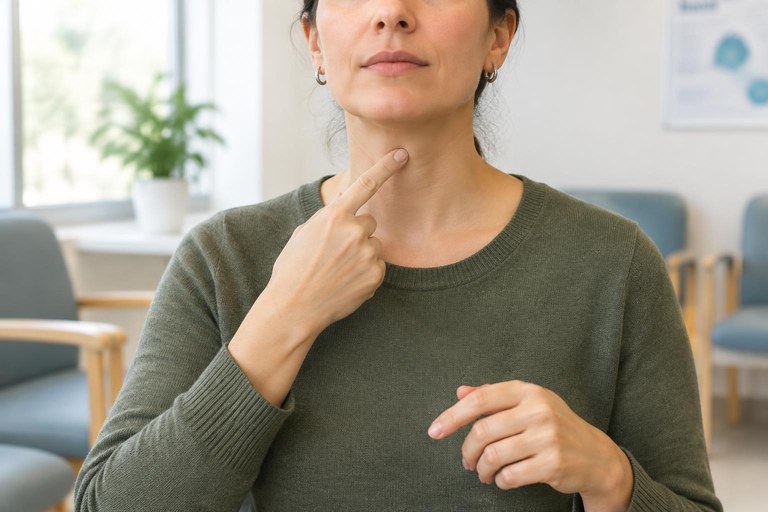
- THROAT — 1 hand, palm in, index finger draws a short line down the front of the throat.
- STOMACH — flat B hand, palm in, pats the belly twice.
- BACK — flat B hand, palm in, pats the lower back, or reaches over the shoulder and pats twice.
- ARM — flat B hand, palm down, strokes down the non-dominant forearm from elbow to wrist.
- LEG — flat B hand, palm down, pats the thigh twice.
- HAND — flat B hand, palm down, brushes across the back of the flat non-dominant hand.
- HEART — open 5 hand, palm in, the tip of the middle finger taps the chest twice over the heart.
SICK, HURT, and moving the sign to the spot
You met SICK in the feelings chapter: both open 5 hands, palms in, the middle finger of the dominant hand touches the forehead while the middle finger of the other hand touches the stomach, with an unwell face. SCARED is also worth reviewing here, since frightened patients are common: both hands start as A fists at the sides of the body and fly open into 5 hands across the chest, with wide eyes.
HURT, also glossed PAIN, is two 1 hands, index fingers pointing toward each other in neutral space, jabbing toward each other twice without touching, with a pinched, pained face. Here is the elegant part: you move HURT to the body part that hurts. Make the two jabbing fingers in front of your forehead and it means headache. Make them in front of your stomach and it means stomach ache. Make them near the jaw and it means toothache. The location parameter is doing the work, exactly as it did for MOTHER and FATHER.
- FEVER — the back of a flat B hand, palm out, presses against the forehead, with a droopy, hot face. Many signers add HOT or SICK.
- COLD, meaning a head cold — thumb and index finger pinch just under the nose and pull down and off, twice, as if wiping the nose. Do not confuse it with the temperature COLD from the describing chapter, which is two S hands shivering.
- COUGH — claw 5 hand, palm in, thumps the upper chest twice while the shoulders jolt and the mouth opens.
- ALLERGY — 1 hand, palm in, index finger touches the nose, then both 1 hands, index fingers pointing toward each other in neutral space, pull sharply apart. Follow it with a fingerspelled food or substance.
Medicine, and where care happens
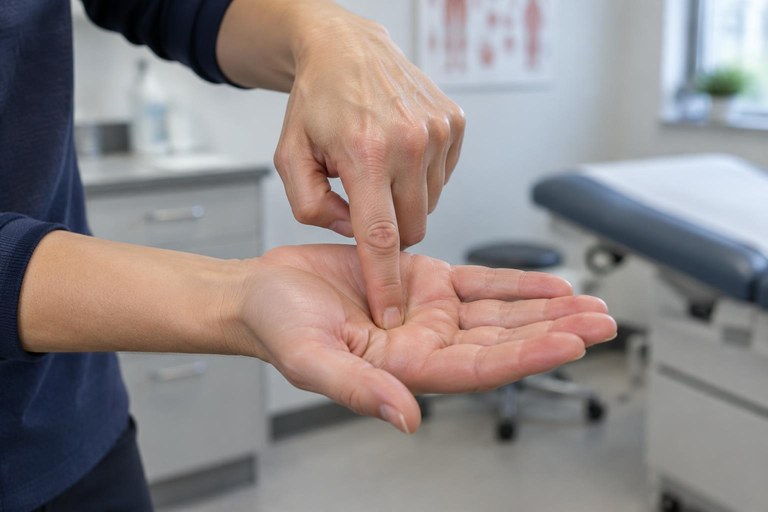
- MEDICINE — non-dominant flat B hand, palm up; the middle finger of a dominant 5 hand presses into that palm and rocks side to side.
- PILL — thumb tucked behind the index fingertip, palm in, near the mouth; the thumb flicks the fingertip open as if tossing a pill in.
- DOCTOR, reviewed — D hand fingertips tap the pulse point of the upturned non-dominant wrist twice.
- NURSE, reviewed — the same tap at the wrist, made with an N hand.
- HOSPITAL — H hand, palm in, draws a small cross on the upper arm of the non-dominant side.
- APPOINTMENT — dominant A hand, palm out, circles once above the non-dominant S hand, then lands on the back of it.
Emergency vocabulary
- EMERGENCY — E hand, palm out, held at shoulder height and shaken quickly side to side, with an urgent face.
- ACCIDENT — two A fists, palms in, knock into each other once with force in neutral space.
- POLICE — C hand, palm to the side, taps twice on the opposite side of the chest where a badge sits.
- FIRE — both 5 hands, palms in, fingers wiggling as the hands rise in front of the body like flames.
- DANGER — non-dominant A fist, palm in; the dominant A fist, thumb up, brushes upward along the back of it twice, with a warning face.
- CALL, meaning phone someone — Y hand, thumb at the ear and pinky at the mouth, moved slightly toward the person you are calling.
- TEXT — non-dominant flat B hand held like a phone, palm up; both thumbs tap quickly on it.
A plain safety note. In a real medical or emergency situation, do not rely on your beginner signing, and do not ask a child to interpret; lean on a family member only for the first moments of a life-threatening emergency, and never let the search for an interpreter delay calling 911 or starting care. In the United States, the Americans with Disabilities Act and Section 504 require hospitals, clinics, and emergency services to provide effective communication at no cost to the patient, which for most medical conversations means a qualified interpreter, on site or by video; the provider does have some say in which aid it uses, so if what is offered is not working, say so plainly and ask again. Rules differ in other countries, so check the law where you live. Your job as a beginner is to stay calm, make eye contact, write notes if needed, and get a professional on the way. Remember that written English is a second language for many Deaf people, so notes are a stopgap for simple things like where to wait, and never a substitute for an interpreter when symptoms, consent, or a diagnosis are involved.
- Listen to the audio with the screen off.
- Earn a certificate upon completion.
- Over 5000 courses for you to explore!

Download the app
INTERPRETER, and the sentence to memorise
INTERPRET is two F hands, palms facing each other, fingertips near the lips, twisting back and forth so the hands swap positions. Add the person marker from the pronouns chapter — both flat B hands, palms facing each other, sliding down the sides of the torso — and you have INTERPRETER. Combine it with NEED, the X hand bending sharply down twice, and you get:
ME NEED INTERPRETER
English: I need an interpreter.
A Deaf person may also point to a card, type on a phone, or sign CALL VIDEO. Two services are worth knowing as vocabulary. Video relay service lets a Deaf person sign to an interpreter on a video screen, who speaks to a hearing caller and signs the reply back; in the United States it is funded for telephone calls only, so when the two of you are in the same room the service to ask for is video remote interpreting, not relay. Text relay does the same thing in typed text. Many areas now accept text to 911, but coverage is patchy, so treat it as a backup rather than a certainty: if the service is unavailable, the phone returns an automatic bounce-back message, and a voice call or a videophone call to 911 should be made instead. You do not need to operate these systems; you only need to recognise the request and not treat it as a delay.
The two questions every helper needs
WHERE HURT? Sign WHERE, the 1 hand shaking side to side, then HURT, with furrowed WH brows held across both signs. Or point at the person, then sign HURT WHERE. Then let them show you by moving HURT to the spot.
HOW LONG? Sign HOW, then LONG, the dominant index finger sliding up the non-dominant arm from the wrist, past the elbow, toward the shoulder, again with WH brows. A simple alternative is START WHEN with the same face.
Dialogue: at the clinic front desk
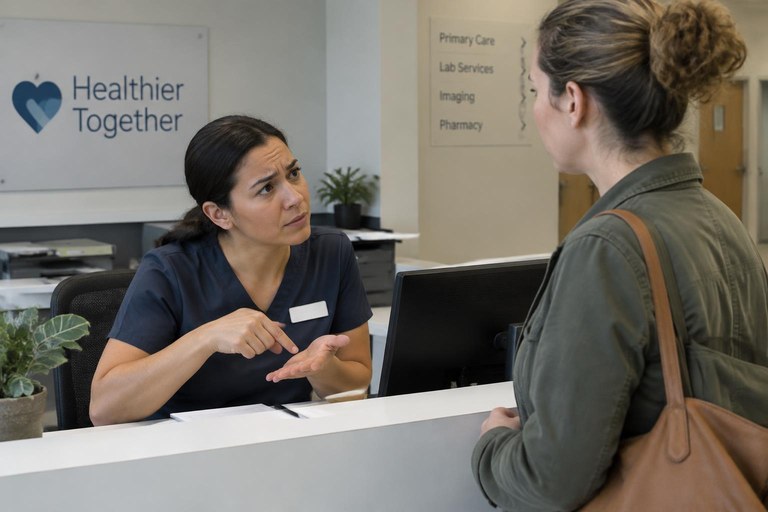
Clerk: HELLO. HELP YOU HOW? WH brows. — Hello. How can I help you?
Patient: ME DEAF. ME NEED INTERPRETER. ME HAVE APPOINTMENT 2. — I'm Deaf. I need an interpreter. I have a two o'clock appointment.
Clerk: FINE. ME CALL INTERPRETER NOW. YOU SICK? Yes/no brows, last sign held. — Okay, I'll call an interpreter now. Are you unwell?
Patient: YES. THROAT HURT, FEVER TOO. — Yes. My throat hurts and I have a fever.
Clerk: HOW LONG? WH brows. — How long has this been going on?
Patient: THREE DAY. YESTERDAY ME COUGH ALL-NIGHT. — Three days. Last night I coughed all night.
Clerk: YOU TAKE MEDICINE FINISH? Yes/no brows. — Have you taken any medicine?
Patient: NOT-YET. ME ALLERGY fingerspell the drug name. — Not yet. I'm allergic to that drug.
Clerk: UNDERSTAND. PLEASE SIT. DOCTOR COME SOON. — Understood. Please have a seat. The doctor will be with you soon.
Four short drills
- Pain map. Sign HURT at eight different body locations in a row, naming each one in English aloud as you go.
- Two questions. Film yourself signing WHERE HURT? and HOW LONG? five times. Check that your eyebrows stay down for the whole question, not just the last sign.
- Emergency five. Sign EMERGENCY, ACCIDENT, FIRE, POLICE, DANGER with a matching urgent face, then again with a blank face, and notice how weak the second version looks.
- The sentence. Practise ME NEED INTERPRETER until you can produce it without thinking, in under two seconds.
Recap and review checklist
This chapter gave you thirteen body-part signs that mostly work by pointing, the symptom signs SICK, HURT, FEVER, COLD, COUGH and ALLERGY, the trick of moving HURT to the aching spot, the care vocabulary MEDICINE, PILL, DOCTOR, NURSE, HOSPITAL and APPOINTMENT, the emergency set EMERGENCY, ACCIDENT, POLICE, FIRE, DANGER, CALL and TEXT, and the request ME NEED INTERPRETER.
- Can I point out head, eyes, ears, nose, mouth, teeth, throat, stomach, back, arm, leg, hand and heart?
- Can I sign HURT at three different body locations to show three different aches?
- Can I tell the head-cold COLD apart from the temperature COLD?
- Can I ask WHERE HURT? and HOW LONG? with furrowed WH brows held throughout?
- Can I sign ME NEED INTERPRETER smoothly and recognise it when a Deaf person signs it to me?
- Do I know that a qualified interpreter, not a family member and not a beginner, is what a medical setting requires?