By the end of this chapter you will be able to name about two dozen relatives in American Sign Language, ask someone whether they have brothers or sisters, answer with a number, and tell someone how old a family member is. You will also use the pointing skills from the pronouns chapter to lay out a family photo in the space in front of you, so you can talk about several relatives without naming them again and again.
The gender rule: chin for female, forehead for male
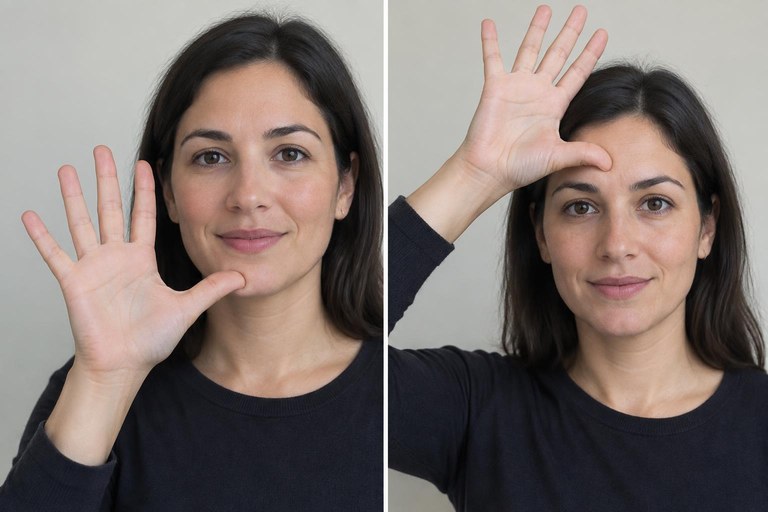
Family vocabulary is the easiest set of signs in this book to remember, because most of it follows one pattern. Signs for female relatives are made near the chin and lower face. Signs for male relatives are made near the forehead and upper face. For pairs such as MOTHER and FATHER, or GRANDMOTHER and GRANDFATHER, nothing else about the sign changes. A few pairs are exceptions: AUNT and UNCLE use different initialised handshapes, A and U, alongside the difference in height, so the rule predicts where a sign is made more reliably than it predicts the handshape. This is location doing grammatical work, exactly as promised in the chapter on the five parameters, and MOTHER and FATHER are the classic minimal pair that proves it.
A useful memory hook: the upper half of the face is the traditionally male half, the lower half the female half. You do not have to like the logic to use it. Once you know it, you can predict half the signs in this chapter before you read them.
- MOTHER. Open 5 hand, palm facing to the side, thumb touching the chin, tap twice. Relaxed face.
- FATHER. Open 5 hand, palm facing to the side, thumb touching the forehead, tap twice.
- PARENTS. Open 5 hand, palm to the side, thumb touches the chin, then lifts and touches the forehead. One smooth move from female to male location.
Grandparents, aunts, uncles, cousins
- GRANDMOTHER. Start in the MOTHER position, thumb of the open 5 hand at the chin, then arc the whole hand forward and away from the face in one or two small hops, as if stepping back a generation.
- GRANDFATHER. The same forward arc, but starting with the thumb at the forehead.
- AUNT. A hand, palm facing out, held beside the jaw at chin height, shake slightly from the wrist.
- UNCLE. U hand, palm facing out, held beside the temple at forehead height, shake slightly from the wrist.
- COUSIN. C hand, palm facing out, shaken at the side of the face. Hold it at chin height for a female cousin, at forehead height for a male cousin, and at cheek height in the middle when it does not matter.
Brothers, sisters, sons, daughters
These signs are two-part compounds. The first part marks gender at the chin or forehead, and the second part joins the two hands together.
- SISTER. Begin with an L hand, palm to the side, thumb resting on the jaw near the chin. Then bring that hand down as a 1 hand, palm down, and tap it onto the non-dominant 1 hand, which waits palm down in neutral space.
- BROTHER. The same shape and the same landing, but the L hand starts with the thumb at the forehead.
- SIBLING. Sign BROTHER then SISTER as a pair. Glossed together, it means siblings in general.
- SON. Flat O hand grasping at the forehead as if tipping a cap, then open both hands flat, palms up, and fold the forearms together in front of the body, cradling a baby.
- DAUGHTER. The same cradle, but the first part is the thumb of an L hand brushing down the jawline at the chin.
- CHILDREN. Both flat B hands, palms down, in neutral space at waist height, pat downward twice while moving to the dominant side, as if patting the heads of several children. Keep the palms flat and down; with palms up this becomes THINGS, one of the minimal pairs from chapter two.
Partners and relationship status
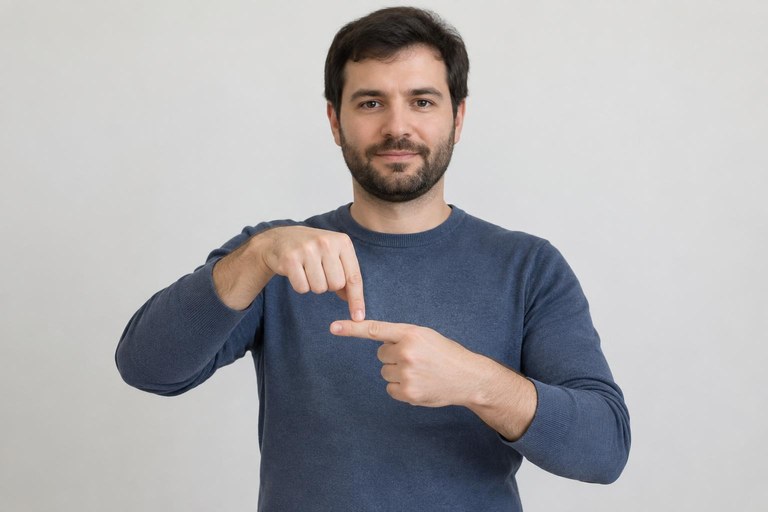
- MARRIED. Both hands slightly curved, dominant palm down, non-dominant palm up in neutral space, and the dominant hand comes down to clasp the other in one firm movement, like joining hands.
- HUSBAND. Flat O hand grasps at the forehead, then both hands drop into the MARRIED clasp.
- WIFE. The thumb of the hand brushes down the jawline at the chin, then both hands drop into the MARRIED clasp.
- PARTNER. Both P hands, palms facing each other, moving together in a small flat circle in neutral space. Many signers simply fingerspell the word, and MARRIED also serves for a spouse of any gender.
- DIVORCED. Both D hands, index fingers up, palms facing each other in neutral space, then twist the wrists apart so both palms turn outward.
- SINGLE. One 1 hand, palm facing in, index finger pointing up, moved in a small circle in neutral space. The circle, not a side-to-side shake, is what makes it read as SINGLE.
- FAMILY. Both F hands, palms facing out, thumbs and index fingers touching in front of the chest, then circle the hands outward and around until the little fingers nearly meet, palms now facing in. Think of a circle of people.
Pets count as family too
- PET. Dominant hand slightly curved, palm down, stroking twice along the back of the non-dominant hand, which is held flat, palm down, in neutral space.
- DOG. Flat B hand, palm in, patting the thigh twice, followed by a finger snap. Some signers use only the snap.
- CAT. F hand, palm facing to the side, thumb and index finger at the corner of the mouth, pulling outward twice like whiskers. Often made with both hands at once.
Asking and answering about family
You already have every grammar piece you need: HAVE and the numbers, HOW-MANY with its furrowed WH face, and yes/no questions with raised brows. Family questions are simply those tools with the new vocabulary dropped in.
- Listen to the audio with the screen off.
- Earn a certificate upon completion.
- Over 5000 courses for you to explore!

Download the app
- YOU HAVE BROTHER SISTER? — raised brows, head forward, last sign held. This means "Do you have any siblings?"
- I HAVE TWO BROTHER. — "I have two brothers." There is no plural S. The number carries the quantity.
- BROTHER SISTER HOW-MANY? — brows down across the whole question. "How many siblings do you have?"
- NONE. I ONLY-ONE CHILD. — a headshake with NONE does the negative work. For "only child" use ONLY-ONE, the 1 hand circling, rather than the relationship-status meaning of SINGLE.
- MY SISTER AGE TWELVE. — form AGE at the chin, then the number twelve. "My sister is twelve."
- YOUR MOTHER AGE HOW-MANY? — a direct question about age, which is generally more acceptable in Deaf cultural norms than in mainstream hearing etiquette, though some people would still rather not answer, so read the response and let it go.
Notice that the possessive is the flat B hand from the pronouns chapter, not the index finger. MY SISTER uses a flat palm to your own chest; YOUR FATHER uses a flat palm toward the other person.
Dialogue: looking at a family photo
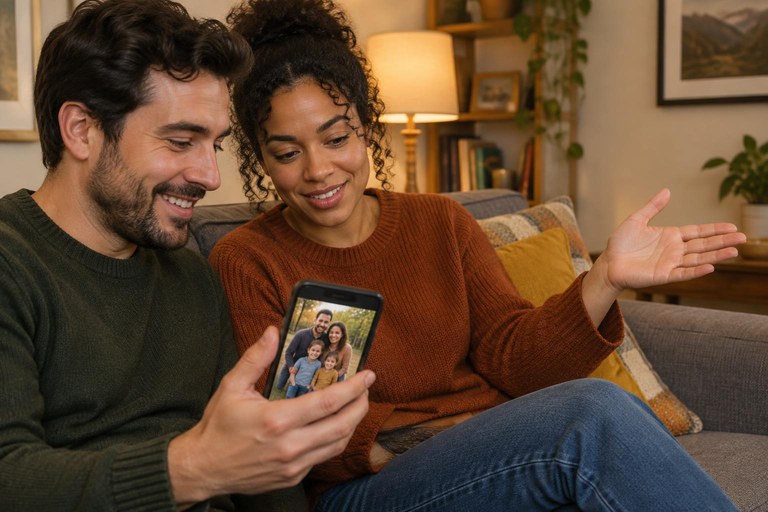
Two people, Dana and Ravi, are looking at a photo on a phone. Watch how Ravi assigns each relative a spot in the space in front of him and then points back to that spot instead of repeating the sign.
DANA: YOUR FAMILY? (raised brows) — "Is that your family?"
RAVI: YES. MY FATHER (point slightly right), MY MOTHER (point slightly left). — "Yes. That's my father, and that's my mother."
DANA: YOU HAVE BROTHER SISTER HOW-MANY? — "How many brothers and sisters do you have?"
RAVI: THREE. TWO BROTHER, ONE SISTER. SISTER (point far left) AGE TWELVE. — "Three. Two brothers and one sister. My sister is twelve."
DANA: (point far left) SHE DEAF? — "Is she Deaf?"
RAVI: NO, HEARING. SHE LEARN SIGN NOW. — "No, hearing. She's learning to sign now."
DANA: NICE. DOG YOURS? — "Nice. Is the dog yours?"
RAVI: YES, MY PET. CAT TWO ALSO. — "Yes, that's my pet. I have two cats as well."
When Dana points far left, Dana is reusing the spot Ravi already built. That consistency is what makes spatial pointing readable, and moving a relative to a new spot halfway through is one of the commonest beginner errors.
Practice plan for this chapter
- Gender drill, one minute. Alternate MOTHER, FATHER, GRANDMOTHER, GRANDFATHER, SISTER, BROTHER, and check in a mirror that the chin signs stay low and the forehead signs stay high.
- Your own family, three minutes. Sign each real relative once, then fingerspell that person's name, then assign them a spot and point to it.
- Number pairing. Say aloud a family fact about yourself and sign it: two brothers, one cat, a grandmother aged eighty-one.
- Record and review. Film yourself answering "YOU HAVE BROTHER SISTER HOW-MANY?" in thirty seconds. Watch it back and check three things: eyebrows down on HOW-MANY, the numbers clear, and your pointing spots unchanged from start to finish.
Review checklist
- I can state the gender-location rule: female signs at the chin, male signs at the forehead.
- I can sign MOTHER, FATHER, PARENTS, GRANDMOTHER, GRANDFATHER, AUNT, UNCLE, and COUSIN with the correct height on the face.
- I can produce the two-part signs SISTER, BROTHER, SON, and DAUGHTER, and I can sign SIBLING and CHILDREN.
- I can sign MARRIED, HUSBAND, WIFE, PARTNER, DIVORCED, SINGLE, and FAMILY.
- I can sign PET, DOG, and CAT.
- I can ask a yes/no question with raised brows and a HOW-MANY question with lowered brows about someone's family.
- I can answer with a number and no plural ending, placing the number either before the noun, as in TWO BROTHER, or after it, as in CAT TWO, since ASL allows both orders.
- I can give a relative's age using AGE at the chin followed by the number.
- I can set two or three relatives in the signing space and point back to the same spots consistently.
To recap: family vocabulary is organised by location, with women low on the face and men high, so learning one sign usually gives you its partner for free. The compound signs add a joining movement to that gender marker. And with HAVE, HOW-MANY, the numbers and AGE from earlier chapters, you can already hold a genuine conversation about who is in your family and how old they are.