By the end of this chapter you will be able to tell a Deaf person what you do for a living, ask them the same question, name school subjects and classroom objects, and walk someone through your typical day using the time-first order you learned in the sentence chapter. You will also meet your first directional verbs, where the direction the sign travels tells us who is doing what to whom.
Work vocabulary
All descriptions follow the book's usual order: handshape, palm orientation, location, movement, then face. Left-handed signers mirror everything. Keep in mind too that ASL vocabulary varies by region, age group and school background, so the versions given here are common ones, not the only correct ones; if a local Deaf signer shows you a different sign for EMAIL, COMPUTER or a school subject, use theirs.
- WORK (review) — two S hands, palms down, in neutral space; the dominant wrist taps the back of the non-dominant wrist twice.
- JOB — many signers fingerspell this as a quick, smooth J-O-B, the lexicalized #JOB you met earlier, while others simply sign WORK and let context do the rest. Keep it small and in your parked hand position.
- BUSY — dominant B hand, palm facing out, resting on the back of the non-dominant S hand; brush it back and forth with a small twisting motion. Squint slightly and mouth "busy" for a hectic day.
- BUSINESS — the same B hand on the same spot, but tapping in place twice instead of brushing. BUSY and BUSINESS are a near minimal pair separated only by movement, so make the difference clear.
- COMPANY — two C hands, palms facing each other in neutral space, circle outward and back until the palms face your chest. This is the same "group" template used for CLASS, so COMPANY and CLASS look alike — context tells them apart, and many signers fingerspell C-O or sign BUSINESS when they mean a company.
- OFFICE — two O hands, palms facing each other, then shift so one hand is in front of the other, exactly like the ROOM sign from the home chapter but with the initialized O handshape.
- MEETING — two 5 hands, palms facing each other, fingers up, in neutral space; bring them together so the thumbs and fingertips meet, like two groups coming face to face.
- BOSS (review) — claw 5 hand tapping the dominant shoulder.
- COWORKER — sign WORK, then both A hands, palms facing each other with knuckles touching, circling once horizontally. The gloss is WORK-TOGETHER, and adding PERSON with the person marker gives you "the person I work with."
- COMPUTER (review) — C hand arcing over the back of the non-dominant forearm.
- EMAIL — non-dominant C hand, palm facing your dominant side, forms a tunnel; the dominant flat B hand, palm sideways, slides straight through it and out the far side.
- WRITE — dominant hand pinches thumb and index together as if holding a pencil, palm down, and drags across the open non-dominant palm twice.
- READ — non-dominant flat B hand, palm facing you like an open page; dominant V hand, palm down, fingertips pointing at the page, moves down the palm like two eyes scanning lines.
School vocabulary
- SCHOOL — both flat B hands, non-dominant palm up; the dominant palm claps down onto it twice, fingers pointing forward.
- CLASS — two C hands, palms facing each other, circling outward and back until the palms face you.
- COLLEGE — start with the SCHOOL clap, then let the dominant hand spiral upward in a circle above the non-dominant palm.
- GRADUATE — dominant G hand, palm down, circles once above the non-dominant flat palm and then drops onto it.
- TEACHER and STUDENT (review) — TEACH plus the person marker, and LEARN plus the person marker.
- HOMEWORK — a compound sign: HOME at the cheek, then WORK at the wrists, blended into one smooth motion.
- TEST — both index fingers, palms out, draw two small question marks in the air, then open into 5 hands that move down and forward. Slight worry on the face is normal and natural.
- BOOK — both flat B hands, palms together in neutral space, open outward hinged at the pinky edges, like a book opening.
- PAPER — dominant flat B hand, palm down, brushes across the heel of the upturned non-dominant palm twice, moving toward your body.
- PEN — many signers simply fingerspell P-E-N; others use the WRITE handshape with one short, single stroke, understood as the object from context.
- MATH — two M hands, palms facing in, brush past each other twice in neutral space.
- SCIENCE — two A hands with thumbs pointing down, palms facing each other, making alternating pouring circles downward, like mixing two beakers.
- ENGLISH — the dominant hand, palm down, grasps the back of the non-dominant hand, also palm down, and pulls both slightly toward your body.
- ART — dominant I hand, pinky extended, palm facing the non-dominant flat palm; the pinky draws a wiggly line down the palm.
- PRACTICE — dominant A hand, palm down, rubs back and forth along the extended index finger of the non-dominant 1 hand.
- START — non-dominant 5 hand, palm out, fingers up; the dominant index finger slips between the index and middle finger and twists like a key in an ignition.
FINISH: a verb and a grammar tool
FINISH is made with both 5 hands, palms facing in toward your chest, fingers up; flip them out quickly so the palms face forward and down. Mouth a short "fsh" as you do it.
FINISH means "to be done," but it does far more than that. Placed after a verb, it marks the action as completed, which is how ASL often shows past events without any word ending: I EAT FINISH means "I have already eaten." Placed before a verb, it can mean "after that": I FINISH EAT, I WORK means "after I eat, I go to work." With yes/no eyebrows, FINISH? on its own asks "are you done yet?" And signed sharply with a firm face, it means "stop that" — a very blunt correction, so save it for close friends, family or a real interruption rather than aiming it at strangers or coworkers. One sign, four jobs, all controlled by placement and face.
Directional verbs: let the movement point
Some ASL verbs travel between people, and the path of the hand replaces the subject and object. Four beginner-friendly examples:
- Listen to the audio with the screen off.
- Earn a certificate upon completion.
- Over 5000 courses for you to explore!

Download the app
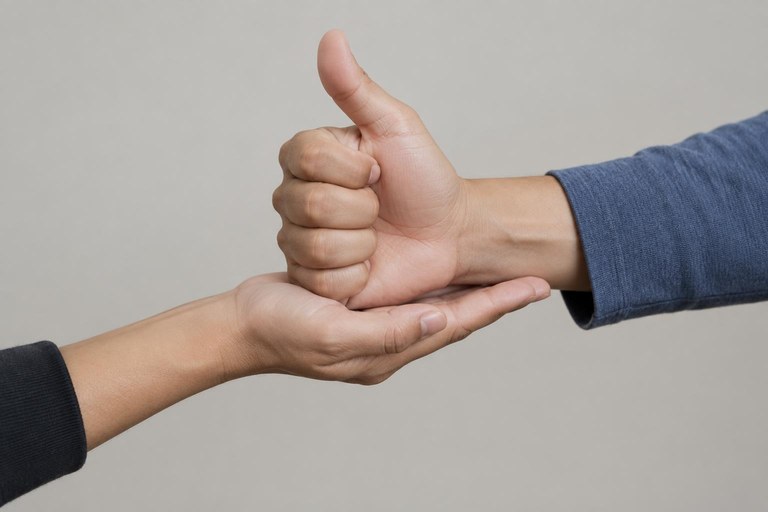
- HELP — non-dominant flat B hand, palm up; dominant A hand with thumb up sits on that palm; both lift together. Lift it starting near your own body and moving toward the other person for I-HELP-YOU. Start it out near them and bring it toward your chest for YOU-HELP-ME.
- GIVE — flat O hand, palm up, moves from the giver toward the receiver. I-GIVE-YOU travels away; YOU-GIVE-ME travels in.
- ASK — dominant 1 hand, palm out, bends into an X as it moves toward the person being asked. I-ASK-YOU goes out; YOU-ASK-ME comes back.
- TELL — dominant index finger touches under the chin, then swings outward toward the listener. Aim it at whoever is being told.
If the person is not present, point to the spot in space you assigned them, then aim the verb at that spot. That is indexing and directional verbs working together.
Dialogue: what do you do?
Ann: HELLO! YOU WORK WHERE? — with WH eyebrows on WHERE.
Ben: I WORK SCHOOL. I TEACHER. I TEACH MATH.
Ann: NICE! TODAY YOU BUSY?
Ben: YES, BUSY BUSY. MORNING I TEACH THREE CLASS. AFTERNOON MEETING BOSS. EVENING HOMEWORK READ.
Ann: WOW. YOU EAT LUNCH FINISH?
Ben: NOT-YET. YOU WORK WHERE?
Ann: I WORK OFFICE, BUSINESS COMPUTER. EVERY-DAY EMAIL, EMAIL, EMAIL.
Ben: TOMORROW I NEED HELP COMPUTER. YOU-HELP-ME?
Ann: SURE. I-HELP-YOU TOMORROW MORNING.
In English: "Hi, where do you work?" "I work at a school. I'm a teacher, and I teach math." "Nice! Are you busy today?" "Very busy. This morning I taught three classes, this afternoon I have a meeting with my boss, and tonight I'm reading homework." "Wow. Have you had lunch yet?" "Not yet. Where do you work?" "I work in an office, in computer business. Every day it's email, email, email." "Tomorrow I need computer help. Could you help me?" "Sure, I'll help you tomorrow morning."
Notice that every sentence about the day begins with the time sign, and no sign for "is" or "am" appears anywhere.
Practice drills
- Your own answer. Build three sentences: where you work, what your role is, and one thing you do every day. Film it and check that the time sign comes first.
- Directional pairs. Sign I-HELP-YOU, YOU-HELP-ME, I-ASK-YOU, YOU-ASK-ME, I-GIVE-YOU, YOU-GIVE-ME in a mirror. Watch the start and end points, not the handshape.
- FINISH four ways. Record yourself signing EAT FINISH, FINISH EAT I WORK, FINISH with yes/no brows, and a firm FINISH meaning stop.
- Subject sort. Sign MATH, SCIENCE, ENGLISH and ART, then say which you liked best in school using LIKE and DON'T-LIKE.
- Desk tour. Point at real objects around you and sign BOOK, PAPER, PEN, COMPUTER, TABLE, CHAIR.

Recap
You now have roughly thirty-five work and school signs, from WORK, JOB, BUSY and MEETING to SCHOOL, CLASS, TEST and GRADUATE. You learned that BUSY and BUSINESS differ only in movement, that HOMEWORK is a compound of HOME and WORK, and that FINISH marks a completed action, links two events, and asks "done yet?" Most importantly, you learned that HELP, GIVE, ASK and TELL carry their subject and object in the direction they travel.
Review checklist
- I can sign WORK, JOB, BUSY, BUSINESS, COMPANY, OFFICE, MEETING, COWORKER and EMAIL.
- I can sign SCHOOL, CLASS, COLLEGE, GRADUATE, HOMEWORK, TEST, BOOK, PAPER, PEN, READ, WRITE and PRACTICE.
- I can name the subjects MATH, SCIENCE, ENGLISH and ART.
- I can tell BUSY from BUSINESS by movement alone.
- I can use FINISH as a completion marker and as a question.
- I can reverse HELP, GIVE, ASK and TELL to change who does what to whom.
- I can answer "where do you work?" and describe my day with the time sign first.