By the end of this chapter you will be able to walk up to a Deaf person, greet them, introduce yourself by fingerspelling your name, say that you are hearing and learning to sign, and politely ask them to slow down or repeat. That is a real conversation, and it uses the fingerspelling you built in chapters three and four plus twenty-eight new signs. Every sign below is described in the book's standard order: handshape, palm orientation, location, movement, and face.
Your face and your eyes are part of every sign
Before your hands move, look at the person. If they have not noticed you yet, get their attention the Deaf way first: wave your hand once or twice inside their field of vision, or give a light tap on the shoulder or upper arm. Never grab someone, poke them repeatedly, tap their head or face, or shout at their back, and if they are across the room, ask a person nearby to pass your wave along. In American Sign Language, eye contact is not optional politeness, it is how the conversation stays open. A greeting delivered to the floor reads as cold or distracted. Let a warm, relaxed smile sit on your face while you greet someone. For a question built on a question word, such as HOW ARE YOU, ASL grammar asks you to draw your eyebrows down and tilt your head slightly forward, while raised eyebrows belong on yes-or-no questions such as YOU DEAF? You will learn the full grammar of question faces later; for now, friendly eyes plus the right brow for the right kind of question will serve you well.
Greetings and how you are doing
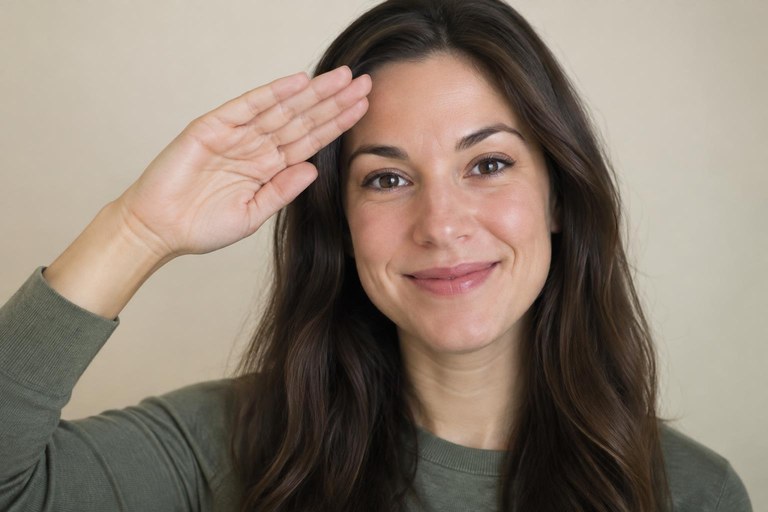
- HELLO. Flat B hand, palm facing out, fingers pointing up, starting at the forehead just above the eyebrow. Brush the hand forward and away in a small friendly salute. Smile.
- GOODBYE. Flat B hand, palm out at about shoulder height. Bend the fingers down toward the palm and open them again, twice. It is simply a finger wave.
- GOOD. Flat B hand, palm in, fingertips touching the chin. Move the hand down and forward, landing palm up in the open palm of your non-dominant flat B hand.
- MORNING. Lay your non-dominant forearm flat across your stomach, palm in, as the horizon. Your dominant flat B hand, palm up, starts touching that forearm and rises up like the sun coming up.
- AFTERNOON. Non-dominant forearm horizontal in front of you, palm down. Rest your dominant flat B hand, palm down, on that forearm and angle it slightly downward, like the sun partway down the sky. One small dip.
- NIGHT. Non-dominant flat B hand, palm down, held in front of you as the horizon. Drape your dominant bent B hand, palm down, over the back of that hand near the wrist, tapping down once, like the sun dropping below the horizon.
- HOW ARE YOU. Two bent hands with the knuckles touching, palms turned in and down, in neutral space in front of the chest. Roll them forward until both palms face up. Then point your index finger toward the person. Because HOW is a question word, lower your eyebrows and bring your head slightly forward rather than raising the brows.
- FINE. 5 hand, palm facing to the side, thumb touching the centre of your chest. Move the hand forward and slightly up off the chest.
- BAD. Flat B hand, palm in, fingertips touching the chin. Flip the hand over so the palm faces down and move it down and away. Let your face look displeased.
- SO-SO. 5 hand, palm down, in neutral space. Rock the wrist side to side, tipping the palm left and right. Wrinkle your nose slightly.
Courtesy signs
- PLEASE. Flat B hand, palm in, pressed flat against the centre of your chest. Circle it on the chest two or three times. Pleasant face.
- THANK YOU. Flat B hand, palm in, fingertips touching the chin or lips. Move the hand forward and down toward the person, ending palm up. The direction matters: the hand travels toward the person you are thanking, not sideways or straight down.
- YOU'RE WELCOME. Flat B hand, palm up, held out to the side at about waist height. Sweep it in toward your body. Many signers simply repeat THANK YOU toward the other person instead; both are common.
- SORRY. A hand, palm in, resting on the centre of the chest. Circle it on the chest. Your face must look genuinely regretful.
- EXCUSE ME. Non-dominant flat B hand, palm up. Brush the fingertips of your dominant flat B hand across that palm from heel to fingertips, twice.
- NICE. Non-dominant flat B hand, palm up. Slide your dominant flat B hand, palm down, across it from heel to fingertips in one smooth wipe.
- MEET. Two 1 hands, index fingers pointing up, palms facing each other, one hand near you and one near the other person. Bring them together until they meet in the middle. To say nice to meet you, sign NICE, then MEET, then point to the person.
Naming yourself and saying who you are
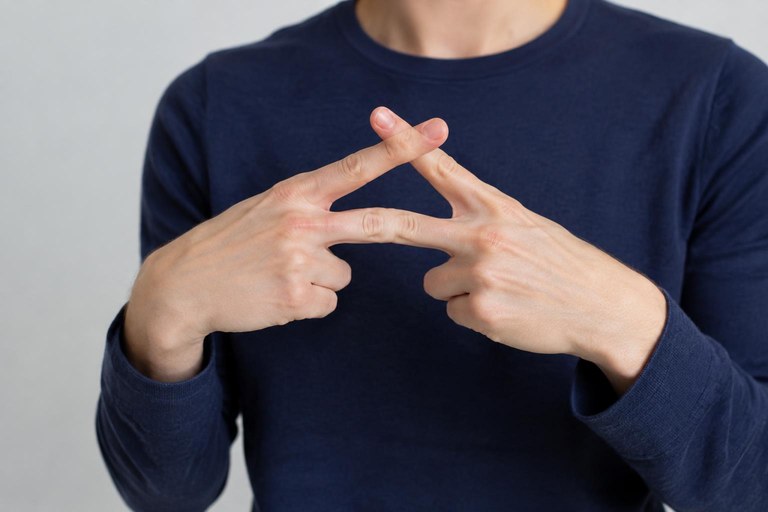
- NAME. Both hands in an H shape, that is index and middle fingers extended side by side. Palms angled in. Tap the two fingers of your dominant hand twice on top of the two fingers of your non-dominant hand, crossing them like an X.
- MY. Flat B hand, palm in, pressed flat on the centre of your chest.
- YOUR. Flat B hand, palm out, pushed forward toward the person.
- DEAF. 1 hand, palm to the side. Touch the index fingertip to your cheek just beside the ear, then move down and touch the cheek near the corner of the mouth.
- HEARING. 1 hand, palm down, index finger held in front of the lips. Roll the finger forward in small circles, suggesting talking.
- HARD OF HEARING. H hand, palm out, in neutral space. Sign the H, hop it a short distance to the side, and sign it again.
- LEARN. Non-dominant flat B hand, palm up. Your dominant claw 5 hand grabs from that palm, closes into a flat O, and lifts to your forehead, as if taking information and putting it in your head.
- SIGN. Two 1 hands, palms out, index fingers pointing up in neutral space. Circle them alternately backward toward your body.
The four repair signs you will use today
Chapter four promised you the actual signs for asking someone to slow down and repeat. Here they are.
- SLOW. Non-dominant flat B hand, palm down. Slide your dominant flat B hand, palm down, from the fingertips of that hand up over the back of it toward the wrist. Move slowly, and let your face show effort.
- AGAIN. Non-dominant flat B hand, palm up. Your dominant bent B hand arcs up and over and taps its fingertips into that palm.
- UNDERSTAND. S hand at the side of the forehead, palm facing in. Flick the index finger straight up. Nod slightly.
- DON'T UNDERSTAND. The same sign, but shake your head from side to side while you make it and furrow your eyebrows. The headshake is what makes it negative. Full negation comes in the feelings chapter.
To ask politely, sign SLOW then PLEASE, or simply AGAIN with raised eyebrows. Neither is rude. Deaf people meet new signers constantly and generally appreciate a clear, honest request over a fake nod.
The self-introduction formula
Memorise this four-part sequence and practise it until it is automatic.
- Listen to the audio with the screen off.
- Earn a certificate upon completion.
- Over 5000 courses for you to explore!

Download the app
- Wave HELLO with a smile.
- Sign MY NAME, then fingerspell your first name once, clearly, hand parked at shoulder height.
- Point your index finger at your own chest and sign HEARING.
- Point to yourself again and sign LEARN SIGN.
In gloss that is: HELLO. MY NAME spelled out. I HEARING. I LEARN SIGN. In English: Hello, my name is such and such, I am hearing, and I am learning sign language. Notice there is no word for am and no article. Pointing at yourself is the pronoun I, and the next chapter will teach the full system of pointing.

A first conversation
Two people meet at a community event. Maya is hearing and learning. Jon is Deaf.
Maya: HELLO. MY NAME M-A-Y-A. YOUR NAME?
Jon: MY NAME J-O-N. NICE MEET YOU.
Maya: NICE MEET YOU. YOU DEAF?
Jon: YES. I DEAF. YOU?
Maya: I HEARING. I LEARN SIGN. SLOW PLEASE.
Jon: FINE. HOW ARE YOU?
Maya: AGAIN?
Jon: HOW ARE YOU?
Maya: UNDERSTAND. I FINE. THANK YOU.
Jon: WELCOME. GOODBYE.
In English: Hello, my name is Maya, what is your name? My name is Jon, nice to meet you. Nice to meet you too, are you Deaf? Yes, I am Deaf, and you? I am hearing and I am learning to sign, please go slowly. That's fine, how are you? Could you repeat that? How are you? I understand, I am fine, thank you. You're welcome, goodbye.
Practise both roles in front of a mirror or a camera. Check three things on the recording: are your eyes on your imaginary partner rather than on your hands, is your face friendly rather than blank, and does your THANK YOU travel forward toward the person instead of dropping straight down.
Review checklist
- I can sign HELLO, GOODBYE, GOOD MORNING, GOOD AFTERNOON, and GOOD NIGHT.
- I can ask HOW ARE YOU with lowered eyebrows, the face used for question-word questions, and answer FINE, GOOD, BAD, or SO-SO.
- I can sign PLEASE, THANK YOU, YOU'RE WELCOME, SORRY, and EXCUSE ME, with THANK YOU moving toward the other person.
- I can sign NICE MEET YOU, NAME, MY, and YOUR.
- I can sign DEAF, HEARING, HARD OF HEARING, LEARN, and SIGN.
- I can run the full introduction: HELLO, MY NAME spelled out, I HEARING, I LEARN SIGN.
- I can ask for help with SLOW PLEASE and AGAIN, and show UNDERSTAND or DON'T UNDERSTAND with a headshake.
- I keep eye contact and a friendly face throughout, and I do not stare at my own hands.
You now have twenty-eight signs and a complete opening conversation. Greetings are the highest-value vocabulary in any language because they are the doorway to everything else, so drill this chapter until the introduction comes out without thinking.