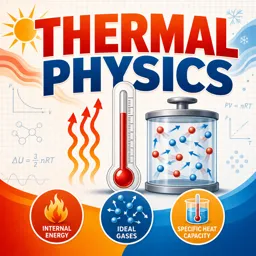


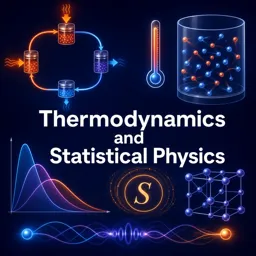

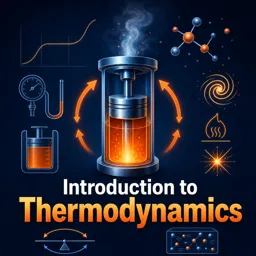
Thermodynamics is the study of heat, work, energy, temperature, and the laws governing energy conversion.

4

1



Thermodynamics in Action: How Energy, Entropy, and Efficiency Shape Real Systems
Understand thermodynamics through energy, entropy, and efficiency, and learn how these principles shape engines, systems, and real-world physics.

Exploring Thermodynamic Processes: From Isothermal to Adiabatic Transformations
Learn about isothermal, adiabatic, isobaric, and other thermodynamic processes essential to energy systems, engines, and natural phenomena.

Fundamentals of Thermodynamics: Understanding Energy, Heat, and Work
Learn the core concepts of thermodynamics, its four laws, and how energy, heat, and work shape technology, science, and the natural world.

The Laws of Thermodynamics: Foundations and Applications
Explore the four laws of thermodynamics and their role in science, engineering, biology, and environmental systems.

Thermodynamic Equilibrium: Concepts and Implications
Learn the types, conditions, and significance of thermodynamic equilibrium in physics and engineering for stable and predictable systems.
Explore our selection of free online Thermodynamics courses and develop essential knowledge about energy, heat, work, temperature, and the physical laws that govern thermal systems. Designed for students, engineering learners, science enthusiasts, and professionals, these educational courses provide accessible lessons that support academic study, exam preparation, and career development.
Study the zeroth, first, second, and third laws of thermodynamics through clear educational content. Learn how energy is conserved, how heat is transferred, why entropy increases, and how systems approach thermal equilibrium. The courses also introduce important concepts such as internal energy, enthalpy, specific heat, reversible and irreversible processes, state variables, and thermodynamic cycles.
These free Thermodynamics courses can help learners understand applications in mechanical engineering, chemical engineering, physics, chemistry, environmental science, and energy technology. Topics may include ideal gases, equations of state, phase transitions, heat engines, refrigerators, heat pumps, Carnot cycles, power generation, and energy efficiency. Educational explanations connect theoretical principles with practical systems and real-world problem solving.
Every course is free, includes exercises for reviewing the lessons, and offers free certification. The exercises allow learners to practice calculations, reinforce scientific vocabulary, evaluate conceptual understanding, and prepare for assessments. After completing an eligible course, the free certificate can demonstrate your commitment to continuing education and Thermodynamics training.
To access the courses, it is necessary to install the Cursa application on your mobile device. Android users can install it through Google Play at Download for Android. iPhone users can obtain it from the App Store at Download for iOS / iPhone.
Start learning at your own pace with flexible online lessons, practical exercises, and free certification. Choose a free online Thermodynamics course today and strengthen the scientific and engineering knowledge needed to analyze energy systems, thermal processes, and modern technologies.
What is thermodynamics?
Thermodynamics is the study of heat, work, energy, temperature, and the laws governing energy conversion.
What are the four laws of thermodynamics?
They are the zeroth law of thermal equilibrium, the first law of energy conservation, the second law of entropy increase, and the third law concerning absolute zero.
What is the difference between heat and work?
Heat is energy transferred because of a temperature difference, while work is energy transferred by forces or organized processes.
What does the first law of thermodynamics state?
It states that energy is conserved: changes in a system’s internal energy equal heat added to it minus work done by it.
What is entropy in thermodynamics?
Entropy is a measure of energy dispersal and the number of possible microscopic arrangements in a system.
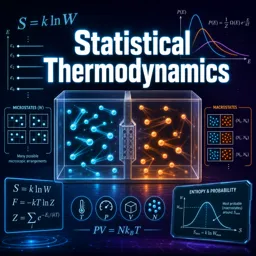
How does statistical thermodynamics relate to thermodynamics?
Statistical thermodynamics explains macroscopic properties such as temperature, pressure, and entropy using the behavior of particles.
What is thermal efficiency in a heat engine?
Thermal efficiency is the fraction of heat input converted into useful work, with the remainder released as waste heat.

Complete any course and issue your certificate via the app — at no cost.

Download the app! to have access to more than 4,000 Online Courses + Certificate, all free!
Download the app! 100% free courses.


Carry knowledge in your pocket.
Download the Cursa app.
There are hundreds of free courses available, with a free certificate of completion that is saved in your mobile image gallery.
Download the app to access the Course Completion Certificate for Free.


+ 10 million
students

Free and Valid
Certificate

60 thousand free
exercises

4.8/5 rating in
app stores

Free courses in
video and ebooks