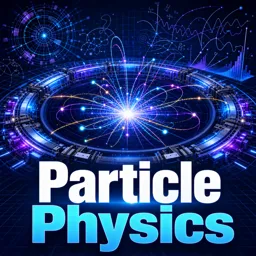


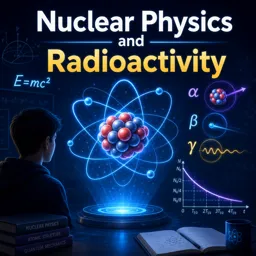
Particle physics studies the fundamental particles of matter and the forces that govern their interactions.

2

Explore the fundamental structure of matter with our selection of free online Particle Physics courses. These educational courses are ideal for students, teachers, science enthusiasts, and professionals who want to study subatomic particles, physical laws, and the forces that shape the universe. Learn online at your own pace through accessible lessons designed to support independent study and academic development.
Build your scientific knowledge through courses covering essential Particle Physics topics. Study atoms, elementary particles, quarks, leptons, bosons, antimatter, particle interactions, and the Standard Model. The course content may also introduce quantum physics, nuclear physics, relativity, conservation laws, particle accelerators, and experimental methods used in modern physics research.
These free Particle Physics courses help learners understand how scientists investigate matter at the smallest known scales. Educational lessons connect theoretical concepts with discoveries made in laboratories and facilities such as the Large Hadron Collider. Whether you are beginning your physics education or reviewing advanced concepts, you can find useful learning opportunities without paying tuition fees.
All listed courses are free, include exercises that reinforce the educational material, and offer free certification. Exercises allow you to review important definitions, test your understanding, and develop problem-solving skills. After completing an eligible course, the free certificate can demonstrate your dedication to continuing education and strengthen your academic or professional profile.
The courses are suitable for high school and university students, educators seeking supplementary teaching resources, researchers reviewing foundational concepts, and curious learners interested in cosmology and modern science. Flexible online learning makes it possible to study Particle Physics according to your schedule while developing analytical reasoning and scientific literacy.
To access the courses, complete the lessons, answer the exercises, and obtain free certification, you must install the Cursa application. Android users can install it through Google Play using Download for Android. iPhone users can install it through the App Store using Download for iOS / iPhone.
Start learning today with free online Particle Physics courses and expand your understanding of particles, forces, energy, and the universe through structured educational content, practical exercises, and free certification.
What is particle physics?
Particle physics studies the fundamental particles of matter and the forces that govern their interactions.
What will I learn in an online particle physics course?
You can learn about quarks, leptons, bosons, antimatter, the Standard Model, and particle interactions.
Is particle physics difficult for beginners?
It can be challenging, but beginner courses often introduce the essential concepts with basic mathematics and physics.
What is the Standard Model in particle physics?
The Standard Model is the theory describing known elementary particles and three fundamental forces: electromagnetic, weak, and strong.
How is particle physics different from nuclear physics?
Particle physics focuses on elementary particles, while nuclear physics examines atomic nuclei, nuclear forces, and nuclear reactions.
Does particle physics include radioactivity?
Yes. Radioactivity is commonly studied alongside nuclear physics and involves unstable nuclei emitting particles or energy.
What careers can particle physics courses support?
They can support paths in research, accelerator science, data analysis, medical physics, engineering, and scientific computing.

Complete any course and issue your certificate via the app — at no cost.

Download the app! to have access to more than 4,000 Online Courses + Certificate, all free!
Download the app! 100% free courses.


Carry knowledge in your pocket.
Download the Cursa app.
There are hundreds of free courses available, with a free certificate of completion that is saved in your mobile image gallery.
Download the app to access the Course Completion Certificate for Free.


+ 10 million
students

Free and Valid
Certificate

60 thousand free
exercises

4.8/5 rating in
app stores

Free courses in
video and ebooks