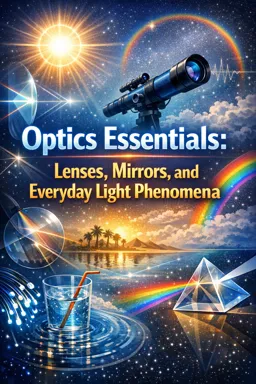
A parsec is the distance at which 1 AU subtends an angle of 1 arcsecond. Distance in parsecs is calculated as d = 1/p, where p is parallax in arcseconds.

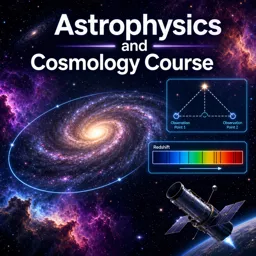
Duration of the online course: 1 hours and 24 minutes
5

(1)
Boost your physics skills with this free online course in astrophysics and cosmology—stars, distances, and the expanding universe, plus practice questions.
Build a clear, exam-ready understanding of how the universe works, from the life cycle of stars to the evidence for cosmic expansion. This free online course is designed for learners who want to strengthen core physics knowledge in astrophysics and cosmology with explanations that connect key ideas into a coherent picture, rather than leaving you with disconnected facts.
You will explore how stars form when interstellar clouds collapse and what conditions can trigger that process. From there, you will follow stellar evolution through major stages and learn what ultimately determines a star’s final fate. By focusing on the physics behind outcomes such as white dwarfs and what can come after the red giant phase for very massive stars, you’ll gain intuition about how mass, pressure, temperature, and gravity shape a star’s journey.
On the cosmology side, the course helps you become confident with the measurements that allow astronomers to map the universe. You’ll understand how parallax is used to calculate distances, what a parsec actually means, and how the simple relationship between distance and parallax fits into real problem solving. You’ll also connect observational tools like Doppler effects with larger-scale ideas such as Hubble’s Law and the cosmic microwave background, building an evidence-based view of an expanding universe.
Throughout the course, short focused questions and practice-style problems reinforce what you learn so you can apply definitions and equations accurately under exam conditions. By the end, you should be able to explain stellar birth and evolution in physical terms, interpret basic astronomical distance measurements, and describe the observational foundations of modern cosmology with far more confidence.

Explore free online Modern Physics courses and master quantum mechanics, relativity, particle physics, atomic theory, and cosmology at your own pace. Learn through flexible lessons from trusted educators, build career-ready scientific skills, and earn a certificate upon completion. Start studying modern physics online for free today.

Explore free online astrophysics courses and learn about stars, galaxies, black holes, cosmology, space science, and the universe from anywhere. Build valuable astronomy skills at your own pace with expert-led lessons designed for beginners and advanced learners. Enroll today, study for free, and earn a certificate to showcase your knowledge.

Discover free online General Relativity courses with certificates and explore spacetime, gravity, black holes, gravitational waves, Einstein’s field equations, and cosmology. Learn at your own pace through expert-led lessons, build valuable physics skills, and earn a certificate upon completion. Start studying General Relativity online for free today.

1 hours and 24 minutes of online video course

Digital certificate of course completion (Free)

Exercises to train your knowledge

100% free, from content to certificate
What is a parsec, and how is it calculated from parallax?
A parsec is the distance at which 1 AU subtends an angle of 1 arcsecond. Distance in parsecs is calculated as d = 1/p, where p is parallax in arcseconds.
What determines whether a star becomes a white dwarf or undergoes a supernova?
Its initial mass is the key factor. Low- and medium-mass stars shed their outer layers and leave white dwarfs, while very massive stars can explode as supernovae.
How do redshift and Hubble's law provide evidence for an expanding universe?
Light from distant galaxies is redshifted, showing they are moving away. Hubble's law shows that more distant galaxies generally recede faster, supporting cosmic expansion.
Ready to get started?Download the app and get started today.
Install the app now
to access the course
Over 5,000 free courses
Programming, English, Digital Marketing and much more! Learn whatever you want, for free.

Study plan with AI
Our app's Artificial Intelligence can create a study schedule for the course you choose.

From zero to professional success
Improve your resume with our free Certificate and then use our Artificial Intelligence to find your dream job.
You can also use the QR Code or the links below.



Free CourseRelativity Course: Special and General Relativity, Tensors, Black Holes, Gravitational Waves and Cosmology
5
(3)

19h01m

39 exercises
Free CourseIntroduction to Thermodynamics
5
(1)
1h48m
9 exercises
Free CourseNuclear and Radiochemistry
5
(1)
31h56m
31 exercises
Free CoursePhysics for beginners
5
(1)
1h57m
2 exercises
Free CourseThermodynamics and Statistical Physics
5
(1)
14h53m
23 exercises
Free CoursePhysics of Solar Energy Conversion
5
(4)
4h59m
16 exercises
Free CourseQuantum Physics
5
(1)
24m
4 exercises
Free CourseFundamentals of Physics
5
(45)
28h44m
23 exercises
Free CoursePhysics 1 course
4.8
(6)
4h10m
19 exercises
Free CourseFundamentals of Physics II
4.7

(24)
29h48m
24 exercises
Carry knowledge in your pocket.
Download the Cursa app.
There are hundreds of free courses available, with a free certificate of completion that is saved in your mobile image gallery.
Download the app to access the Course Completion Certificate for Free.


+ 10 million
students

Free and Valid
Certificate

60 thousand free
exercises

4.8/5 rating in
app stores

Free courses in
video and ebooks