They are inversely related: t½ = ln(2)/λ, where λ is the decay constant.

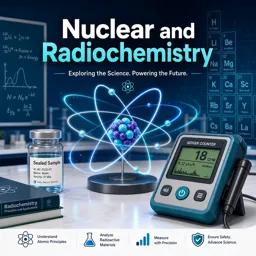
Duration of the online course: 31 hours and 56 minutes
5

(1)
Master nuclear decay, radiation detection and radiochemistry basics with a free online course—clear lessons, practice questions, and a sharable certificate option.
Build a solid foundation in nuclear and radiochemistry and learn to think like a physicist when it comes to radioactive processes, nuclear structure, and radiation measurement. This free online course is designed for students and curious learners who want clarity on concepts that often feel abstract: why some nuclei are stable while others decay, how to quantify radioactive change over time, and how different types of radiation interact with matter.
You will move step by step from the language of nuclei and isotopes to the practical mathematics of decay. Along the way, you will connect half-life, decay constants, and equilibrium ideas to real scenarios encountered in environmental measurements, medicine, research labs, and nuclear technology. Rather than memorizing facts, you will practice interpreting decay behavior and predicting outcomes, building confidence with the reasoning that underpins nuclear physics.
The course also emphasizes the models used to explain nuclear behavior, showing how different viewpoints complement one another when describing binding, stability, and pathways such as beta decay. You will gain intuition for what changes inside the nucleus during beta minus and beta plus processes and how these transformations fit into a broader picture of nuclear structure.
A key practical skill you will develop is understanding radiation interaction and detection. You will learn what makes charged particles lose energy differently in matter, why fast electrons behave unlike heavy charged particles, and what it means for a detector to convert radiation into a measurable signal. By exploring common detector approaches and the advantages of scintillation materials used for gamma counting, you will be better prepared to read instrumentation results and evaluate measurement choices.
To reinforce learning, the course includes question-driven checkpoints that help you test your understanding as you progress. If you are preparing for school physics exams, strengthening fundamentals for further study, or simply exploring how radiochemistry supports modern applications, this course offers a structured path from core ideas to meaningful insight.

Explore free online Nuclear Physics courses and earn a certificate while mastering atomic nuclei, radioactivity, nuclear reactions, fission, fusion, radiation, and particle interactions. Learn at your own pace with accessible lessons from trusted educators, build valuable scientific skills, and advance your studies or career in physics and energy.

Explore free online Radioactivity courses and earn a certificate while learning radioactive decay, isotopes, nuclear radiation, half-life, detection methods, safety, and real-world applications. Study at your own pace with accessible lessons designed for beginners, students, and professionals seeking valuable skills in nuclear science.

31 hours and 56 minutes of online video course

Digital certificate of course completion (Free)

Exercises to train your knowledge

100% free, from content to certificate
What is the relationship between radioactive half-life and the decay constant?
They are inversely related: t½ = ln(2)/λ, where λ is the decay constant.
What is secular equilibrium in a radioactive decay series?
It occurs when the parent isotope has a much longer half-life than its daughter, so the daughter’s activity becomes nearly equal to the parent’s activity.
Why is sodium iodide doped with thallium used for gamma-ray counting?
NaI(Tl) has high light output and efficiently converts gamma-ray interactions into measurable scintillation signals.
Ready to get started?Download the app and get started today.
Install the app now
to access the course
Over 5,000 free courses
Programming, English, Digital Marketing and much more! Learn whatever you want, for free.

Study plan with AI
Our app's Artificial Intelligence can create a study schedule for the course you choose.

From zero to professional success
Improve your resume with our free Certificate and then use our Artificial Intelligence to find your dream job.
You can also use the QR Code or the links below.



Free CourseRelativity Course: Special and General Relativity, Tensors, Black Holes, Gravitational Waves and Cosmology
5
(3)

19h01m

39 exercises
Free CourseIntroduction to Thermodynamics
5
(1)
1h48m
9 exercises
Free CoursePhysics for beginners
5
(1)
1h57m
2 exercises
Free CourseThermodynamics and Statistical Physics
5
(1)
14h53m
23 exercises
Free CourseAstrophysics and Cosmology Course
5
(1)
1h24m
5 exercises
Free CoursePhysics of Solar Energy Conversion
5
(4)
4h59m
16 exercises
Free CourseQuantum Physics
5
(1)
24m
4 exercises
Free CourseFundamentals of Physics
5
(45)
28h44m
23 exercises
Free CoursePhysics 1 course
4.8
(6)
4h10m
19 exercises
Free CourseFundamentals of Physics II
4.7

(24)
29h48m
24 exercises
Carry knowledge in your pocket.
Download the Cursa app.
There are hundreds of free courses available, with a free certificate of completion that is saved in your mobile image gallery.
Download the app to access the Course Completion Certificate for Free.


+ 10 million
students

Free and Valid
Certificate

60 thousand free
exercises

4.8/5 rating in
app stores

Free courses in
video and ebooks
Course comments: Nuclear and Radiochemistry
K.Theykessh
good