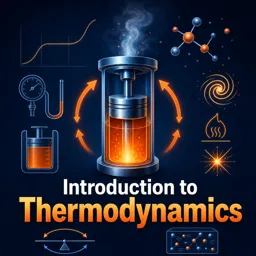
Intensive properties, such as temperature and pressure, do not depend on system size. Extensive properties, such as mass and volume, scale with the amount of matter.

Duration of the online course: 1 hours and 48 minutes
5

(1)
Build confidence with thermodynamics—systems, properties, energy and phase changes—in a free online course with practice questions and clear examples.
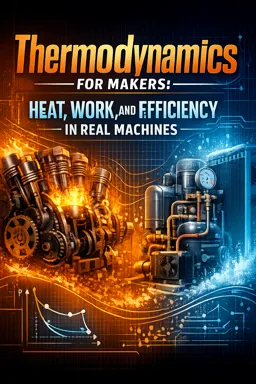
Thermodynamics can feel abstract at first, but it becomes far more intuitive when you learn how to translate real situations into the right concepts, variables, and equations. This free online course is designed to help you build that skill step by step, turning a topic that often seems intimidating into a practical tool you can apply in physics, engineering, and everyday problem-solving.
You will start by learning how to study effectively in an online format, so you can keep momentum and retain what you learn. From there, the course introduces the language of thermodynamics: how to describe a system, what it means for a system to be closed, and why those definitions matter when you track mass, energy, and interactions with the surroundings. You will also get comfortable with units and the difference between extensive and intensive properties, a foundational distinction that prevents many common mistakes.
As you progress, key ideas such as internal energy, enthalpy, and entropy are clarified in a way that emphasizes meaning and use, not memorization. You will connect temperature scales and conversions, and you will see how the state of a substance can be described with the state postulate and the idea of equilibrium. Instead of leaving the material in theory, the course regularly reinforces understanding through questions and problem-solving practice, helping you recognize what information is given, what assumptions are reasonable, and which approach fits best.
Worked examples with manometers and flow measurement build confidence with pressure relationships and real-world instrumentation, while phase change diagrams help you visualize how substances behave across different conditions. Later, you will explore why common shortcuts are not always valid, such as when the ideal gas equation fails to accurately represent steam. By the end, you will have a clearer, more practical grasp of the concepts that power thermodynamics and a stronger ability to reason through unfamiliar physics problems with precision.

1 hours and 48 minutes of online video course

Digital certificate of course completion (Free)

Exercises to train your knowledge

100% free, from content to certificate
What is the difference between intensive and extensive thermodynamic properties?
Intensive properties, such as temperature and pressure, do not depend on system size. Extensive properties, such as mass and volume, scale with the amount of matter.
Why must temperature be converted from Celsius to Kelvin in thermodynamics?
Kelvin is an absolute temperature scale required in equations such as the ideal gas law. Convert using K = °C + 273.15.
Why is steam not always treated as an ideal gas?
Near saturation or at high pressures, steam’s real-fluid behavior can differ significantly from the ideal-gas model, so steam tables or real-gas data are more accurate.
Ready to get started?Download the app and get started today.
Install the app now
to access the course
Over 5,000 free courses
Programming, English, Digital Marketing and much more! Learn whatever you want, for free.

Study plan with AI
Our app's Artificial Intelligence can create a study schedule for the course you choose.

From zero to professional success
Improve your resume with our free Certificate and then use our Artificial Intelligence to find your dream job.
You can also use the QR Code or the links below.



Free CourseRelativity Course: Special and General Relativity, Tensors, Black Holes, Gravitational Waves and Cosmology
5
(3)

19h01m

39 exercises
Free CourseNuclear and Radiochemistry
5
(1)
31h56m
31 exercises
Free CoursePhysics for beginners
5
(1)
1h57m
2 exercises
Free CourseThermodynamics and Statistical Physics
5
(1)
14h53m
23 exercises
Free CourseAstrophysics and Cosmology Course
5
(1)
1h24m
5 exercises
Free CoursePhysics of Solar Energy Conversion
5
(4)
4h59m
16 exercises
Free CourseQuantum Physics
5
(1)
24m
4 exercises
Free CourseFundamentals of Physics
5
(45)
28h44m
23 exercises
Free CoursePhysics 1 course
4.8
(6)
4h10m
19 exercises
Free CourseFundamentals of Physics II
4.7

(24)
29h48m
24 exercises
Carry knowledge in your pocket.
Download the Cursa app.
There are hundreds of free courses available, with a free certificate of completion that is saved in your mobile image gallery.
Download the app to access the Course Completion Certificate for Free.


+ 10 million
students

Free and Valid
Certificate

60 thousand free
exercises

4.8/5 rating in
app stores

Free courses in
video and ebooks