


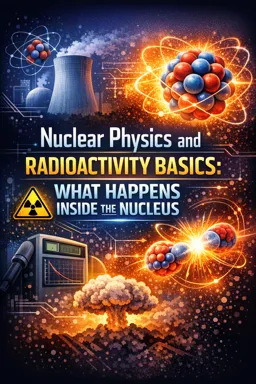
Nuclear physics is the study of atomic nuclei, including their structure, forces, reactions, and radioactive decay.

2

1


An Introduction to Nuclear Physics: The Science of the Atomic Nucleus
Discover the fundamentals of nuclear physics, exploring atomic nuclei, forces, applications, and experiments that reveal the building blocks of matter.

Exploring Nuclear Forces: The Glue of the Atomic Nucleus
Discover how nuclear forces hold the atomic nucleus together, influencing stability, energy, medicine, and scientific innovation.

The Role of Nuclear Reactions in Everyday Life
Discover how nuclear reactions impact daily life, from energy and medicine to archaeology, industry, and the future of sustainable nuclear physics.

Understanding Nuclear Decay: How Unstable Nuclei Transform
Explore nuclear decay, the process where unstable nuclei emit radiation to reach stability, and learn its types, applications, and safety considerations.
Discover a selection of free online Nuclear Physics courses designed for students, educators, science enthusiasts, and professionals who want to expand their knowledge of atomic nuclei and nuclear phenomena. These educational courses offer accessible learning materials, structured lessons, exercises, and free certification. Study at your own pace while developing a stronger understanding of the theories, calculations, experiments, and practical applications associated with modern nuclear science.
Nuclear Physics examines the structure, behavior, and interactions of atomic nuclei. Depending on the selected course, lessons may address nuclear models, isotopes, radioactivity, radioactive decay, nuclear reactions, binding energy, mass defect, fission, fusion, particle detection, radiation, and the fundamental forces involved in nuclear stability. Learners may also explore applications in medicine, energy production, scientific research, industry, and environmental analysis.
Each free Nuclear Physics course provides a flexible opportunity to review important scientific principles without following a fixed classroom schedule. The included exercises support active learning, help learners practice calculations, and make it easier to assess comprehension. Whether you are preparing for an academic examination, reviewing university-level physics, supporting classroom study, or pursuing continuing education, these online courses can complement your learning goals.
The courses listed on this page are free and also include free certification. A course certificate can help document your educational progress and may be useful for your résumé, professional profile, portfolio, academic activities, or personal development records. Course topics and instructional levels may vary, so learners can choose content that matches their current knowledge and study objectives.
To access the free online Nuclear Physics courses, complete the lessons, answer the exercises, and obtain free certification, you must install the Cursa application. Android users can install it through Google Play at Download for Android. Apple users can install it through the App Store at Download for iOS / iPhone. Choose a course, begin studying, and advance your Nuclear Physics education from your mobile device.
What is nuclear physics?
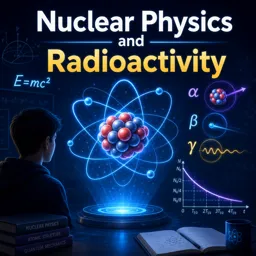
Nuclear physics is the study of atomic nuclei, including their structure, forces, reactions, and radioactive decay.
What topics are covered in a nuclear physics and radioactivity course?
Typical topics include nuclear structure, isotopes, decay modes, half-life, nuclear reactions, fission, fusion, and radiation detection.
What is radioactivity?
Radioactivity is the spontaneous emission of particles or electromagnetic energy from unstable atomic nuclei.
What are alpha, beta, and gamma decay?
Alpha decay emits a helium nucleus, beta decay changes a neutron or proton while emitting a beta particle, and gamma decay releases high-energy photons.
What is half-life in nuclear physics?
Half-life is the time required for half of the unstable nuclei in a radioactive sample to decay.
What is the difference between nuclear fission and fusion?
Fission splits a heavy nucleus into smaller nuclei, while fusion combines light nuclei to form a heavier nucleus and release energy.
What is studied in nuclear and radiochemistry?
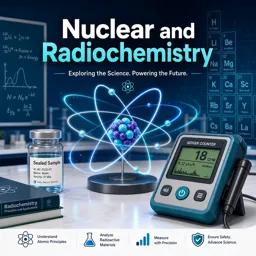
Nuclear and radiochemistry examines radioactive isotopes, nuclear reactions, radiation measurement, isotope applications, and the chemical behavior of radioactive materials.

Complete any course and issue your certificate via the app — at no cost.

Download the app! to have access to more than 4,000 Online Courses + Certificate, all free!
Download the app! 100% free courses.


Carry knowledge in your pocket.
Download the Cursa app.
There are hundreds of free courses available, with a free certificate of completion that is saved in your mobile image gallery.
Download the app to access the Course Completion Certificate for Free.


+ 10 million
students

Free and Valid
Certificate

60 thousand free
exercises

4.8/5 rating in
app stores

Free courses in
video and ebooks