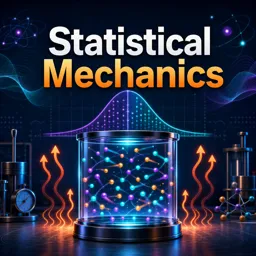
The course covers microcanonical, canonical, and grand canonical ensembles, including how they describe energy, temperature, particle number, and equilibrium.

Duration of the online course: 35 hours and 54 minutes
New
Build real intuition for heat, entropy and quantum gases in this free online physics course, with practice questions to reinforce statistical mechanics.
Statistical mechanics is where everyday thermal phenomena meet the microscopic world. If you have ever wondered why heat flows in one direction, what entropy really measures, or how pressure emerges from countless particle collisions, this course helps you connect the dots with clear physical reasoning and the mathematical tools that support it.
You will begin by strengthening your thermodynamics foundation, learning to describe a system through state variables, energy balance, and the meaning of the laws of thermodynamics beyond memorized statements. From there, the course shifts to probability, showing how distributions arise, what typical behavior means in large systems, and how unbiased assumptions guide predictions when you have incomplete information.
With that toolkit in place, you will build a kinetic picture of gases: how microscopic motion produces macroscopic equations of state, why equilibrium is a special limit, and how evolution toward equilibrium can be framed through statistical ideas. Along the way, you develop an intuition for how models link with measurable quantities, and what it means to describe a system using a density over states rather than tracking each particle individually.
Next, the course develops classical statistical mechanics through the language of ensembles, helping you see how different constraints lead to different, but consistent, descriptions of the same physics. You then explore interacting particles and learn how real materials depart from idealized behavior, gaining insight into why phase transitions and non-ideal equations of state matter in practice.
Finally, the course transitions to quantum statistical mechanics, where new principles reshape the rules of counting and probability. You will learn how the density matrix captures uncertainty and mixture, how pure and mixed states differ, and why quantum statistics splits into fermions and bosons with dramatically different outcomes. By the end, topics such as ideal quantum gases, degeneracy pressure, Bose-Einstein condensation, and superfluidity feel less like isolated buzzwords and more like logical consequences of a coherent framework.
Each lesson is paired with questions that let you check understanding immediately, making this a strong option for students who want to sharpen physics skills for school, exam preparation, or a deeper grasp of modern thermal and quantum phenomena.

35 hours and 54 minutes of online video course

Digital certificate of course completion (Free)

Exercises to train your knowledge

100% free, from content to certificate
What statistical mechanics ensembles are explained in this course?
The course covers microcanonical, canonical, and grand canonical ensembles, including how they describe energy, temperature, particle number, and equilibrium.
How does the course connect kinetic theory with the Boltzmann equation?
It explains gas particle probability densities, collisions, approach to equilibrium, and how the Boltzmann equation models dilute gases.
Does the course cover Bose-Einstein condensation and fermion occupation rules?
Yes. It covers ideal quantum gases, the differences between bosons and fermions, Bose-Einstein condensation, and superfluid helium.
Ready to get started?Download the app and get started today.
Install the app now
to access the course
Over 5,000 free courses
Programming, English, Digital Marketing and much more! Learn whatever you want, for free.

Study plan with AI
Our app's Artificial Intelligence can create a study schedule for the course you choose.

From zero to professional success
Improve your resume with our free Certificate and then use our Artificial Intelligence to find your dream job.
You can also use the QR Code or the links below.



Free CourseRelativity Course: Special and General Relativity, Tensors, Black Holes, Gravitational Waves and Cosmology
5

(3)

19h01m

39 exercises
Free CourseIntroduction to Thermodynamics
5
(1)
1h48m
9 exercises
Free CourseNuclear and Radiochemistry
5
(1)
31h56m
31 exercises
Free CoursePhysics for beginners
5
(1)
1h57m
2 exercises
Free CourseThermodynamics and Statistical Physics
5
(1)
14h53m
23 exercises
Free CourseAstrophysics and Cosmology Course
5
(1)
1h24m
5 exercises
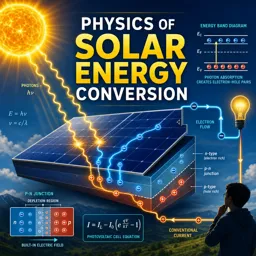
Free CoursePhysics of Solar Energy Conversion
5
(4)
4h59m
16 exercises
Free CourseQuantum Physics
5
(1)
24m
4 exercises
Free CourseFundamentals of Physics
5
(45)
28h44m
23 exercises
Free CoursePhysics 1 course
4.8
(6)
4h10m
19 exercises
Carry knowledge in your pocket.
Download the Cursa app.
There are hundreds of free courses available, with a free certificate of completion that is saved in your mobile image gallery.
Download the app to access the Course Completion Certificate for Free.


+ 10 million
students

Free and Valid
Certificate

60 thousand free
exercises

4.8/5 rating in
app stores

Free courses in
video and ebooks