The course also introduces thermodynamics, electricity, magnetism, quantum mechanics, SI units, scientific notation, and unit conversions.

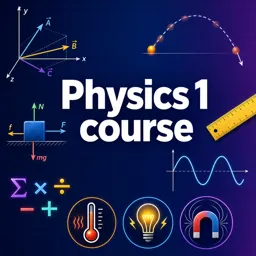
Duration of the online course: 4 hours and 10 minutes
4.7


(3)
Build strong physics skills fast with a free online course: motion, vectors, units, conversions, and core laws—ideal for exams and study confidence.
Understanding physics is easier when the ideas connect and the math stops feeling like a barrier. This free online Physics 1 course is designed to help you build a solid foundation from the ground up, so you can read problems with confidence, choose the right approach, and explain results clearly. Whether you are reinforcing school learning, preparing for exams, or returning to the subject after a break, you will develop the habits and intuition that make physics feel logical rather than intimidating.
You will start with the big picture of what physics studies, then move into core concepts such as force and motion, the basic relationship between heat and work in thermodynamics, and key ideas in electricity and magnetism. Instead of treating these topics as isolated facts, the course helps you see patterns: how laws describe nature, why units matter, and how to interpret what a situation is asking before plugging in numbers.
Because success in physics depends on clear math and measurement skills, you will also strengthen the tools that support every solution. You will review essential algebra, trigonometry, and scientific notation, then apply them to physics units, the metric system, and practical unit conversions. This makes it easier to avoid common errors and to communicate answers in a form that is scientifically meaningful.
A major focus is learning to think in vectors. You will learn the difference between scalars and vectors, how to add and subtract vectors graphically, how scalar multiplication changes magnitude and direction, and how to break vectors into x and y components. These skills are fundamental for analyzing displacement, velocity, and many real-world motion problems. Practice questions throughout the course help you check understanding, correct misconceptions early, and build problem-solving speed without sacrificing accuracy.
By the end, you will be better equipped to tackle introductory physics with a structured method, stronger math fluency, and clearer physical intuition—skills that transfer directly to further science study and many technical pathways.

4 hours and 10 minutes of online video course

Digital certificate of course completion (Free)

Exercises to train your knowledge

100% free, from content to certificate
What topics are covered in Physics 1 beyond force and motion?
The course also introduces thermodynamics, electricity, magnetism, quantum mechanics, SI units, scientific notation, and unit conversions.
How are distance and displacement different in one-dimensional motion?
Distance is the total path traveled, while displacement is the final position minus the initial position, including direction.
How do you calculate the x and y components of a vector?
For a vector of magnitude V at angle θ from the x-axis, use Vx = V cos(θ) and Vy = V sin(θ), applying signs based on direction.
Ready to get started?Download the app and get started today.
Install the app now
to access the course
Over 5,000 free courses
Programming, English, Digital Marketing and much more! Learn whatever you want, for free.

Study plan with AI
Our app's Artificial Intelligence can create a study schedule for the course you choose.

From zero to professional success
Improve your resume with our free Certificate and then use our Artificial Intelligence to find your dream job.
You can also use the QR Code or the links below.



Free CourseRelativity Course: Special and General Relativity, Tensors, Black Holes, Gravitational Waves and Cosmology
5
(3)

19h01m

39 exercises
Free CourseIntroduction to Thermodynamics
5
(1)
1h48m
9 exercises
Free CourseNuclear and Radiochemistry
5
(1)
31h56m
31 exercises
Free CoursePhysics for beginners
5
(1)
1h57m
2 exercises
Free CourseThermodynamics and Statistical Physics
5
(1)
14h53m
23 exercises
Free CourseAstrophysics and Cosmology Course
5
(1)
1h24m
5 exercises
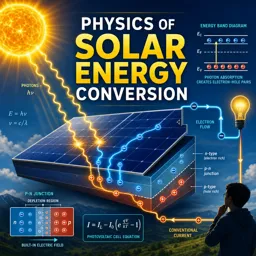
Free CoursePhysics of Solar Energy Conversion
5
(4)
4h59m
16 exercises
Free CourseQuantum Physics
5
(1)
24m
4 exercises
Free CourseFundamentals of Physics
5
(45)
28h44m
23 exercises
Free CourseFundamentals of Physics II
4.7
(24)
29h48m
24 exercises
Carry knowledge in your pocket.
Download the Cursa app.
There are hundreds of free courses available, with a free certificate of completion that is saved in your mobile image gallery.
Download the app to access the Course Completion Certificate for Free.


+ 10 million
students

Free and Valid
Certificate

60 thousand free
exercises

4.8/5 rating in
app stores

Free courses in
video and ebooks