It showed that atoms are mostly empty space, with nearly all their mass and positive charge concentrated in a tiny, dense nucleus.

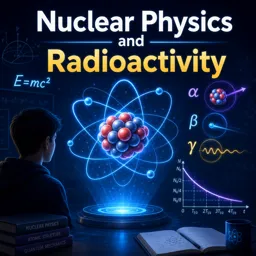
Duration of the online course: 1 hours and 24 minutes
New
Master nuclear physics for exams: decay, half-life, fission and fusion with a free online course and practice questions to sharpen your calculations fast.
Build confidence in nuclear physics and radioactivity with a focused, exam-ready learning experience designed for school-level Physics. This course helps you move from memorizing facts to understanding how nuclear models explain real observations, so you can tackle typical assessment questions with clarity and speed. You will revisit the structure of the atom, why the nucleus is stable despite strong electrostatic repulsion, and how experimental evidence shaped the modern picture of nuclear size and charge distribution.
Radioactivity is treated as a topic you can calculate with, not just describe. You will learn to connect activity, decay constant, and number of unstable nuclei, and to interpret exponential decay in a way that makes half-life problems feel intuitive. Along the way, you will strengthen your ability to handle scientific notation, units, and rearranging key equations without losing physical meaning. Practice questions are integrated to help you spot common traps and improve accuracy under time pressure.
The course also develops a clear qualitative and quantitative sense of nuclear energy. You will work with binding energy ideas to explain why some reactions release vast amounts of energy, and how fission and fusion differ in mechanism and outcomes. Realistic examples reinforce how mass-energy changes are linked to nuclear stability, and why certain decay pathways are more likely than others.
Finally, you will connect theory to applications through nuclear reactors, including how reaction rates are managed for safe, steady power output. By the end, you should be able to explain key nuclear concepts in clean Physics language and solve core calculation problems with greater confidence, whether you are revising for exams or strengthening fundamentals for the next level of study.

Explore free online Modern Physics courses and master quantum mechanics, relativity, particle physics, atomic theory, and cosmology at your own pace. Learn through flexible lessons from trusted educators, build career-ready scientific skills, and earn a certificate upon completion. Start studying modern physics online for free today.

Explore the best free online Particle Physics courses and learn about subatomic particles, quantum fields, accelerators, the Standard Model, and modern experimental methods. Study at your own pace with expert-led lessons, build valuable science skills, and earn a certificate. Start learning particle physics online for free today.

Explore free online Nuclear Physics courses and earn a certificate while mastering atomic nuclei, radioactivity, nuclear reactions, fission, fusion, radiation, and particle interactions. Learn at your own pace with accessible lessons from trusted educators, build valuable scientific skills, and advance your studies or career in physics and energy.

Explore free online Radioactivity courses and earn a certificate while learning radioactive decay, isotopes, nuclear radiation, half-life, detection methods, safety, and real-world applications. Study at your own pace with accessible lessons designed for beginners, students, and professionals seeking valuable skills in nuclear science.

1 hours and 24 minutes of online video course

Digital certificate of course completion (Free)

Exercises to train your knowledge

100% free, from content to certificate
What did Rutherford's alpha-particle scattering experiment reveal about the atom?
It showed that atoms are mostly empty space, with nearly all their mass and positive charge concentrated in a tiny, dense nucleus.
How do you calculate the initial number of radioactive nuclei from activity and decay constant?
Use A = λN, so N = A/λ. For 3.5 × 10^10 Bq and 0.15 s^-1, the initial number is about 2.3 × 10^11 nuclei.
What do control rods do in a nuclear reactor?
They absorb neutrons to control the rate of the fission chain reaction; inserting them further reduces or stops the reaction.
Ready to get started?Download the app and get started today.
Install the app now
to access the course
Over 5,000 free courses
Programming, English, Digital Marketing and much more! Learn whatever you want, for free.

Study plan with AI
Our app's Artificial Intelligence can create a study schedule for the course you choose.

From zero to professional success
Improve your resume with our free Certificate and then use our Artificial Intelligence to find your dream job.
You can also use the QR Code or the links below.



Free CourseRelativity Course: Special and General Relativity, Tensors, Black Holes, Gravitational Waves and Cosmology
5

(3)

19h01m

39 exercises
Free CourseIntroduction to Thermodynamics
5
(1)
1h48m
9 exercises
Free CourseNuclear and Radiochemistry
5
(1)
31h56m
31 exercises
Free CoursePhysics for beginners
5
(1)
1h57m
2 exercises
Free CourseThermodynamics and Statistical Physics
5
(1)
14h53m
23 exercises
Free CourseAstrophysics and Cosmology Course
5
(1)
1h24m
5 exercises
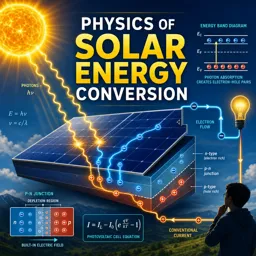
Free CoursePhysics of Solar Energy Conversion
5
(4)
4h59m
16 exercises
Free CourseQuantum Physics
5
(1)
24m
4 exercises
Free CourseFundamentals of Physics
5
(45)
28h44m
23 exercises
Free CoursePhysics 1 course
4.8
(6)
4h10m
19 exercises
Carry knowledge in your pocket.
Download the Cursa app.
There are hundreds of free courses available, with a free certificate of completion that is saved in your mobile image gallery.
Download the app to access the Course Completion Certificate for Free.


+ 10 million
students

Free and Valid
Certificate

60 thousand free
exercises

4.8/5 rating in
app stores

Free courses in
video and ebooks