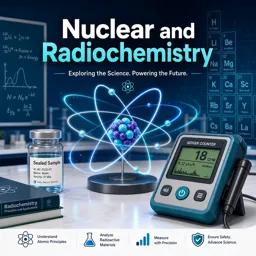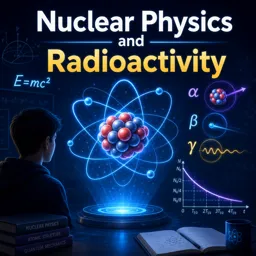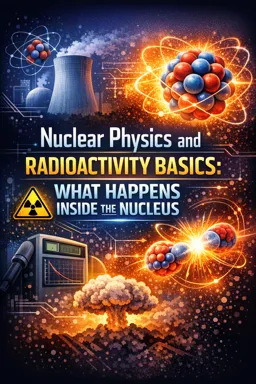

Free ebook on nuclear physics and radioactivity: isotopes, decay, half-life, radiation detection, fission, fusion, and applications.
Free ebook content
-

Nuclear Physics Foundations: Nucleons, Isotopes, and Nuclear Notation
+ Exercise: Two nuclides have the same atomic number Z but different neutron number N. Which statement best describes their relationship and expected chemical behavior (for neutral atoms)?
-
Nuclear Forces and Why Nuclei Hold Together
+ Exercise: For two nuclei with the same total number of nucleons, nucleus A has a higher fraction of protons than nucleus B. Which statement best predicts their relative stability?
-
Binding Energy, Mass Defect, and the Stability Landscape
+ Exercise: When computing binding energy using atomic masses (Template A), why is it valid to use Z·M(1H) for the protons without separately subtracting electron masses?


-
Radioactive Transformations: Learned Rules for Nuclear Decay
+ Exercise: A sample undergoes beta minus (β−) decay. Which change to the nucleus must occur according to the decay rules?
-
Alpha Decay: Heavy Nuclei, Helium Nuclei, and Energy Release
+ Exercise: A nucleus undergoes alpha decay. Which change correctly describes what happens to the parent nucleus and why alpha particles from a given nuclide have discrete energies?
-
Beta Decay and Neutrinos: Changing Neutrons and Protons
+ Exercise: A beta source must be shielded in a lab. Which material is best to use as the first shielding layer to stop the beta particles while minimizing unwanted secondary radiation?
-
Gamma Emission and Nuclear Energy Levels
+ Exercise: A daughter nucleus is produced in an excited state after a β− decay. Which statement best describes the subsequent γ emission step?
-
Half-Life, Decay Law, Activity, and Units Used in Radioactivity
+ Exercise: Why does the number of undecayed nuclei N(t) follow an exponential decay law?
-
How Radiation Interacts with Matter: Ionization, Energy Loss, and Shielding Logic
+ Exercise: When shielding a high-energy beta source, which approach best reduces dose while minimizing bremsstrahlung production?
-
Detecting Radiation: Counting Statistics and Detector Principles
+ Exercise: Why does increasing the counting time T usually improve the precision of a radiation count-rate measurement?
-
Fission: Chain Reactions, Neutrons, and Reactor Basics
+ Exercise: In a thermal reactor, what is the most direct effect of inserting control rods slightly deeper into the core?
-
Fusion: Light Nuclei, Conditions, and Energy Considerations
+ Exercise: Why might a fusion reaction with a lower energy release (Q-value) still produce more power than a reaction with a higher Q-value?
-
Applications and Limits: Medicine, Energy, and Radiometric Dating
+ Exercise: When choosing a radionuclide for a diagnostic radiotracer study, which combination best matches the main practical constraints described?
About the free ebook
Nuclear Physics and Radioactivity Basics: What Happens Inside the Nucleus
This free ebook introduces the physics of the atomic nucleus, explaining how protons and neutrons form nuclei, why isotopes differ, and how nuclear notation represents atomic structure.
Explore nuclear stability and energy
Learn how the strong nuclear force competes with electrical repulsion between protons, and how mass defect and binding energy help explain why some nuclei are stable while others transform. The ebook connects these ideas to the stability landscape and energy released in nuclear processes.
Understand radioactive decay
Study the rules behind alpha, beta, and gamma emission. See how alpha decay releases helium nuclei, how beta decay changes neutrons and protons while involving neutrinos, and how gamma rays arise when an excited nucleus loses energy.
Work with radioactivity measurements
The text explains half-life, exponential decay, activity, and common units used in radioactivity. It also examines how radiation ionizes matter, loses energy, and can be shielded, along with the principles behind radiation detectors and counting statistics.
Connect nuclear processes to real applications
Discover the essential physics of fission chain reactions, reactor basics, and fusion conditions. The ebook closes by relating nuclear science to medicine, electricity generation, and radiometric dating, while emphasizing the limits and safety considerations of radiation use.
Built for physics study
Clear explanations and connected concepts help students develop a reliable foundation for understanding nuclear reactions, radiation, and the energy hidden inside atomic nuclei.
What is the difference between alpha, beta, and gamma decay?
Alpha decay emits a helium nucleus, beta decay changes a neutron or proton, and gamma emission releases nuclear energy as high-energy light.
How is half-life related to radioactive decay?
Half-life is the time required for half of the unstable nuclei in a sample to decay.
Why does nuclear fission release energy?
Fission products have greater binding energy per nucleon than a heavy unstable nucleus, so part of the mass difference is released as energy.
This ebook includes:

13 content chapters

Digital certificate of course completion (Free)

Exercises to train your knowledge

100% free, from content to certificate
Ready to get started?

 recommended
In the app you will also find...

Over 5,000 free courses
Programming, English, Digital Marketing and much more! Learn whatever you want, for free.

Study plan with AI
Our app's Artificial Intelligence can create a study schedule for the course you choose.

From zero to professional success
Improve your resume with our free Certificate and then use our Artificial Intelligence to find your dream job.
You can also use the QR Code or the links below.