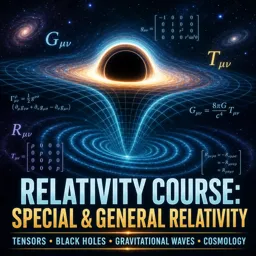
Free Course Image Relativity Course: Special and General Relativity, Tensors, Black Holes, Gravitational Waves and Cosmology

Free online courseRelativity Course: Special and General Relativity, Tensors, Black Holes, Gravitational Waves and Cosmology

Duration of the online course: 19 hours and 1 minutes

New

Free course on special and general relativity, tensors, black holes, gravitational waves, and cosmology, from spacetime basics to Einstein equations.

In this free course, learn about

  • Foundations: Galilean Relativity and Core Math Ideas
  • Galilean Spacetime, Transformations, and the Classical Limit
  • Special Relativity Essentials: Lorentz Transformations, Intervals, and 4-Vectors
  • Acceleration, Non-Inertial Frames, and Geometry in Flat Spacetime
  • Tensors and Covectors in Relativity
  • General Relativity Core: Equivalence Principle, Curvature, and Field Equations
  • Black Holes and Schwarzschild Spacetime
  • Gravitational Waves: Linearized Gravity and Polarizations
  • Cosmology: FLRW Spacetime and the Evolution of the Universe

Course Description

Dive into the foundations of modern physics with this free online course on special and general relativity, designed to build real intuition alongside the mathematical tools used in contemporary theory. Starting from Galilean relativity, you will develop the language of spacetime diagrams, intervals, and transformation rules, then progress to the geometry and equations of Lorentz transformations, time dilation, length contraction, and relativistic dynamics with 4-vectors.

As the course advances, you will explore accelerated motion and its consequences through hyperbolic trajectories, horizons, and classic thought experiments, while learning how changing coordinates reshapes the way physics is expressed. You will also gain a practical understanding of covariance, contravariance, Jacobians, and covariant derivatives, forming a clear bridge from flat spacetime to curved geometry.

From there, the course moves into the core ideas of general relativity: equivalence, manifolds, geodesics, and curvature described through the Riemann and Ricci tensors and related scalars. You will connect gravity to spacetime structure via the stress-energy-momentum tensor and follow the logic leading to the Einstein field equations. With these foundations, you will investigate the Schwarzschild solution, interpret gravitational time dilation and horizons, and examine geodesic motion and coordinate extensions that clarify black hole physics and related spacetime features.

To round out the journey, you will study gravitational waves through linearized gravity, gauge choices, polarizations, and physical effects on free particles, linking theory to landmark detections. Finally, you will step into cosmology, developing the FLRW metric, redshift, horizons, comoving coordinates, and the Friedmann equations to understand expanding-universe models and the evolution of cosmic geometry.

Course content

  • Video class: Relativity 101a: Introduction to Galilean Relativity 10m
  • Exercise: What does the Galilean principle of relativity state?
  • Video class: Relativity 101b: Introduction to Special Relativity 15m
  • Exercise: Which statement is one of the two postulates of special relativity?
  • Video class: Relativity 102a: Keys to Mathematics of Relativity - Invariance 08m
  • Exercise: What does “invariance” mean when describing a vector in relativity?
  • Video class: Relativity 102b: Keys to Relativity - Covariance and Contravariance 11m
  • Exercise: When the basis vectors are scaled to be twice as long, what happens to the components of the same vector (to keep the vector unchanged)?
  • Video class: Relativity 103a: Galilean Relativity - Spacetime Diagrams 09m
  • Exercise: In a Galilean spacetime diagram (time vertical, position horizontal), what does a vertical world line represent?
  • Video class: Relativity 103b: Galilean Relativity - Spacetime Separation (Interval) Vector and Invariance 14m
  • Video class: Relativity 103c: Galilean Relativity - Galilean Transform and Covariance/Contravariance 20m
  • Exercise: In Galilean relativity, how do space-time components transform from the scientist frame (t, x) to the car frame (\u007et, \u007ex) for a relative velocity v?
  • Video class: Relativity 103d: Galilean Relativity - Euclidean Metric Tensor 20m
  • Exercise: In a non-orthonormal basis, what is the correct general method to compute the length of a vector?
  • Video class: Relativity 103e: Galilean Relativity - The problems with Galilean Relativity 20m
  • Exercise: Why does Galilean relativity fail for electromagnetism in the wire-and-proton example?
  • Video class: Relativity 104a: Special Relativity - Lorentz Transformation Geometry (no equations) 15m
  • Exercise: What key change distinguishes the Lorentz transformation from the Galilean transformation when switching inertial reference frames?
  • Video class: Relativity 104b: Special Relativity - Lorentz Transform Equations Derivation 17m
  • Exercise: In the Lorentz transformation, what is the scaling factor \(\gamma\) in terms of \(\beta = v/c\)?
  • Video class: Relativity 104c: Special Relativity - Time Dilation and Length Contraction Geometry 31m
  • Video class: Relativity 104d: Special Relativity - Velocity Addition and Relativity of Simultaneity 23m
  • Exercise: In special relativity, what is the correct rule for adding colinear velocities using  Lorentz transformations?
  • Video class: Relativity 104e: Special Relativity - Spacetime Interval and Minkowski Metric 34m
  • Exercise: In 1+1 dimensional spacetime using the mostly-minuses convention, what quantity is invariant under Lorentz transformations for a displacement between two events?
  • Video class: Relativity 104f: Special Relativity - Relativistic Dynamics and 4-Vectors (E=mc^2) 35m
  • Exercise: Which expression gives the time component of the four-momentum in special relativity?
  • Video class: Relativity 105a: Acceleration - Hyperbolic Motion and Rindler Horizon 31m
  • Exercise: In special relativity, what is the defining condition for constant proper acceleration (in the x direction)?
  • Video class: Relativity 105b: Acceleration - Bell's Spaceship Paradox and Rindler Coordinates 34m
  • Exercise: In Bell’s spaceship paradox, when both ships undergo the same proper acceleration (as seen by a stationary observer), what happens to a string connecting them?
  • Video class: Relativity 105c: Acceleration - The Jacobian (changing basis in curvilinear Rindler coordinates) 34m
  • Exercise: In curvilinear coordinates, how do basis vectors and vector components transform relative to the Jacobian?
  • Video class: Relativity 105d: Acceleration - Twin Paradox and Proper Time Along Curves (Rindler Metric) 32m
  • Exercise: In the twin paradox, why is it not a contradiction that the traveling twin ages less?
  • Video class: Relativity 105e: Acceleration - Covariant Derivative in Flat Spacetime (Rindler Coordinates) 27m
  • Exercise: In flat spacetime, what is the key feature of the covariant derivative in a non-inertial coordinate system?
  • Video class: Relativity 105f: Acceleration - Geodesics, Curved Light Beams (Rindler Coordinates) 30m
  • Video class: Relativity 106a: Tensors - Frequency Wave Covectors and Doppler Shift (with accelerating frames) 33m
  • Exercise: In this geometric picture, what does a covector output when it acts on a vector?
  • Video class: Relativity 107a: General Relativity Basics - Equivalence Principle and Proper Acceleration 25m
  • Exercise: What does an accelerometer measure for an object in free fall under gravity (with no other forces acting)?
  • Video class: Relativity 107b: General Relativity Basics - Manifolds, Covariant Derivative, Geodesics 36m
  • Video class: Relativity 107c: General Relativity Basics - Curvature, Riemann Tensor, Ricci Tensor, Ricci Scalar 34m
  • Exercise: What does it imply if all components of the Riemann curvature tensor are zero in a region of spacetime?
  • Video class: Relativity 107d: General Relativity Basics - Curved Spacetime for Newtonian Gravity (Newton Cartan) 25m
  • Exercise: In Newton–Cartan theory, which component of the Ricci tensor is non-zero and what does it equal?
  • Video class: Relativity 107e: General Relativity Basics - Stress-Energy-Momentum Tensor 34m
  • Exercise: What does the energy-momentum tensor represent in relativity?
  • Video class: Relativity 107f: General Relativity Basics - Einstein Field Equation Derivation (w/ sign convention) 36m
  • Exercise: Which tensor combination is used so the left-hand side has zero divergence in the Einstein field equations?
  • Video class: Relativity 108a: Schwarzschild Metric - Derivation 30m
  • Exercise: In the vacuum region outside a spherically symmetric mass (with cosmological constant set to zero), what do the Einstein field equations reduce to?
  • Video class: Relativity 108b: Schwarzschild Metric - Interpretation (Gravitational Time Dilation, Event Horizon) 33m
  • Exercise: What happens to the Schwarzschild coordinate time basis vector e_t at the Schwarzschild radius r = r_s?
  • Video class: Relativity 108c: Schwarzschild Metric - Geodesics (Mercury perihelion advance, photon sphere) 36m
  • Exercise: In Schwarzschild spacetime, at what radius can light orbit in a circular path (the photon sphere)?
  • Video class: Relativity 108d: Schwazrschild Metric - Eddington-Finkelstein, Kruskal-Szekeres, White/Wormholes 37m
  • Exercise: What is the main advantage of switching from Schwarzschild coordinates to Eddington–Finkelstein or Kruskal–Szekeres coordinates for a black hole?
  • Video class: Relativity 108e: Schwarzschild Metric - Gravitational Redshift / Blueshift (via covector fields) 28m
  • Exercise: Why must an observer use a unit-length (orthonormal) time basis vector when computing a light wave’s measured frequency from the wave covector in Schwarzschild spacetime?
  • Video class: Relativity 109a - Gravitational Waves: Introduction (LIGO, Wave Equation) 15m
  • Exercise: What is the basic physical effect a gravitational wave has as it passes through a region of spacetime?
  • Video class: Relativity 109b: Gravitational Waves - Linearized Gravity / Weak Gravity 13m
  • Exercise: In linearized gravity, which terms are neglected due to the weak-field assumptions?
  • Video class: Relativity 109c: Gravitational Waves - Wave Derivation (The Lorenz Gauge) 23m
  • Exercise: In linearized general relativity, what condition defines the Lorenz gauge that simplifies the Einstein field equations into a wave equation for the metric perturbation?
  • Video class: Relativity 109d: Gravitational Waves - Transverse-Traceless Gauge (Plus and Cross Polarizations) 21m
  • Exercise: In the transverse traceless (TT) gauge for a plane gravitational wave propagating in the z-direction, how many independent components of the wave amplitude remain, and what do they represent?
  • Video class: Relativity 109e: Gravitational Waves - How Gravitational Wave Affect Free Particles 18m
  • Exercise: In the transverse-traceless (TT) gauge for a gravitational wave traveling in the z-direction, which statement correctly describes how the two polarizations affect proper distances in the x–y plane?
  • Video class: Relativity 110a: Cosmology - Introduction to Modern Cosmology 32m
  • Exercise: What observational evidence led to the conclusion that the universe’s expansion is accelerating, supporting a small positive cosmological constant?
  • Video class: Relativity 110b: Cosmology - FLRW Metric Derivation (3 possible geometries) 25m
  • Exercise: In the FLRW metric, what does the curvature parameter k indicate?
  • Video class: Relativity 110c: Cosmology - FLRW Tensor/Coefficient Derivations 21m
  • Exercise: In the FLRW metric, how does the curvature parameter k select the universe geometry?
  • Video class: Relativity 110d: Cosmology - FLRW Geodesics, Cosmological Redshift, Horizons, Comoving Coordinates 33m
  • Exercise: In an expanding FLRW universe, how does the wavelength of a light beam change between emission and reception for co-moving observers?
  • Video class: Relativity 110e: Cosmology - Perfect Fluids, Cosmic Rest Frame, Equation of State 24m
  • Exercise: What defines the cosmic rest frame in cosmology?
  • Video class: Relativity 110f: Cosmology - Friedmann Equations Derivation Universe Evolution Models (FINALE) 40m

This free course includes:

19 hours and 1 minutes of online video course

Digital certificate of course completion (Free)

Exercises to train your knowledge

100% free, from content to certificate

Ready to get started?Download the app and get started today.

Install the app now

to access the course
Icon representing technology and business courses

Over 5,000 free courses

Programming, English, Digital Marketing and much more! Learn whatever you want, for free.

Calendar icon with target representing study planning

Study plan with AI

Our app's Artificial Intelligence can create a study schedule for the course you choose.

Professional icon representing career and business

From zero to professional success

Improve your resume with our free Certificate and then use our Artificial Intelligence to find your dream job.

You can also use the QR Code or the links below.

QR Code - Download Cursa - Online Courses

More free courses at Physics

Free Ebook + Audiobooks! Learn by listening or reading!

Download the App now to have access to + 5000 free courses, exercises, certificates and lots of content without paying anything!

  • 100% free online courses from start to finish

    Thousands of online courses in video, ebooks and audiobooks.

  • More than 60 thousand free exercises

    To test your knowledge during online courses

  • Valid free Digital Certificate with QR Code

    Generated directly from your cell phone's photo gallery and sent to your email

Cursa app on the ebook screen, the video course screen and the course exercises screen, plus the course completion certificate