

Free ebook on classical mechanics covering motion, forces, energy, momentum, collisions, circular motion, and rotation for physics learners.
Free ebook content
-

Classical Mechanics Foundations: Quantities, Units, and Motion as a Model
+ Exercise: Which statement best explains why choosing a coordinate system and sign convention matters when modeling motion?
-
Kinematics in One Dimension: Position, Velocity, and Acceleration
+ Exercise: On a velocity–time (v–t) graph, what physical quantity is given by the signed area under the curve over a time interval?
-
Kinematics in Two Dimensions: Vectors, Projectiles, and Relative Motion
+ Exercise: In ideal projectile motion (no air drag) with +y upward, which statement correctly describes how the horizontal and vertical velocity components change during flight?


-
Newton’s Laws of Motion: From Interaction to Equation
+ Exercise: A 2.0 kg block is pulled to the right with 9.0 N while friction from the floor acts to the left with 3.0 N. What is the block’s acceleration?
-
Free-Body Diagrams: Turning Real Situations into Solvable Models
+ Exercise: When analyzing two blocks connected by a rope, why might you choose the combined system (A + B) instead of drawing separate free-body diagrams?
-
Friction and Drag in Intro Mechanics: When Surfaces Fight Motion
+ Exercise: A block rests on a horizontal floor while a small horizontal force is applied. Which statement correctly describes static friction in this situation?
-
Uniform Circular Motion: Centripetal Acceleration and Real Forces
+ Exercise: In an inertial-frame free-body diagram for uniform circular motion, which statement correctly describes “centripetal force”?
-
Work and Energy: A Second Way to Solve Motion Problems
+ Exercise: A block slides down a ramp and you want to use an energy equation instead of solving for acceleration. In which situation can you correctly use conservation of mechanical energy (Ki + Ui = Kf + Uf) without adding a work term?
-
Momentum and Impulse: Collisions and Explosions in One Dimension
+ Exercise: Two objects collide and stick together in one dimension while external impulse during the collision is negligible. Which statement best describes what must be true about momentum and kinetic energy for the two-object system?
-
Two-Dimensional Momentum: Vector Conservation and Glancing Collisions
+ Exercise: In a 2D glancing collision where one object initially moves along +x and the other object is initially at rest, what must be true about the system’s total y-momentum immediately after the collision (assuming negligible external impulse)?
-
Rotational Motion Essentials: Torque, Angular Quantities, and Energy in Rotation
+ Exercise: A point on a rotating wheel moves in a circle with constant angular speed ω (so angular acceleration α = 0). Which statement correctly describes its accelerations?
About the free ebook
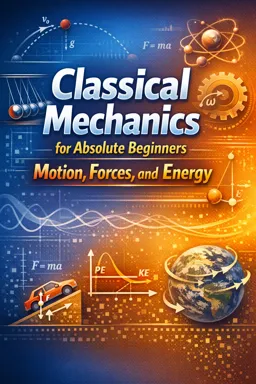
Classical Mechanics for Absolute Beginners: Motion, Forces, and Energy
This free ebook introduces the ideas that explain how everyday objects move, stop, collide, fall, turn, and rotate. Written for school-level physics learners, it builds a practical foundation in classical mechanics through clear models, units, equations, diagrams, and problem-solving habits.
Build a reliable physics toolkit
Start by treating motion as a model that can be measured. Learn how position, displacement, velocity, acceleration, mass, and force are represented with quantities and SI units. The ebook distinguishes scalar quantities from vectors, helping you describe motion accurately in one and two dimensions.
Connect forces to motion
Newton’s laws are presented as tools for turning a physical situation into equations. You will learn to identify interactions, draw effective free-body diagrams, and account for forces such as weight, normal force, tension, friction, drag, and centripetal force.
- Analyze straight-line motion using kinematic relationships.
- Study projectiles, relative motion, and vector components.
- Model friction, circular motion, and common real-world forces.
- Use units and signs consistently to check your reasoning.
Solve motion problems in more than one way
Beyond forces and acceleration, the ebook develops work, energy, momentum, impulse, and conservation principles. These approaches provide efficient ways to analyze ramps, speed changes, collisions, explosions, and glancing impacts. Rotational motion then extends the same reasoning to angular displacement, torque, rotational energy, and spinning objects.
Designed for confident problem solving
Each topic supports a structured approach: define the system, choose axes, represent known quantities, select a physical principle, solve symbolically where possible, and verify the result. The final material combines multiple concepts while highlighting frequent mistakes involving units, vector directions, signs, and unsupported assumptions.
Use this ebook as a focused introduction to mechanics or as a reference while practicing physics problems involving motion, forces, energy, momentum, and rotation.
How do free-body diagrams help solve Newton’s law problems?
They isolate an object and show all external forces, making it easier to write the correct force equations.
What is the difference between velocity and acceleration?
Velocity describes the rate and direction of position change; acceleration describes how velocity changes.
When should I use energy instead of Newton’s second law?
Use energy when forces act over a displacement and speeds or heights are easier to relate than time and acceleration.
This ebook includes:

12 content chapters

Digital certificate of course completion (Free)

Exercises to train your knowledge

100% free, from content to certificate
Ready to get started?

 recommended
In the app you will also find...

Over 5,000 free courses
Programming, English, Digital Marketing and much more! Learn whatever you want, for free.

Study plan with AI
Our app's Artificial Intelligence can create a study schedule for the course you choose.

From zero to professional success
Improve your resume with our free Certificate and then use our Artificial Intelligence to find your dream job.
You can also use the QR Code or the links below.