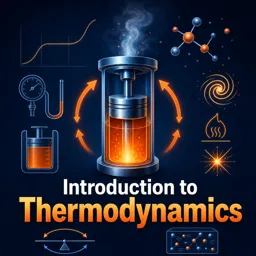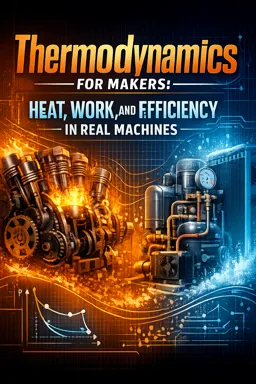

Free ebook on practical thermodynamics for makers: analyze heat, work, efficiency, engines, refrigeration, and household thermal systems.
Free ebook content
-

Energy, Temperature, and State Variables in Real Devices
+ Exercise: Which statement best distinguishes a state variable from heat or work in real devices?
-
Zeroth Law and Practical Temperature Measurement
+ Exercise: When comparing two temperature sensors using the same stirred ice-water bath, what is the main reason this comparison is meaningful?
-
Heat and Work as Energy Transfer: Sign Conventions and Boundaries
+ Exercise: Using the engineering sign convention, which statement correctly assigns signs for energy transfers across a system boundary?
-
First Law Accounting for Makers: Balancing Energy in Household Machines
+ Exercise: When doing First Law accounting on a household machine that cycles on and off (like a refrigerator), what approach best helps the energy balance close?


-
Properties of Pure Substances and Phase Change: Boiling, Condensation, and Latent Heat
+ Exercise: In a pure substance undergoing boiling at constant pressure, what happens after the liquid reaches the saturation temperature?
-
Gases in Practice: Ideal vs Real Behavior and When Approximations Break
+ Exercise: In which situation is using PV = nRT most likely to give a misleading estimate of how much gas is in the container?
-
Pressure–Volume Diagrams and Quasi-Static Processes You Can Plot
+ Exercise: Why is using absolute pressure (rather than gauge pressure) important when calculating boundary work from a P–V diagram?
-
Heat Transfer Pathways: Conduction, Convection, and Radiation in Builds and Repairs
+ Exercise: In a sealed electronics enclosure, a larger heatsink was added but temperatures barely dropped. Which diagnosis best matches this situation?
-
Entropy and the Second Law: Why Efficiency Has Hard Limits
+ Exercise: Why must any cyclic heat engine reject some heat to a colder reservoir, even with perfect insulation and machining?
-
Thermodynamic Cycles as Design Tools: Carnot, Otto, and Vapor-Compression Refrigeration
+ Exercise: Which change most directly increases the COP of a vapor-compression refrigeration system by reducing temperature lift?
-
Refrigerators, Air Conditioners, and Heat Pumps: COP, Load, and Common Failure Modes
+ Exercise: When estimating cooling COP in the field using the air-side method, what set of measurements and calculations best supports a reasonable diagnostic COP estimate?
-
Engines and Combustion Devices: Power, Losses, and Practical Optimization
+ Exercise: When comparing two small engines or combustion devices, which approach best supports practical optimization?
-
Insulation, Radiators, and Thermal Management: Choosing Materials and Geometries
+ Exercise: When a component is overheating but the attached heat sink stays relatively cool, what is the most likely cause?
-
Troubleshooting with Thermodynamics: Diagnosing Compressors, Leaks, and Poor Performance
+ Exercise: A shop air compressor runs continuously and takes much longer than usual to fill the tank. After shutting it off and isolating the tank, the tank pressure decays quickly over 10–30 minutes. What does this pattern most strongly indicate?
-
Misconceptions and Impossible Claims: Identifying "Free Energy" and Perpetual Motion Errors
+ Exercise: When checking a claimed overunity device with pulsed or non-sinusoidal output, what is the most reliable way to determine real output power?
-
Capstone Efficiency Upgrade: Evaluate and Improve a Household Thermal System
+ Exercise: When evaluating an efficiency upgrade for a household thermal system, what best distinguishes a real efficiency improvement from a misleading result?
About the free ebook
Thermodynamics for Makers: Heat, Work, and Efficiency in Real Machines
This free ebook connects core physics principles to the machines and thermal systems found in homes, workshops, and practical builds. Learn to track energy, interpret temperature and pressure, and understand why real devices lose useful energy.
Turn thermal theory into practical insight
Explore heat and work as different forms of energy transfer, apply the first and second laws, and use state variables to describe gases, liquids, and phase changes. Clear maker-focused examples show how boiling, condensation, compression, insulation, and heat flow affect device performance.
Analyze real machines with confidence
Use pressure–volume diagrams, efficiency concepts, and coefficient of performance to examine engines, refrigerators, air conditioners, and heat pumps. The ebook explains where approximations such as the ideal-gas model work and where they can produce misleading results.
Design, diagnose, and improve
Build a practical framework for evaluating thermal systems. Identify common causes of poor cooling, heat loss, compressor issues, and inefficient combustion. Compare materials and geometries for thermal management, then apply your knowledge to an efficiency-upgrade project.
What you will be able to do
- Balance energy entering, leaving, and stored in a household machine.
- Distinguish conduction, convection, and radiation in repairs and builds.
- Estimate realistic efficiency limits and recognize impossible “free energy” claims.
- Make evidence-based improvements to insulation, cooling, heating, and power systems.
Designed for curious makers and physics learners, this ebook emphasizes useful calculations, sound assumptions, and safe, realistic reasoning about thermal technology.
How does the ebook explain refrigerator and heat-pump efficiency?
It uses coefficient of performance, thermal load, and common losses to explain real cooling and heating performance.
What is the difference between heat and work in a thermal system?
Heat is energy transferred because of a temperature difference; work is energy transferred through force, motion, or electrical effects.
How can thermodynamics help diagnose poor air-conditioner performance?
It helps trace heat flow, insulation losses, airflow problems, refrigerant leaks, and compressor-related inefficiencies.
This ebook includes:

16 content chapters

Digital certificate of course completion (Free)

Exercises to train your knowledge

100% free, from content to certificate
Ready to get started?

 recommended
In the app you will also find...

Over 5,000 free courses
Programming, English, Digital Marketing and much more! Learn whatever you want, for free.

Study plan with AI
Our app's Artificial Intelligence can create a study schedule for the course you choose.

From zero to professional success
Improve your resume with our free Certificate and then use our Artificial Intelligence to find your dream job.
You can also use the QR Code or the links below.