

Free ebook on latitude, longitude, time zones, map projections, GPS, seasons, and the International Date Line.
Free ebook content
-

Earth’s Coordinate System: Latitude and Longitude for Global Position
+ Exercise: Which statement correctly explains how negative values are used in decimal degrees for latitude and longitude?
-
Degrees vs. Distance: Converting Coordinates into Real-World Measurements
+ Exercise: Why does the real-world distance represented by 1° of longitude get smaller as you move toward the poles?
-
Hemispheres, Signs, and Coordinate Notation: Avoiding Common Confusions
+ Exercise: A coordinate is written as “-23.5505°N, -46.6333°E”. What is the best correction if you want to keep hemisphere letters (not signs)?
-
Map Grids and Projections: Why Coordinates Look Different on Flat Maps
+ Exercise: You need to compare the sizes of countries on a world map as fairly as possible. Which map choice best fits this goal?


-
Time Zones and Local Solar Time: How Longitude Connects to the Clock
+ Exercise: Two locations are at 75°W and 15°E. Using the longitude-based local solar time rule, what is the estimated local solar time difference, and which location is later?
-
The International Date Line: Calendar Changes and Crossing the Pacific
+ Exercise: A traveler crosses the International Date Line westbound. What calendar change should they apply immediately after crossing to match the local date on the other side?
-
Day Length and Seasons: Latitude, Sun Angle, and What Changes Through the Year
+ Exercise: Why can a high-latitude location still feel relatively cool even during summer when its days are very long?
-
Great-Circle Thinking: The Shortest Path on a Sphere and Why Routes Curve on Maps
+ Exercise: On a Mercator map, a long route between two mid-latitude cities looks like a curved arc that bows toward higher latitudes. What is the most likely interpretation?
-
Coordinates in Modern Mapping and GPS: From Satellites to Your Device
+ Exercise: A set of latitude/longitude coordinates plots on a map with a consistent offset from the real location (for example, always shifted by a similar distance). Which issue is the most likely cause?
-
Practical Coordinate Workflows: Reading, Sharing, and Verifying Locations Worldwide
+ Exercise: When verifying received coordinates that seem to land in the wrong country, which approach best helps diagnose a likely typo without immediately changing the meaning of the original coordinates?
About the free ebook
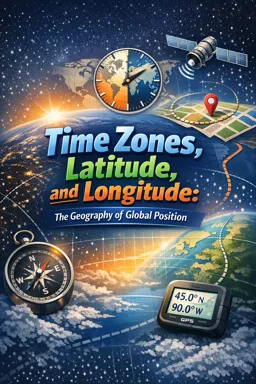
Time Zones, Latitude, and Longitude: The Geography of Global Position
This free ebook explains how geographers describe any place on Earth using latitude, longitude, map grids, and time zones. Learn how coordinates identify locations, why the planet is divided into hemispheres, and how to read common coordinate formats accurately.
Connect position, distance, and time
Explore how degrees relate to real-world distance and why longitude is essential for calculating local time. The ebook examines local solar time, standard time zones, and the International Date Line, showing why crossing parts of the Pacific can change the calendar date.
Understand Earth as a sphere
Discover how latitude affects sun angle, seasonal change, and day length. Learn why the shortest route between two places follows a great-circle path and why those routes may appear curved on flat maps.
Use coordinates with confidence
Clear explanations of hemispheres, directional signs, notation, projections, GPS, and practical location-sharing methods help readers avoid common errors. By the end, you will be able to interpret, compare, verify, and communicate locations worldwide.
Key skills developed
- Read latitude and longitude in multiple notations.
- Relate longitude to clocks, time zones, and date changes.
- Explain how projections alter the appearance of coordinate grids.
- Apply GPS and map-based workflows to real locations.
How does longitude determine time zones?
Earth rotates 15 degrees per hour, so longitude is used to estimate differences in local solar time and organize standard time zones.
Why does the date change at the International Date Line?
Crossing the Date Line generally adds or subtracts one calendar day to keep dates consistent around the globe.
Why do great-circle routes look curved on maps?
They are the shortest paths on a sphere, but map projections can make those paths appear curved on a flat surface.
This ebook includes:

10 content chapters

Digital certificate of course completion (Free)

Exercises to train your knowledge

100% free, from content to certificate
Ready to get started?

 recommended
In the app you will also find...

Over 5,000 free courses
Programming, English, Digital Marketing and much more! Learn whatever you want, for free.

Study plan with AI
Our app's Artificial Intelligence can create a study schedule for the course you choose.

From zero to professional success
Improve your resume with our free Certificate and then use our Artificial Intelligence to find your dream job.
You can also use the QR Code or the links below.