Terrestrial planets are small, rocky, and dense, while Jovian planets are much larger and made mainly of gases and ice.

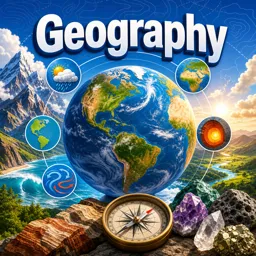
Duration of the online course: 6 hours and 49 minutes
4.8

(30)
Master key Geography concepts with a free online course: Earth systems, climate, oceans and landforms—learn faster with bite-size lessons and practice.
Build a clear, exam-ready understanding of Geography by connecting what you learn to the real world around you. This free online course strengthens your foundation in physical geography and helps you think like a geographer: observing patterns, explaining processes, and relating local features to global systems. Whether you are studying school subjects, revising for assessments, or returning to basics for personal learning, you will gain confidence in the core ideas that shape our planet.
You will start by understanding Geography as a discipline, including the kinds of questions geographers ask and the tools they use to interpret space, place, and human–environment relationships. From there, the course guides you through how Earth formed and why the Solar System is organized the way it is, helping you distinguish planetary types and appreciate the forces that shaped our world. As your base grows, you will explore Earth’s interior and the processes that originate within it, building a logical picture of why earthquakes, volcanism, and tectonic changes occur and how they influence the surface we live on.
The learning then moves to the distribution of oceans and continents, showing how land and water are arranged across the globe and why this arrangement matters for climate, ecosystems, and human activity. You will develop strong conceptual clarity on minerals, rocks, and the transformations they undergo, which makes later topics like landscape evolution much easier to grasp. By focusing on geomorphic processes and the way landforms change over time, you will learn to explain valleys, mountains, plains, and coasts as outcomes of continuous interactions rather than isolated features.
As the course shifts upward into the atmosphere, you will understand its composition, structure, and the role it plays in maintaining life and regulating temperature. You will link solar radiation to heat balance and temperature patterns, and then connect these ideas to atmospheric circulation and everyday weather systems. This helps you interpret winds, pressure belts, rainfall patterns, and seasonal variation with reasoning instead of memorization. You will also explore water in the atmosphere, including its changing states, and see how clouds, humidity, and precipitation fit into the larger water cycle.
Finally, you will connect climate concepts to broader global patterns, including how climates are classified and what drives climate variability and change. Ocean topics tie everything together, showing how water is distributed on Earth, how oceans influence weather and climate, and how ocean water moves through waves, tides, and currents. Throughout, short practice questions help you check understanding, correct misconceptions, and improve recall under test conditions. By the end, you will be able to explain major Earth systems in an organized way and apply Geographic thinking to maps, current events, and environmental challenges.

6 hours and 49 minutes of online video course

Digital certificate of course completion (Free)

Exercises to train your knowledge

100% free, from content to certificate
What is the difference between terrestrial and Jovian planets?
Terrestrial planets are small, rocky, and dense, while Jovian planets are much larger and made mainly of gases and ice.
What percentage of Earth’s surface is covered by oceans?
Oceans cover about 71% of Earth’s surface.
What are the major constituents of Earth’s atmosphere?
The atmosphere consists mainly of nitrogen, oxygen, and argon, with small amounts of carbon dioxide and other gases.
Ready to get started?Download the app and get started today.
Install the app now
to access the course
Over 5,000 free courses
Programming, English, Digital Marketing and much more! Learn whatever you want, for free.

Study plan with AI
Our app's Artificial Intelligence can create a study schedule for the course you choose.

From zero to professional success
Improve your resume with our free Certificate and then use our Artificial Intelligence to find your dream job.
You can also use the QR Code or the links below.



Free CourseHuman Geography course
5
(5)

3h34m

34 exercises
Free CourseGeography Through Maps
5
(1)
20h32m
22 exercises
Free CoursePhysical Geography
5
(2)
11h24m
42 exercises
Free CourseWorld geography
4.7

(28)
2h03m
10 exercises
Free CourseWorld Regional Geography
4.7
(3)
3h42m
10 exercises
Free CourseGeography
4.6
(21)
28h42m
11 exercises
Free CourseUK geography
New
8h58m
17 exercises
Free CourseGeography Course
New
10h34m
9 exercises
Free CourseIntroduction to Marine Magnetometry
New
46m
6 exercises
Free CourseSeismic Training
New
58m
7 exercises
Carry knowledge in your pocket.
Download the Cursa app.
There are hundreds of free courses available, with a free certificate of completion that is saved in your mobile image gallery.
Download the app to access the Course Completion Certificate for Free.


+ 10 million
students

Free and Valid
Certificate

60 thousand free
exercises

4.8/5 rating in
app stores

Free courses in
video and ebooks