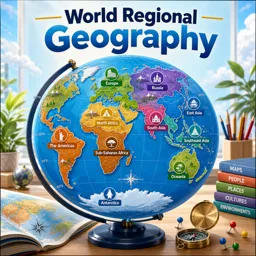

Free ebook covering map skills, climate systems, human geography, and world regions through 30 practical geography lessons.
Free ebook content
-

Map Symbols, Scale, and Direction for Everyday Map Reading
+ Exercise: You need to estimate how long a walk will take using a map. Which approach best combines map reading skills to make a realistic time estimate?
-
Latitude, Longitude, and the Global Grid System
+ Exercise: Which practice best prevents placing a coordinate in the wrong location when sharing or entering latitude and longitude?
-
Coordinates in Practice: Locating Places and Estimating Distance
+ Exercise: When estimating straight-line distance from coordinate differences, which procedure best matches the recommended planar approximation?
-
Map Projections and Why the World Looks Different on Different Maps
+ Exercise: You are creating a thematic world map to compare carbon emissions per square kilometer across countries. Which projection property is most important to prioritize so the visual comparison is fair?
-
Interpreting Physical Maps: Landforms, Elevation, and Relief
+ Exercise: On a physical map with contour lines, what does a tight cluster of contour lines most directly indicate?
-
Interpreting Political Maps: Borders, States, and Administrative Regions
+ Exercise: On a political map, what is the most reliable way to distinguish an international border from internal administrative boundaries when no legend is available?
-
Topographic Thinking: Contour Lines and Terrain Interpretation
+ Exercise: On a topographic map, contour lines form a V shape along a drainage feature. What does it mean when the tip of the V points uphill?
-
Navigating with Map Exercises: Routes, Bearings, and Spatial Reasoning
+ Exercise: When planning a multi-leg route on a map, what is the main purpose of adding a catching feature to a leg?
-
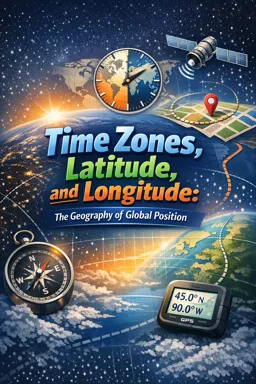
Time Zones, the International Date Line, and Local Time Calculations
+ Exercise: When converting between two cities with different UTC offsets, what approach most reliably avoids sign errors and missed date changes?
-
Using Memory Aids for Capitals, Regions, and Spatial Patterns
+ Exercise: Which approach best supports remembering a geography spatial pattern so you can apply it to unfamiliar cases?


-
Atmosphere Basics: Weather Elements and What They Indicate
+ Exercise: A barometer shows steadily falling pressure over several hours while clouds thicken. What is the most reasonable interpretation for the next 6–12 hours?
-
Global Climate Drivers: Latitude, Altitude, Oceans, and Winds
+ Exercise: A mid-latitude coastal region has prevailing winds blowing from the ocean toward a nearby mountain range. Which climate pattern is most likely across the mountains?
-
Ocean Currents and Their Role in Regional Climates
+ Exercise: A coastal city has frequent onshore winds and is influenced by a cold ocean current. Which climate pattern is the most likely outcome near the coast?
-
Climate Zones and the Logic Behind Climate Classification
+ Exercise: Why can two places with the same annual rainfall be placed in different climate zones?
-
Reading Climate Graphs: Temperature, Precipitation, and Seasonality
+ Exercise: A climate graph shows the warmest months in December to February. What is the best inference about the location when interpreting seasonality?
-
Biomes and Ecosystems: Linking Climate to Vegetation Patterns
+ Exercise: A region is warm year-round but has a strong wet season followed by a long dry season. Based on climate–vegetation links, which vegetation pattern is most likely?
-
Water on Earth: Rivers, Drainage Basins, and Watersheds
+ Exercise: Which statement best distinguishes a drainage basin from a watershed (drainage divide) in physical geography?
-
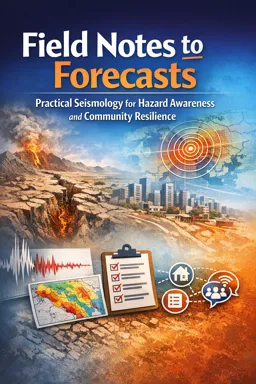
Natural Hazards and Spatial Risk: Earthquakes, Volcanoes, Storms, and Drought
+ Exercise: Two towns face the same storm surge height during a cyclone, but one experiences far greater damage. Which explanation best fits the concept of spatial risk?
-
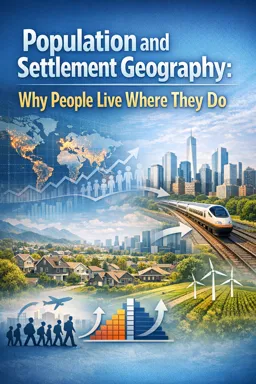
Population Patterns: Density, Urbanization, and Settlement Geography
+ Exercise: A region has a moderate arithmetic density, but most of its land is mountainous and only a small coastal plain is farmable. Which measure best indicates the pressure of the population on the usable farmland?
-
Cultural Geography Snapshots: Language, Religion, and Identity Landscapes
+ Exercise: In a cultural geography snapshot, what does the presence of a language on official public signs most strongly suggest?
-
Economic Geography Snapshots: Resources, Trade Routes, and Development Patterns
+ Exercise: Which situation best illustrates how improved connectivity can make an inland region economically competitive?
-
Regional Frameworks: How Geographers Divide the World
+ Exercise: A planner wants to draw regions for transit investment using where most residents commute for work. Which type of region best matches this approach?
-
North America: Physical Regions, Climate, and Economic Links
+ Exercise: Which statement best explains how mountains in western North America influence both climate and nearby economic activities?
-
Latin America and the Caribbean: Biomes, Cities, and Trade Patterns
+ Exercise: Which statement best links biomes, city locations, and trade corridors in Latin America and the Caribbean?
-
Europe: Peninsula Geography, Climate Gradients, and Regional Diversity
+ Exercise: A student compares a coastal location in western Europe with an inland location farther east at a similar latitude. Which outcome best fits the typical climate gradient described?
-
North Africa and Southwest Asia: Aridity, Water Systems, and Connectivity
+ Exercise: Which statement best explains why major movement routes and cities in North Africa and Southwest Asia often align with coasts, river valleys, and oasis chains?
-
Sub-Saharan Africa: Biomes, Population Patterns, and Economic Corridors
+ Exercise: Which situation best illustrates how a biome can shape both settlement patterns and the design of an economic corridor?
-
South Asia: Monsoon Systems, Rivers, and Dense Settlement
+ Exercise: Which explanation best describes why the Indo-Gangetic Plain tends to have very dense settlement?
-
East and Southeast Asia: Coastal Hubs, Mountains, and Regional Networks
+ Exercise: Which description best explains why a city near a narrow strait often becomes a major logistics hub in Southeast Asia?
-
Oceania and Polar Regions: Islands, Remote Climates, and Environmental Challenges
+ Exercise: Which situation most strongly suggests a low coral island or atoll rather than a high volcanic island?
About the free ebook
World Geography Essentials: Maps, Climate, and Regions in 30 Lessons
Build practical geographic knowledge with this free online ebook for students exploring how people, places, environments, and global systems connect.
Read maps with confidence
Learn to interpret symbols, scale, direction, coordinates, projections, political boundaries, physical features, contour lines, routes, bearings, and time zones. Clear explanations help turn maps into useful tools for locating places, estimating distance, and understanding spatial patterns.
Understand weather, climate, and environments
Explore the atmosphere, climate drivers, ocean currents, climate zones, climate graphs, biomes, rivers, watersheds, and natural hazards. Connect latitude, altitude, winds, and water systems to the landscapes and living conditions found around the world.
Connect human and regional geography
Examine population density, urbanization, culture, resources, trade, and development. Regional lessons introduce the physical geography, climate, settlement patterns, and economic links of major world regions.
What you will practice
- Using latitude and longitude to locate places
- Comparing map projections and interpreting terrain
- Reading temperature and precipitation patterns
- Explaining how climate influences biomes and settlement
- Recognizing regional connections across the globe
Use this ebook as a focused study companion for geography classes, map-reading practice, and a stronger understanding of the world.
How does latitude and longitude help locate a place?
Latitude measures distance north or south of the Equator, while longitude measures distance east or west of the Prime Meridian.
Why do different map projections make continents look different?
Flattening Earth’s curved surface causes distortion in shape, area, distance, or direction, depending on the projection.
How do ocean currents affect regional climate?
Warm and cold currents transfer heat, influencing coastal temperatures, rainfall, fog, and storm patterns.
This ebook includes:

30 content chapters

Digital certificate of course completion (Free)

Exercises to train your knowledge

100% free, from content to certificate
Ready to get started?

 recommended
In the app you will also find...

Over 5,000 free courses
Programming, English, Digital Marketing and much more! Learn whatever you want, for free.

Study plan with AI
Our app's Artificial Intelligence can create a study schedule for the course you choose.

From zero to professional success
Improve your resume with our free Certificate and then use our Artificial Intelligence to find your dream job.
You can also use the QR Code or the links below.