
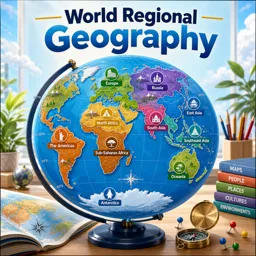
The course examines Europe and Russia, the Americas, sub-Saharan and Northern Africa, South and East Asia, Southeast Asia, Oceania, and Antarctica.

Duration of the online course: 3 hours and 42 minutes
4.5


(2)
Build global geography skills fast with this free online course—learn regions, culture, and geopolitics through video lessons and quizzes for confident exams.
Understand why places look, work, and change the way they do. This free online World Regional Geography course helps you see the planet as a set of connected regions shaped by landforms, climate, history, culture, and economic choices. Instead of memorizing isolated facts, you will practice thinking like a geographer: asking better questions, spotting patterns, and explaining how physical and human forces interact across different parts of the world.
You will begin with a clear framework for reading the world geographically, then travel region by region to build perspective. As you explore Europe and Russia, you will connect political change and boundaries to resources, migration, and everyday life, including the Cold War legacy symbolized by the Berlin Wall. Moving through the Americas, you will link major physical features and settlement patterns to development, trade, and regional identities across North, Middle, and South America.
From there, the course turns to Africa with attention to contrasts between northern and sub-Saharan regions, highlighting how environment, colonial history, conflict, and economic networks can influence opportunity and stability. In Asia, you will examine South, East, and Southeast Asia through the lens of population, religion, production, and rapid urban transformation, supported by concrete historical examples such as the Terracotta Warriors and what their preservation reveals about material culture. You will finish in Oceania and Antarctica, considering Australia and the South Pacific in terms of modern economic trends, connectivity, and geographic isolation.
Short exercises throughout reinforce key ideas and strengthen critical thinking so you can apply concepts to maps, current events, or exam questions with greater confidence. By the end, you will have a more accurate mental map of the world, a stronger vocabulary for describing regions, and a practical way to analyze how geography influences people and how people reshape geography.

3 hours and 42 minutes of online video course

Digital certificate of course completion (Free)

Exercises to train your knowledge

100% free, from content to certificate
What world regions are covered in the World Regional Geography course?
The course examines Europe and Russia, the Americas, sub-Saharan and Northern Africa, South and East Asia, Southeast Asia, Oceania, and Antarctica.
Does the course explain the physical geography of South America?
Yes. It explores South America’s major physical features, including the Andes Mountains and the Amazon River Basin.
What historical topics are included in the Europe and East Asia sections?
Topics include the Berlin Wall and Iron Curtain, as well as the history and ongoing excavation of China’s Terracotta Army.
Ready to get started?Download the app and get started today.
Install the app now
to access the course
Over 5,000 free courses
Programming, English, Digital Marketing and much more! Learn whatever you want, for free.

Study plan with AI
Our app's Artificial Intelligence can create a study schedule for the course you choose.

From zero to professional success
Improve your resume with our free Certificate and then use our Artificial Intelligence to find your dream job.
You can also use the QR Code or the links below.



Free CourseHuman Geography course
5
(5)

3h34m

34 exercises
Free CourseGeography Through Maps
5
(1)
20h32m
22 exercises
Free CoursePhysical Geography
5
(2)
11h24m
42 exercises
Free CourseGeography
4.8
(31)
6h49m
11 exercises
Free CourseWorld geography
4.7
(28)
2h03m
10 exercises
Free CourseGeography
4.6
(21)
28h42m
11 exercises
Free CourseUK geography
New
8h58m
17 exercises
Free CourseGeography Course
New
10h34m
9 exercises
Free CourseIntroduction to Marine Magnetometry
New
46m
6 exercises
Free CourseSeismic Training
New
58m
7 exercises
Carry knowledge in your pocket.
Download the Cursa app.
There are hundreds of free courses available, with a free certificate of completion that is saved in your mobile image gallery.
Download the app to access the Course Completion Certificate for Free.


+ 10 million
students

Free and Valid
Certificate

60 thousand free
exercises

4.8/5 rating in
app stores

Free courses in
video and ebooks
Course comments: World Regional Geography
Safia Khalil Rahman
a very good video and use full full of education