It uses maps to explain climatology, latitudes, deserts, vegetation, landforms, rocks, plate tectonics, and major world regions.

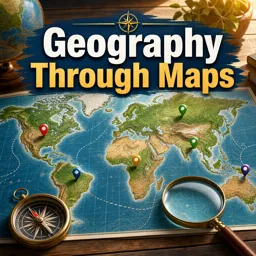
Duration of the online course: 20 hours and 32 minutes
New
Build map-reading skills fast in this free geography course—climate, tectonics, landforms and more, with practice questions to reinforce learning.
Maps turn complex geography into clear, memorable patterns. This free online course helps you learn to read the world through maps and connect what you see on an atlas to real physical processes on Earth. Instead of treating geography as isolated facts, you will build a visual way of thinking that links latitude and sunlight, climate zones, deserts, winds, ocean influence, and global circulation to the places where these forces shape daily life.
You will strengthen core skills such as interpreting location and scale, understanding why seasons vary across latitudes, and recognizing how climate characteristics emerge in different regions. Along the way, you will explore why some areas experience intense rainfall while others develop arid conditions, and how factors like cloud formation, humidity, vertical convection, and the Coriolis effect help organize global weather and climate patterns. This perspective makes it easier to remember what happens where and, more importantly, why it happens.
The course also supports a solid foundation in physical geography and Earth systems. You will connect maps with tectonic activity, plate boundaries, and the major structures that define the planet’s surface. Concepts such as shields and mineral-rich regions, fold mountains and ancient orogenies, rock formation, and key physiographic regions become easier to grasp when you can place them spatially. You will also encounter examples from across the world, from polar regions affected by climate anomalies to volcanic landscapes and distinctive vegetation belts, helping you practice geographic reasoning on real settings.
To keep learning active, the course includes exercises that check understanding and improve recall, making it suitable for students of school geography as well as learners preparing for competitive exams who need sharp, map-based clarity. By the end, you will be more confident in interpreting maps, explaining regional patterns, and using geographic concepts to make sense of news, climate discussions, and the physical layout of our planet.

20 hours and 32 minutes of online video course

Digital certificate of course completion (Free)

Exercises to train your knowledge

100% free, from content to certificate
What does the Geography Through Maps course cover for UPSC preparation?
It uses maps to explain climatology, latitudes, deserts, vegetation, landforms, rocks, plate tectonics, and major world regions.
Why are tropical deserts such as the Sahara common on western sides of continents?
Descending dry air in subtropical high-pressure belts, often reinforced by cold ocean currents, suppresses clouds and rainfall.
What geographical process occurs between the North American and Eurasian plates in Iceland?
The plates diverge along the Mid-Atlantic Ridge, producing seafloor spreading, volcanic activity, and rift formation.
Ready to get started?Download the app and get started today.
Install the app now
to access the course
Over 5,000 free courses
Programming, English, Digital Marketing and much more! Learn whatever you want, for free.

Study plan with AI
Our app's Artificial Intelligence can create a study schedule for the course you choose.

From zero to professional success
Improve your resume with our free Certificate and then use our Artificial Intelligence to find your dream job.
You can also use the QR Code or the links below.



Free CourseHuman Geography course
5

(5)

3h34m

34 exercises
Free CoursePhysical Geography
5
(2)
11h24m
42 exercises
Free CourseGeography
4.8
(31)
6h49m
11 exercises
Free CourseWorld geography
4.7

(28)
2h03m
10 exercises
Free CourseWorld Regional Geography
4.7
(3)
3h42m
10 exercises
Free CourseGeography
4.6
(21)
28h42m
11 exercises
Free CourseUK geography
New
8h58m
17 exercises
Free CourseGeography Course
New
10h34m
9 exercises
Free CourseIntroduction to Marine Magnetometry
New
46m
6 exercises
Free CourseSeismic Training
New
58m
7 exercises
Carry knowledge in your pocket.
Download the Cursa app.
There are hundreds of free courses available, with a free certificate of completion that is saved in your mobile image gallery.
Download the app to access the Course Completion Certificate for Free.


+ 10 million
students

Free and Valid
Certificate

60 thousand free
exercises

4.8/5 rating in
app stores

Free courses in
video and ebooks